
Your marketing team has the budget. The talent. The brand book. So why does the work still feel inconsistent when artificial intelligence enters the workflow.
Beryl Agency runs corporate AI design training programs that close the gap between AI capability and execution quality. We train marketing, branding, and creative teams inside large corporates and ambitious MSMEs to use artificial intelligence systematically, responsibly, and at the standard your brand actually deserves.
The Gap We Fix
Most large corporates do not have an AI access problem. They have an implementation problem. The marketing team is sharp, the branding team is qualified, the agency roster is long, and the AI tools sit neatly inside every workflow. Yet the output across decks, social posts, vendor creatives, internal communication, and sales collateral keeps slipping, feeling inconsistent, off tone, and rarely matching the intended standard.
The reason is simple and rarely admitted out loud. Marketing and branding professionals are trained to run campaigns, manage budgets, and brief vendors. They are not trained in the underlying principles of prompt engineering, AI output governance, visual consistency within brand systems, the writing frameworks that hold brand voice across AI assisted channels, or the operational thinking that keeps AI adoption from fragmenting execution quality. These are different disciplines, and most corporate L&D programs never touch them.
This is where Beryl Agency comes in. We do not run motivational sessions or generic AI awareness workshops. We train your team in the foundational frameworks that senior designers, brand strategists, and AI implementation leaders use every day, applied directly to your brand, your guidelines, and your real world output.
Signs your team needs AI design training
– Your brand book exists, but AI generated outputs do not respect visual hierarchy or colour systems.
– Decks from different departments using AI look like they belong to different companies.
– AI generated creatives keep coming back with the same corrections, cycle after cycle.
– Social posts generated through AI feel safe, generic, and indistinguishable from competitors.
– Marketing copy produced with AI assistance is grammatically correct but emotionally flat or off brand.
– Sales collateral and campaigns mixing human content with AI outputs feel inconsistent.
– Your team can describe what AI can do but cannot manage prompt quality or output reliability.
– You are spending more on AI tools and production revision while output quality stays below standard.
– Vendor teams using AI to support your brand produce work that drifts from guidelines.
– Your governance awareness around AI remains unclear while adoption accelerates across departments.
If three or more of these are true, the issue is not effort or talent. It is missing systematic implementation principles.
Who We Train
- Chief Marketing Officers and marketing heads
who want their teams to operate at a higher execution standard while maintaining governance awareness around artificial intelligence.
- Brand managers and brand custodians
responsible for consistency across regions and channels as AI adoption accelerates and affects visual output.
- Internal creative and design teams
who execute daily with increasing AI assistance but rarely receive structured training on prompt quality and governance.
- Communications and content teams
who write at scale across email, social, decks, and PR while integrating AI assistance into workflows.
- Operations and innovation groups
seeking operational frameworks supporting AI implementation across business functions.
- Vendor and agency partners
executing work inside corporate environments and needing alignment with brand guidelines around AI generated assets.
- L&D and HR leaders
sourcing high quality functional training for marketing and creative cohorts navigating artificial intelligence adoption.
Founder voice
This practice exists because we have spent 16 years on the other side of the table. We have built brands, packaging, websites, and campaigns for over 1500 clients across 19 countries, including Hyundai, Mobil, and other Fortune 500 names. In every engagement, the same pattern repeats. Internal teams are intelligent and motivated, but the principles they need are scattered across design schools, branding books, AI research papers, prompt engineering frameworks, and governance thinking that no one has stitched together for them.
Beryl Agency was built on the belief that good design is not a department, it is a way of thinking. Our corporate AI training practice is the most direct way we share that thinking inside artificial intelligence adoption environments. When we walk into a corporate room, we are not delivering a course. We are bringing 16 years of client work, a CII National Committee perspective on Indian design policy, and a co founder team that includes a RISD trained industrial designer and a brand strategist trained at MICA and IIM Kozhikode. Your team gets practitioners who ship real work with emerging AI systems every week, not presenters working from frozen curricula.
What participants learn
01
Understanding AI capabilities, benefits, and limitations. The foundational understanding of artificial intelligence systems, how they influence enterprise environments, and where capability actually creates business value. Participants explore both opportunities and limitations of enterprise AI adoption, learning where AI creates operational efficiency, where automation supports execution quality, and where human judgement remains essential. Outcome, your team understands where artificial intelligence creates value, where limitations exist, and how organisations build systems supporting responsible long term adoption.

02
Prompt engineering and reliable output systems. Effective prompting is not simply asking AI systems questions. Inside enterprise environments, prompting functions as a business capability influencing consistency standards, execution quality, and operational efficiency. Participants explore why identical AI systems generate different outputs depending on instruction design, context quality, and sequencing methods, and work through practical prompting frameworks built for enterprise execution rather than personal experimentation. Outcome, your team builds structured prompting capability that produces reliable outcomes consistently while reducing revision cycles.

03
Fact checking, source validation, and human intervention. AI capability inside workflows does not remove the need for human oversight. It changes where oversight must sit. Participants learn validation approaches designed to strengthen accuracy standards, output reliability, and implementation accountability across operational systems increasingly influenced by artificial intelligence. Outcome, your team builds validation frameworks that maintain accuracy and governance accountability while supporting faster execution.

04
AI assisted content creation across email, social, design, and translation. Practical AI applications across business execution environments. Professional email drafting, social media and content creation, design concept generation, AI assisted translation for multilingual environments, presentation preparation, and internal communication support. Outcome, your team improves communication efficiency, reduces manual workload, and supports faster business execution while maintaining operational standards.

Using AI tools for ideation and brainstorming. How AI systems strengthen ideation capability and creative exploration without replacing human judgement, business understanding, or strategic thinking. Participants work through brainstorming acceleration, concept variation development, content planning, and problem solving environments where teams need faster exploration without compromising implementation quality. Outcome, your team strengthens innovation capability and improves brainstorming efficiency without compromising strategic thinking.

06
Ethical considerations including bias, plagiarism, and misinformation. Enterprise teams increasingly recognise that successful implementation depends not only on technology adoption but on responsible usage practices. Participants explore identifying and reducing bias in AI generated outputs, understanding plagiarism risks, strengthening fact checking capability, recognising misinformation risks, and building responsible approval and review systems. Outcome, your team develops governance awareness and implementation systems that support sustainable adoption while reducing operational risks.

07
Enterprise AI workflow integration across operations. Understanding AI capability and successfully implementing it inside operational environments are two different stages of adoption. Participants work through workflow mapping, operational bottleneck identification, AI integration across business systems, and cross functional implementation alignment. Outcome, your team strengthens workflow capability and implementation maturity while maintaining quality standards and organisational consistency.

08
Enterprise AI operations and long term capability development. Early adoption focuses on experimentation. Sustainable adoption requires structure. Participants explore long term implementation planning, AI operational readiness frameworks, governance awareness, enterprise capability development systems, and scalable implementation structures designed to support enterprise scale adoption. Outcome, your team strengthens operational maturity and long term organisational readiness while maintaining execution quality and implementation discipline.

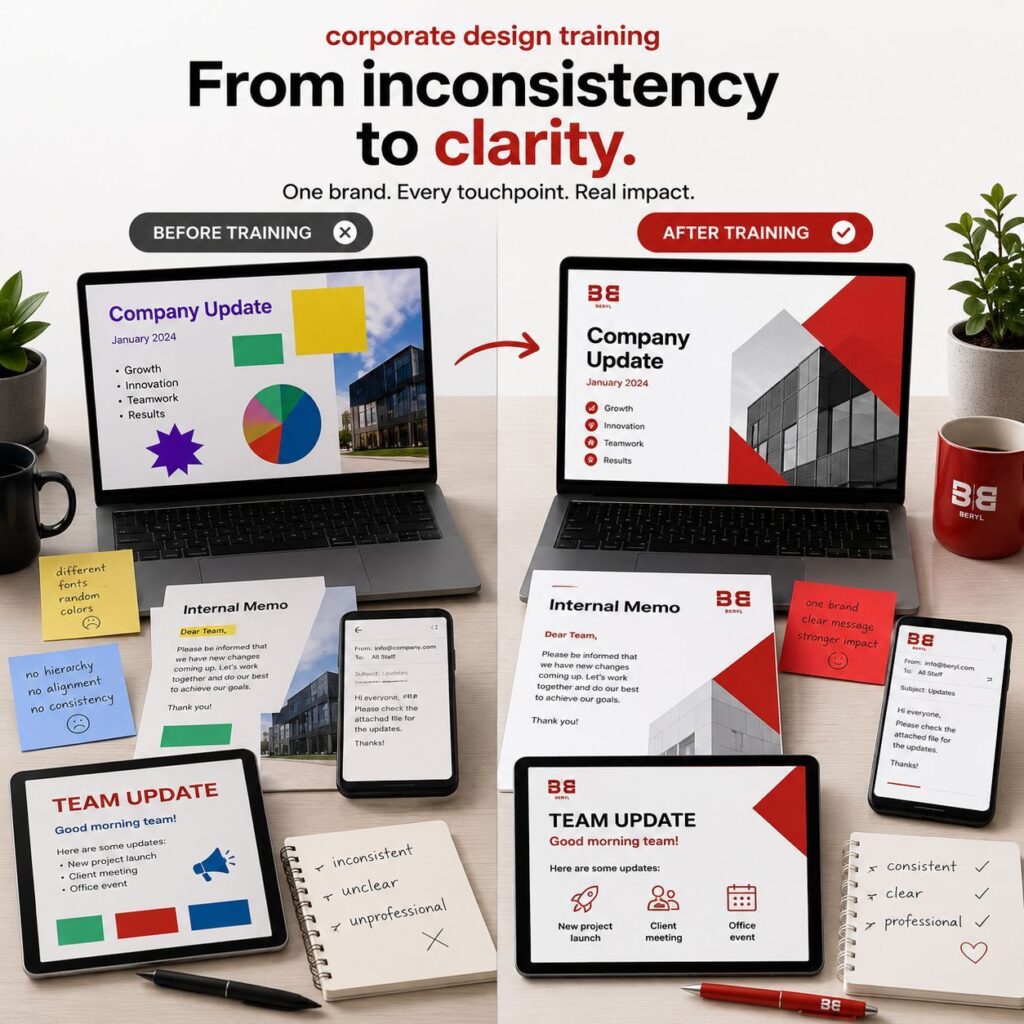
Before.
Inconsistent output across teams using AI. Decks that look like they come from different companies. Vendor briefs producing rework cycles around AI generated assets. Generic social content from AI lacking distinctive voice. Brand voice that drifts across AI assisted channels. Marketing copy that is correct but emotionally flat or off brand. Uncontrolled AI experiments producing off brand visuals. Manual approval cycles consuming time despite automation capability.
After.
Consistent AI-assisted outputs across teams and regions, creating a unified visual and verbal identity. Clearer creative briefs improve first-round approvals, while AI-supported workflows maintain brand voice across content, marketing, and communication channels. AI-generated visuals align with brand standards, reducing revisions and accelerating approval processes through structured implementation and governance frameworks.
Before and after the training
satisfied clients across branding, design, and digital solutions.
Our methodology
01 Pre training audit. Before any session is delivered, we audit your existing brand book, recent campaigns, AI experimentation environments, social output, vendor work, and internal communication systems. This shapes the training to your actual gaps and current AI adoption maturity, not a generic curriculum.
02
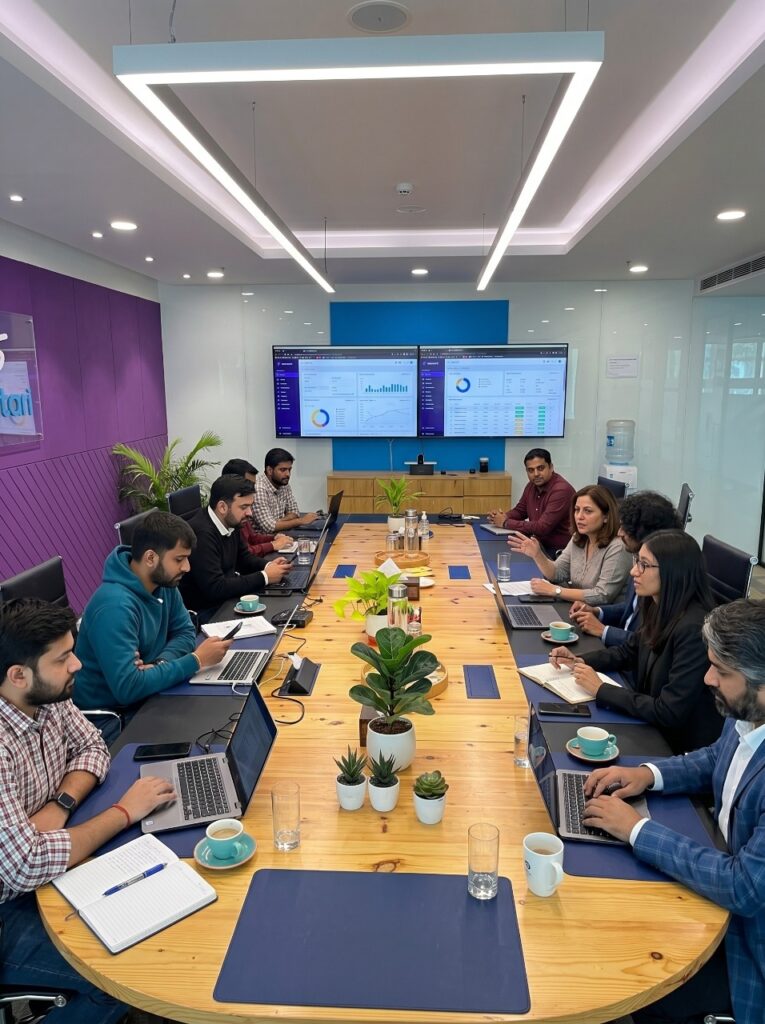
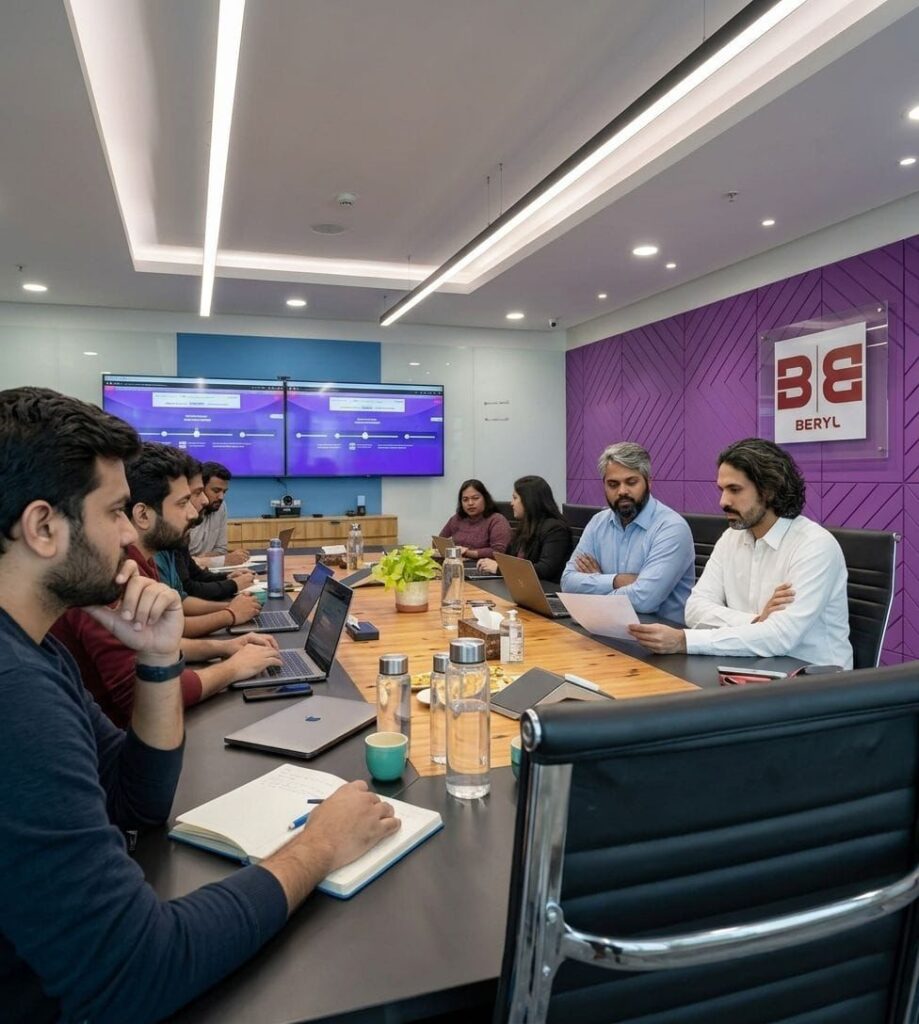
Live workshop delivery. The core training is delivered on site or hybrid across one to three days, structured around active practice, live exercises, and real time application to your brand and operational environments. Theory is kept tight. Application is heavy.
We deliver AI implementation frameworks that ensure consistency across prompt systems, content workflows, visual outputs, and governance structures so your brand stays coherent, scalable, and AI ready.
We deliver brand guidelines that ensure consistency across packaging, website, social media, and more — so your brand stays clear, strong, and scalable.
03 Post training application support. For two to four weeks after the program, your team receives structured prompts and review windows to apply the frameworks to live work, with feedback loops from our team. This is where most training programs fail, and where ours holds its weight.

final step
Follow up review. A closing review session four to six weeks later, where your team presents work produced after the training, and we assess shifts in cohesion, voice, governance awareness, and implementation capability. This converts learning into measurable change.

Sample training agenda
Day one, morning. Understanding AI capabilities and limitations, prompt engineering fundamentals, fact checking and validation frameworks, live audit of existing AI generated outputs and workflows.
Day one, afternoon. AI assisted content creation across email, social, and internal communication, applied exercises on your real brand assets and live prompting practice.
Day two, morning. AI ideation and brainstorming systems, brand voice consistency across AI assisted channels, ethical AI usage including bias, plagiarism, and misinformation awareness.
Day two, afternoon. Visual consistency in AI generated assets, prompt engineering for image generation within brand guidelines, live prompting on Midjourney and Gemini within your actual brand book.
Day three, morning. Enterprise AI workflow integration, operational bottleneck mapping, governance frameworks, and cross functional implementation alignment.
Day three, afternoon. Application clinic, team presents AI generated work produced during the program, structured feedback, action plan for the next 30 days.
This is a representative flow. Every program is custom scoped to your team size, maturity, and priorities.
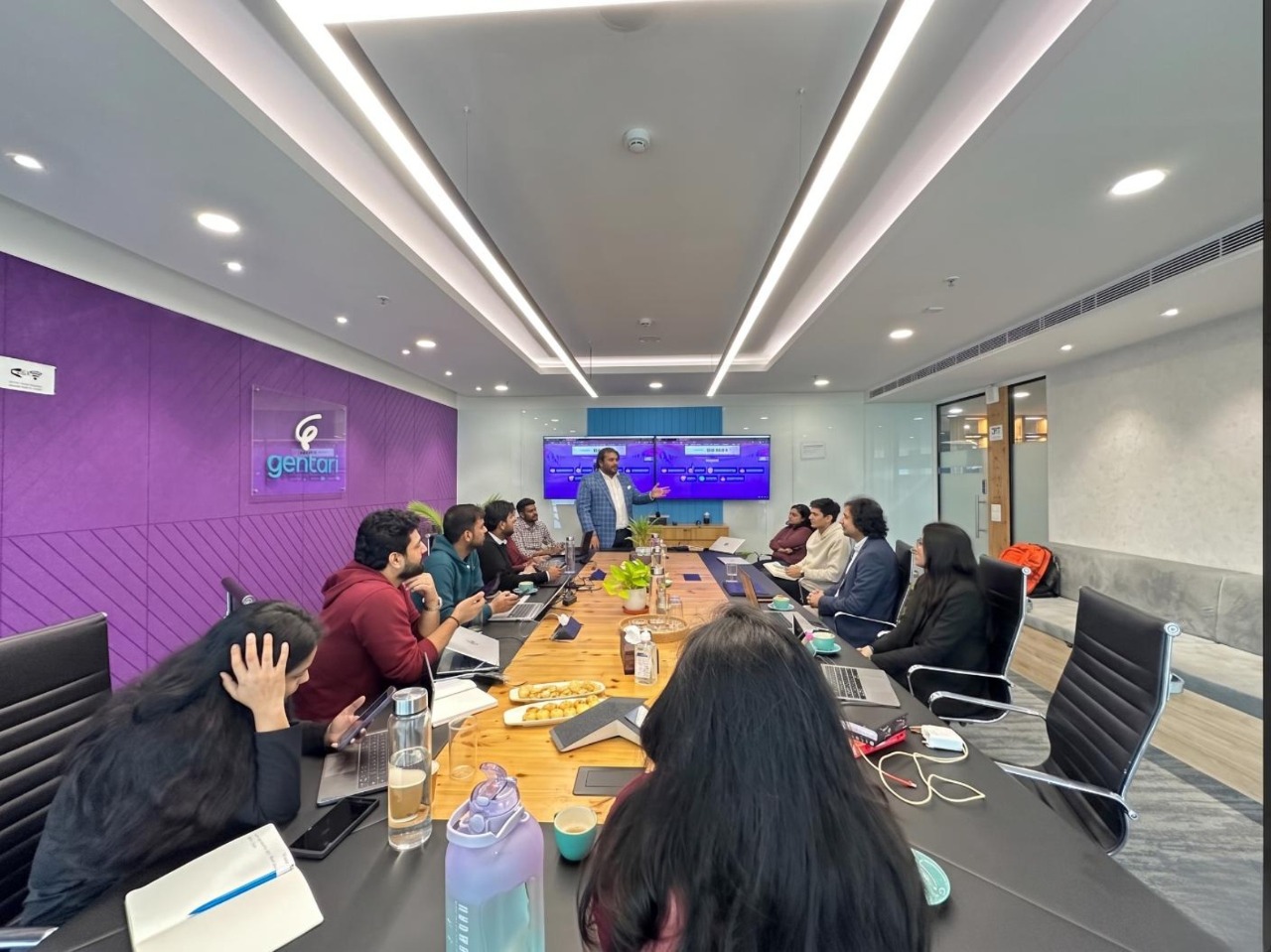
Training formats
On site intensive. One to three full days at your office or offsite venue, ideal for teams of 12 to 40 participants who need a full reset across AI implementation capability.
Hybrid program. A blend of live on site sessions and remote application clinics over four to six weeks, ideal for distributed teams across regions navigating AI adoption at different maturity levels.
Half day masterclass. A focused four hour session on a single topic such as prompt engineering, AI governance, or visual consistency within brand guidelines, ideal for senior teams who want a sharp intervention rather than a full program.
Why Beryl
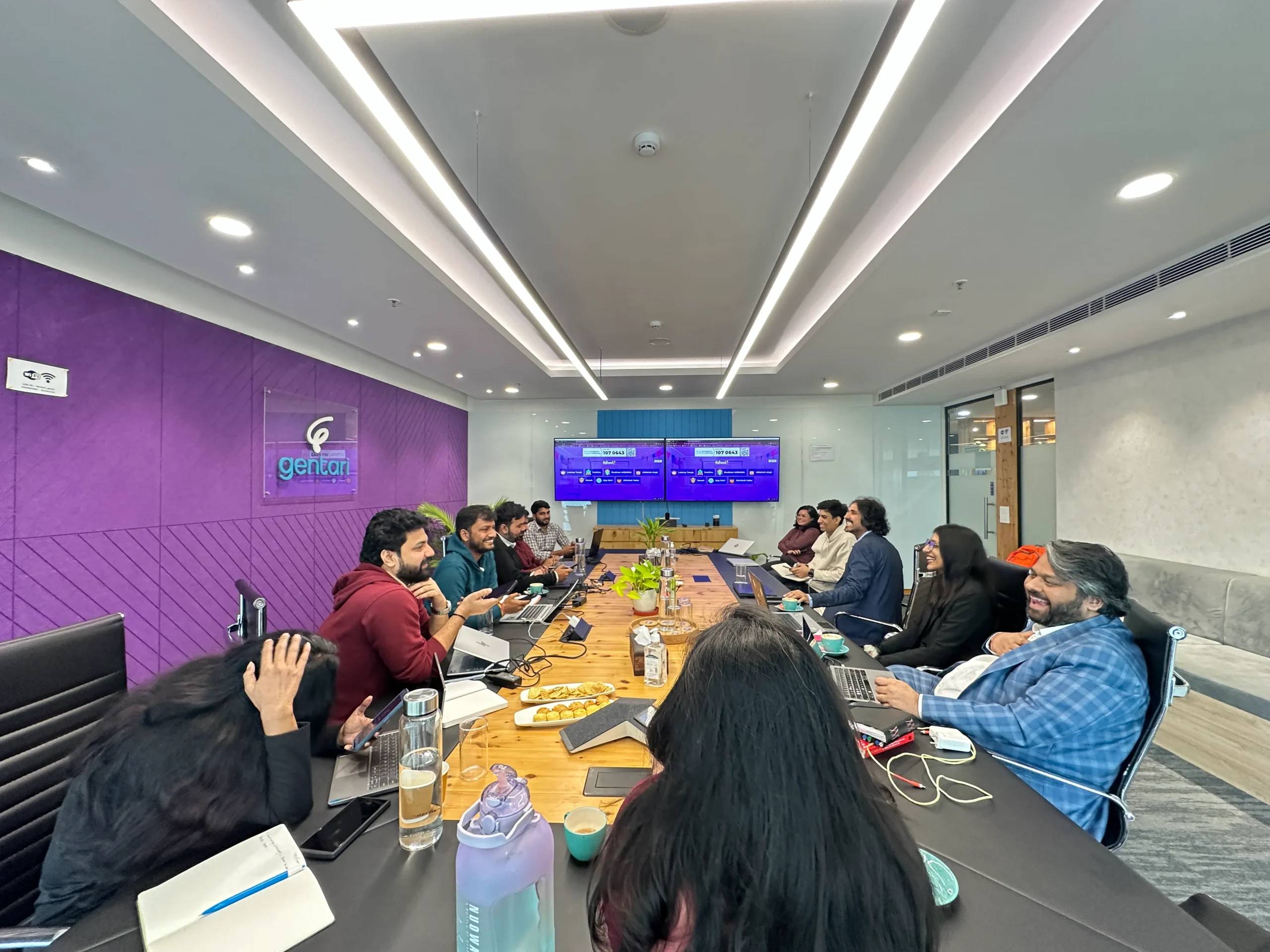
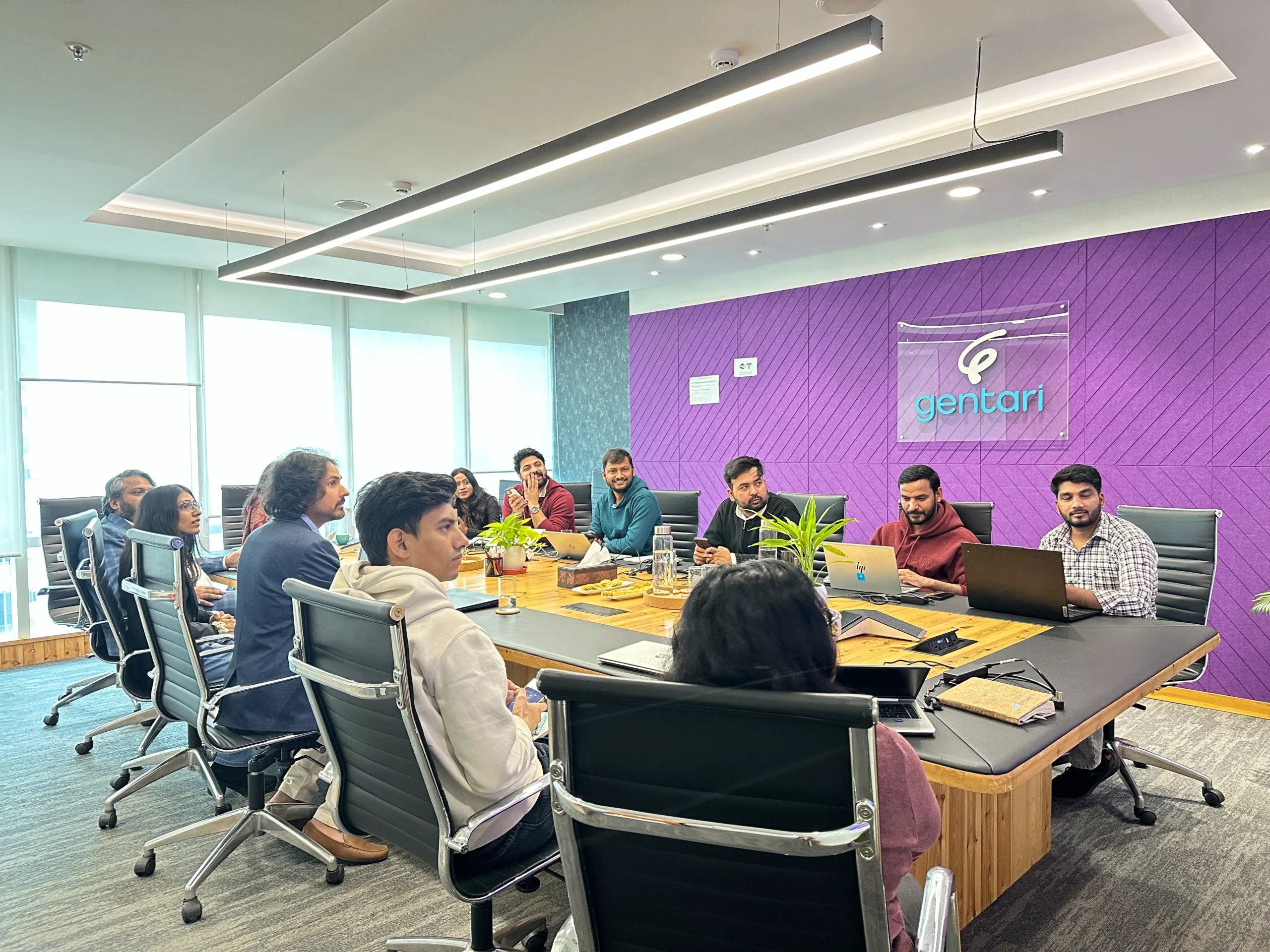
We are not a training company that occasionally talks about AI. We are a design and branding agency that has been doing the work for 16 years, with 1573 clients across 19 countries and 67 industries, including four Fortune 500 engagements. Our co founder Akshat Raghava is a RISD trained industrial designer, a four time I Design Award winner, and recipient of the RISD Faculty Award. Prashant Gupta holds a seat on the CII National Committee on Design Innovation and Design Policy and is trained at MICA and IIM Kozhikode. Our most recent corporate training engagement was with Gentari, a fully owned subsidiary of Petronas, delivered across modules covering visual design, verbal identity, storytelling, photography, and AI image generation within brand guidelines.
When you bring Beryl in, your team learns from practitioners who ship real client work with emerging AI systems every week, not from a curriculum frozen years ago.
How Beryl compares to other corporate AI design training options
Most corporate L&D teams evaluating AI design training for their marketing function end up looking at four kinds of providers, each with real tradeoffs. Here is an honest comparison so your procurement and L&D teams can make a clean decision.
Generic corporate training companies.
These vendors offer broad catalogues covering soft skills, leadership, IT, compliance, and digital marketing. AI design and brand implementation rarely sit at the centre of their practice. The trainers are professional facilitators rather than working designers or brand strategists, which means the frameworks they teach are often borrowed and rarely tested against live client work. For a marketing team that needs to genuinely lift AI implementation quality, this category produces sessions that feel polished but rarely change output.
Design schools and education institutions.
NID, NIFT, Pearl Academy, and similar institutions occasionally offer corporate programs. The faculty are educators, the curricula are academic, and the structure is built for students rather than working professionals operating under brand book constraints and live AI adoption pressures. The depth is real, but the application to a corporate AI workflow and a working marketing team is usually missing. Programs feel like extensions of a design degree, not interventions inside a live business.
Executive education from IIMs, MICA, and ISB.
These programs carry institutional weight and pass procurement filters easily. They are excellent for strategic frameworks around AI adoption, design thinking, and marketing leadership. Where they fall short is in applied craft. A two day MICA program will not teach your team to interrogate your brand book with AI tools, build prompt libraries for your specific brand voice, audit your own AI generated social output for consistency failures, or generate AI imagery within your guidelines. Academic depth, low applied yield.
Branding agencies that occasionally run workshops.
A small number of agencies in Delhi NCR list workshops and training as a secondary service. The offering is usually a one off session led by a senior team member squeezed between client deliverables. The agency has the practitioner credibility, but training is not their core practice, which shows up in curriculum depth, structure, and follow through.
Where Beryl Agency sits.
We are a working design and branding agency that has built corporate AI training into a deliberate, structured practice, anchored by two co founders who personally lead every program. Akshat Raghava brings the international design education layer as a Rhode Island School of Design alumnus, a four time I Design Award winner, and a recipient of the RISD Faculty Award, with over 15 years spent teaching and mentoring design students and professionals across premier institutions in India and internationally. The pedagogical rigour you would expect from a top tier design school sits inside our training room, taught by someone who actually ships client work with emerging AI systems every week. Prashant Gupta brings the brand strategy, MSME, and Indian corporate context as a CII National Committee member on Design Innovation and Design Policy, trained at MICA and IIM Kozhikode, with 16 years of agency leadership and 1573 clients across 19 countries.
The result is a hybrid that does not exist elsewhere in Delhi NCR.
RISD level design pedagogy combined with live agency AI practice, applied directly to your brand book, your team, and your real output, delivered by the founders themselves rather than handed off to junior trainers. This is the gap our most recent corporate engagement, Gentari, a fully owned subsidiary of Petronas, was designed to fill.
If your team needs a one off motivational session, generic vendors will do.
If your team needs theoretical frameworks for a leadership offsite, executive education will do. If your team needs to actually shift AI output quality, voice consistency, and brand fidelity across daily work, this is the practice we have built Beryl Agency around.
Featured case study
Gentari, a fully owned subsidiary of Petronas. A multi module corporate AI design training program covering prompt engineering, visual consistency within brand guidelines, AI assisted content workflows, brand voice across AI channels, and AI image generation within brand guidelines. Outcome, cohesive AI assisted team output matching intended brand standard, growing market share in Southeast Asia, increased inbound inquiry, and stronger regional brand presence. Read the full case study.
Engagement model and investment
Every program is custom scoped to your team, your brand book, and your AI implementation priorities. Programs typically range from a focused half day masterclass to a three day intensive with four to six weeks of application support. Investment varies by scope, geography, and team size. We work with corporate L&D budgets and procurement processes, and we are happy to share an indicative range during the scoping call.
Suggested deep dive topics

Understanding AI: Capabilities, Benefits, and Limitations
Foundational understanding of AI systems, human narrative psychology, and body-led content perception. Teams learn AI’s value, limitations, and effective real-world applications

Enterprise Prompt Engineering and Reliable Output Systems
Structured prompting methods that enable consistent AI performance. Teams understand how instruction quality shapes outputs, efficiency, and business results

Fact-Checking, Validation, and Governance Frameworks
Human oversight frameworks that improve AI accuracy, reliability, and quality control. Teams build validation processes that ensure accountability and trustworthy outcomes.

AI-Assisted Communication Systems and Brand Voice
Build AI-powered content systems that preserve brand voice and consistency. Teams create scalable content that remains authentic across channels.

Visual Consistency in AI-Generated Assets
Implement AI design systems that accelerate visual creation while maintaining brand consistency. Teams produce review-ready visuals with fewer revisions.

Workflow Integration and Operational Efficiency
Develop AI automation frameworks that streamline operations without sacrificing oversight. Teams eliminate bottlenecks while ensuring reliability and compliance.

Ethical AI Implementation and Responsible Adoption
Develop AI governance practices that manage risk and accountability. Teams support responsible adoption while maintaining compliance and trust.

Long-Term Capability Development and Scalable Implementation
Create enterprise-wide AI systems that enable consistent adoption and governance. Teams scale capabilities effectively across functions and locations.
most asked questions
What is corporate AI design training and why does it matter for large companies in 2026.
Corporate AI design training is a structured intervention that teaches marketing, branding, communications, and creative teams the underlying principles of using artificial intelligence systematically while maintaining brand consistency, quality standards, and governance awareness. It is different from a generic AI workshop because it is built around your actual brand, your actual output, and your actual operational environment, not a generic curriculum.
In 2026, large companies are realising that adopting AI tools without systematic thinking creates inconsistency rather than efficiency. Marketing budgets are larger, content volume is exploding, AI image generation has entered every workflow, and yet brand consistency across regions, vendors, and channels keeps slipping. The reason is rarely effort or budget. It is missing systematic implementation principles.
Your team uses AI daily, but no one has structured the foundational frameworks that decide why an AI prompt produces reliable outputs, why AI generated content maintains voice, and why visual consistency holds across AI assisted assets. Beryl Agency built this practice to close that exact gap. The training matters because every percentage point of brand inconsistency caused by uncontrolled AI adoption directly translates into weaker recall, slower vendor cycles, more rework, and lower marketing return.
Who should attend corporate AI design training.
The program is built for working professionals across marketing, branding, communications, and creative functions. Chief Marketing Officers and marketing heads attend to understand what their teams should be operating at when AI tools enter workflows. Brand managers and brand custodians attend because they are responsible for consistency across regions and channels as AI adoption accelerates. Internal creative and design teams attend because they execute daily with AI assistance but rarely receive structured training. Communications and content teams attend because they write at scale across email, social, decks, PR, and internal channels while integrating AI.
Operations and innovation groups attend because they seek frameworks supporting systematic AI implementation. Vendor and agency partners attend because they execute inside corporate environments and need alignment around brand guidelines when AI tools produce assets. L&D and HR leaders bring the program in for marketing cohorts as part of a structured capability building plan.
The program is intentionally designed to be accessible to non designers while remaining rigorous enough that experienced designers gain new frameworks. We have trained mixed cohorts of marketing managers, agency partners, internal designers, and senior leadership in the same room, and the curriculum holds for all because the underlying principles apply universally.
How is AI design training different from a regular marketing or soft skills workshop.
A regular marketing workshop covers campaigns, channels, performance metrics, growth tactics, and platform updates. A soft skills workshop covers communication, leadership, time management, and team dynamics. AI design training is a different discipline entirely. It covers the underlying systematic thinking required to use artificial intelligence without creating inconsistency, drawing from prompt engineering, governance frameworks, workflow integration, brand consistency systems, and responsible adoption practices.
Most large corporates invest heavily in marketing and soft skills training while investing almost nothing in systematic AI adoption capability. The result is teams with strong marketing strategy but fragmented execution as AI tools proliferate independently across departments. Beryl Agency operates exclusively in the systematic AI adoption and brand consistency layer.
What specific topics are covered in the Beryl Agency corporate AI design training program.
The full curriculum spans understanding AI capabilities and limitations, effective prompt engineering systems and structured prompting frameworks, fact checking and responsible AI usage practices, AI assisted communication workflows and content creation, design exploration and ideation using AI tools, ethical implementation including bias and plagiarism awareness, enterprise workflow integration and operational efficiency, governance frameworks and long term capability development.
Every module combines structured learning with practical enterprise application designed around business operating realities. Teams work through communication systems, workflow environments, brand consistency, content production systems, governance considerations, and execution structures increasingly influenced by artificial intelligence.
Can the training be customised for different industries and business contexts.
Yes. Enterprise operating environments differ significantly across industries. Communication systems vary. Workflow structures evolve differently. Operational complexity changes. Implementation priorities differ.
Corporate AI Design Training can be adapted around organisational requirements, operational maturity, business functions, communication capability, implementation readiness, and enterprise execution environments influencing different industries. The objective remains practical capability development aligned with operational realities rather than generic frameworks applied universally.
How long does a typical Beryl corporate AI design training program run.
Programs range from a focused four hour masterclass on a single topic to a full three day intensive covering the entire curriculum, with two to four weeks of post training application support included for longer engagements.
Most corporate engagements sit in the two to three day range. Day one typically covers AI fundamentals, prompt engineering, and fact checking capabilities. Day two covers AI assisted content and creative workflows, with particular emphasis on brand voice consistency. Day three is reserved for workflow integration implementation, governance frameworks, and closing application clinics.
The post training phase runs for two to four weeks and includes structured prompts, review windows, and feedback loops on live work, converting learning into measurable operational capability.
Do you offer on site corporate AI design training in India and Southeast Asia.
Yes. Beryl Agency is headquartered in Noida, India, and delivers on site corporate training across India, the Middle East, Southeast Asia, the United Kingdom, and the United States. We have served 1573 clients across 19 countries over 16 years of practice, which means our team is comfortable operating across cultural and regional contexts.
We can travel to your office, your offsite venue, or a third location of your choice. For distributed teams across regions, we also offer hybrid programs that combine live on site sessions with remote application clinics over four to six weeks. Travel and venue costs are scoped separately during program planning.
What makes Beryl Agency different from generic corporate training providers.
Beryl Agency is a working design and branding agency operating at enterprise scale, not a training company that occasionally talks about AI. Every framework we teach has been tested across 1573 client engagements over 16 years, in 19 countries and 67 industries, including four Fortune 500 names.
Our co founder Akshat Raghava is a Rhode Island School of Design alumnus, a four time I Design Award winner, and a recipient of the RISD Faculty Award, bringing international design school pedagogical depth into the training room. Our co founder Prashant Gupta holds a seat on the CII National Committee on Design Innovation and Design Policy, trained at MICA and IIM Kozhikode, with 16 years of agency leadership experience. Both founders personally deliver every program rather than handing off to junior trainers.
Generic corporate training providers sell horizontal catalogues across IT, soft skills, leadership, and compliance, with AI or design as a peripheral offering taught by professional facilitators rather than working practitioners. The difference shows up in curriculum depth, applied rigour, and the credibility your team brings back to their daily work after the program.
How do you measure outcomes after a corporate AI design training program.
We measure outcomes through a structured follow up review session held four to six weeks after the program closes. In this session, the team presents real work produced since the training, and we assess shifts across four specific dimensions.
The first is implementation consistency across departments, measured by sampling communications, social posts, and AI generated assets produced after training and comparing them to pre training output. The second is brand voice consistency across AI assisted channels, measured by auditing email, social, and internal communication for distinctive recognisable voice traits. The third is execution quality, measured by reviewing prompt reliability, output consistency, and approval cycle reduction. The fourth is operational efficiency, measured through reduction in revision cycles, faster approval timelines, and fewer feedback rounds on AI assisted briefs.
For longer engagements, we also track downstream outcomes such as inbound inquiry quality, brand recall in audience research, and stakeholder feedback on content quality shifts.
Does the training include governance and responsible AI capability.
Yes. Responsible AI capability forms an important component of sustainable enterprise adoption. The program explores governance awareness, review systems, approval environments, validation capability, ownership understanding, operational accountability, and responsible usage capability designed to support long term enterprise adoption.
Artificial intelligence capability becomes significantly stronger when governance awareness develops alongside implementation maturity rather than operating independently. The ethical layer remains integrated throughout the curriculum rather than existing as an isolated module.
What happens after the training concludes.
The objective of Corporate AI Design Training is not temporary capability improvement. The objective remains long term enterprise readiness and sustainable AI adoption across functions.
Participants leave with practical frameworks, operational understanding, workflow approaches, implementation thinking capability, and responsible AI awareness designed to strengthen business capability beyond structured training environments. The post training application support phase ensures that learning converts into measurable operational change rather than fading after the workshop ends.
Sustainable organisational capability remains the long term objective of every engagement.

Engagement Model and Investment
Every program is custom scoped to your team, your brand systems, and your implementation priorities. Programs typically range from a focused half day masterclass to a three day intensive with two to four weeks of application support. Investment varies by scope, geography, and team size. We work with corporate L&D budgets and procurement processes, and we are happy to share an indicative range during the scoping call.
Why Beryl
We are not a training company that occasionally talks about design. We are a design and branding agency that has been doing the work for 16 years, with 1573 clients across 19 countries and 67 industries, including four Fortune 500 engagements. Our co founder Akshat Raghava is a RISD trained industrial designer, a four time I Design Award winner, and recipient of the RISD Faculty Award. Prashant Gupta holds a seat on the CII National Committee on Design Innovation and Design Policy and is trained at MICA and IIM Kozhikode. Our practice operates at the intersection of design pedagogy, brand strategy, and practical agency delivery.
When you bring Beryl in, your team learns from practitioners who ship real client work every week, not from a curriculum frozen years ago or taught by facilitators unfamiliar with enterprise complexity.