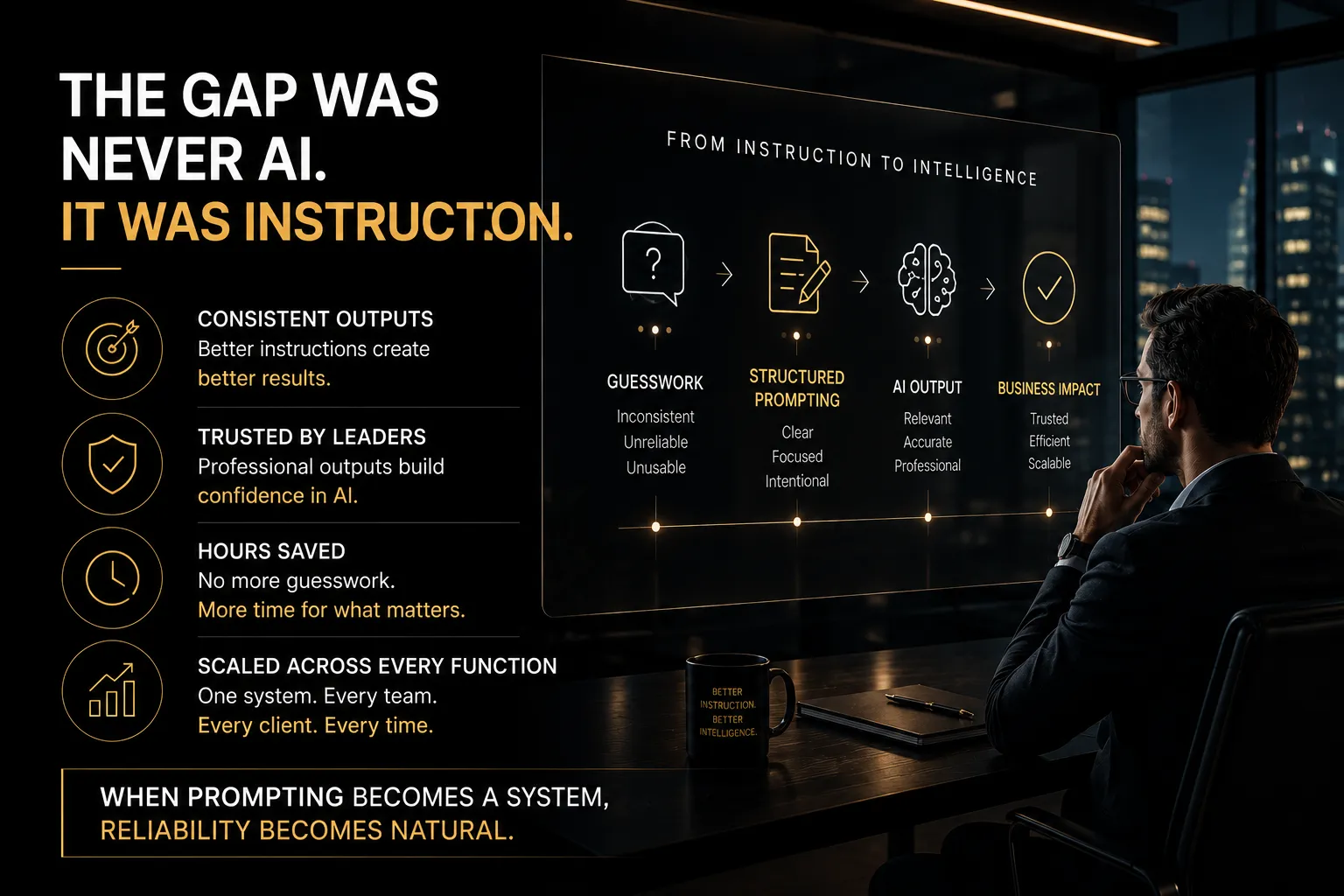

Enterprise Prompt Engineering entered a space where every organisation was using AI tools, but most outputs were inconsistent, unreliable, or simply not good enough for professional use. Teams were copying prompts from the internet, guessing at instructions, or abandoning AI altogether after poor results. The gap was not in the technology. It was in the instruction. Teams needed a system that made AI output predictable, professional, and repeatable at scale.

After structured prompting was introduced, the shift was immediate.
Teams produced consistent outputs because the instruction quality improved.
Leaders trusted AI results more because the outputs met professional standards.
Creative and strategy teams saved hours because the guesswork was removed.
And most importantly, the system created a foundation that could scale across every function, client, and deliverable.

That is the power of instruction that shapes intelligence.
When prompting becomes a system, reliability becomes natural.

Steaming chai latte in a CHAI RUSK mug on a wooden table with toasted bread and a branded backdrop.

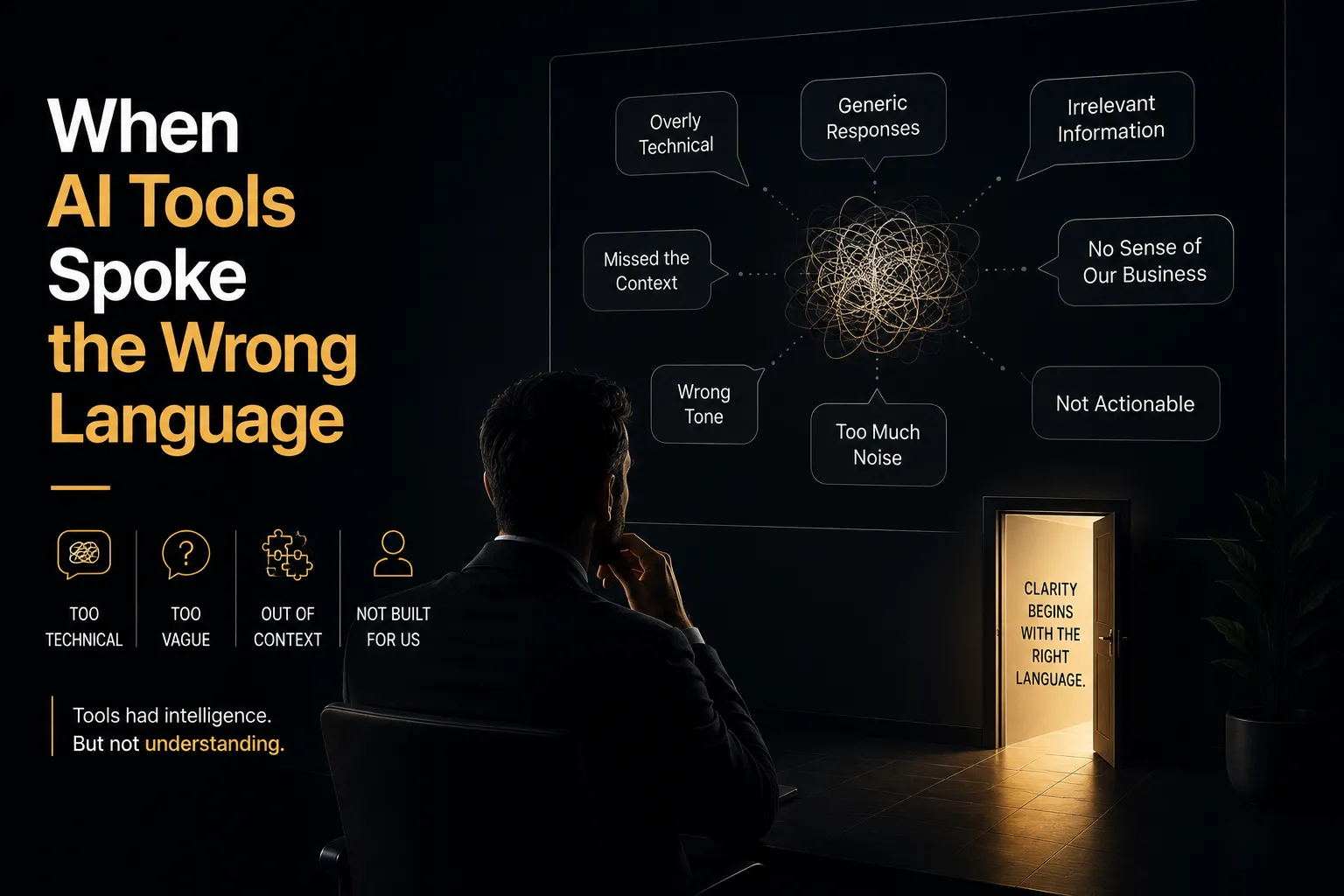
The Context. When AI Tools Spoke the Wrong Language

AI adoption was growing, but most outputs felt unprofessional.
Too generic.
Too inconsistent.
Too random.
Too far from the brief.

The problem was not the AI.
It was the instruction given to it.
This module was created to give teams a prompting system they could trust and leaders would approve.

Steaming chai latte in a CHAI RUSK mug on a wooden table with toasted bread and a branded backdrop.

The Challenge. To Build a Prompting System That Feels Universal

The brief was clear.
A framework that works for copywriters.
For strategists.
For every person producing AI-assisted work.

It needed to be structured but not rigid.
Detailed but not complicated.
Reliable but not mechanical.

A system that does not work for one person only.
A system that scales across the entire team.

The Insight. Why AI Outputs Fail Most Teams

Our research revealed a familiar truth.
AI produces poor output when the instruction is vague, incomplete, or poorly structured.

Prompt psychology showed

Teams want results they can use.
Leaders want outputs they can trust.

A prompting system must deliver both.

ambiguous instructions produce ambiguous results

missing context forces AI to guess and guess badly

no tone guidance produces generic lifeless output

one size prompts fail across different tasks and audiences

We approached prompt engineering like system design.

Our strategy revolved around three principles

– Purpose: create a structured instruction framework for consistent AI output

– Design: ensure prompts are layered, reusable, and role-specific

– Tone: precise, professional, and practically transferable

The goal was not to make AI sound clever.
It was to make AI output genuinely usable.

The Strategy. Designing Reliability, Not Randomness

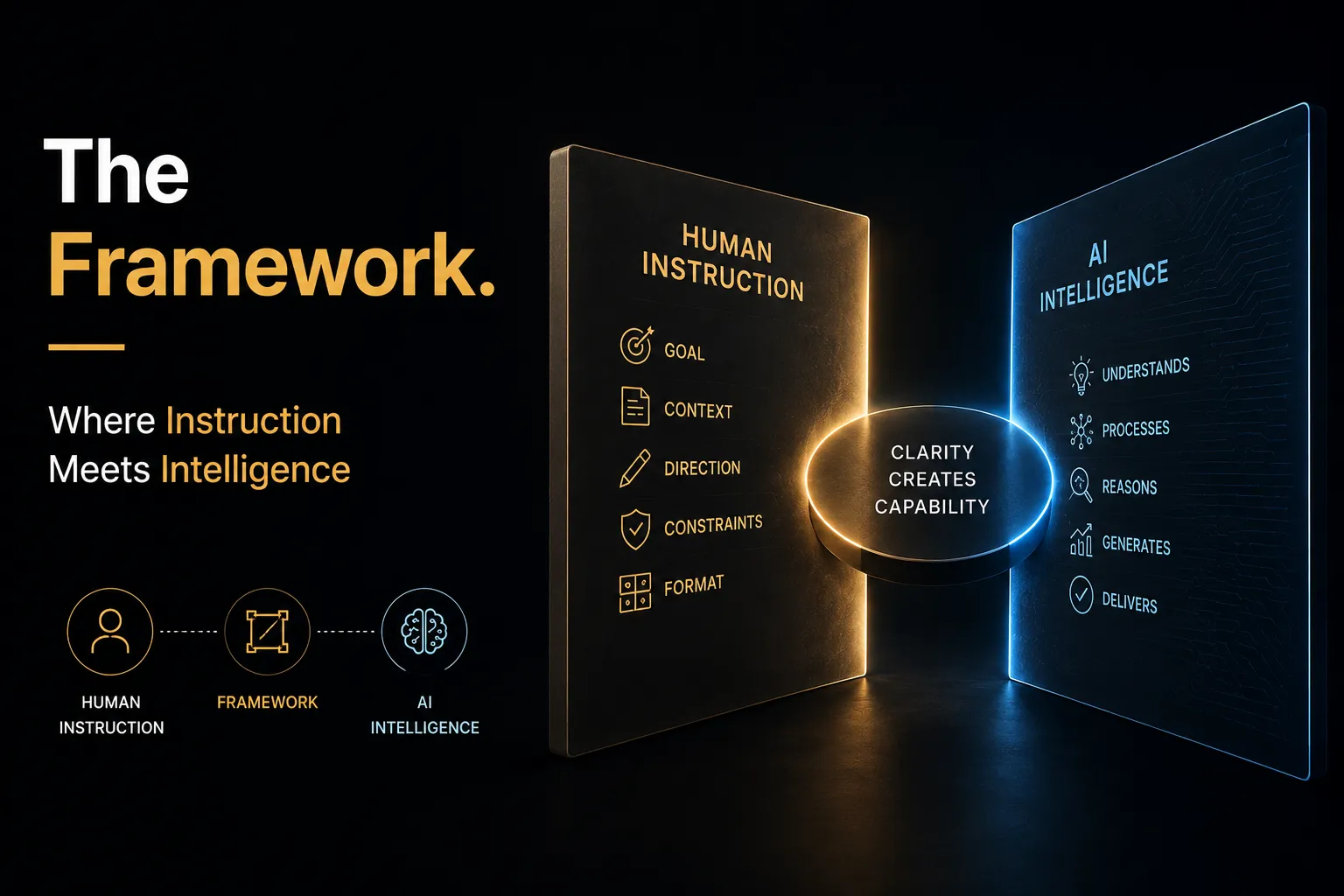
The Framework. Where Instruction Meets Intelligence

Even though this was a prompting module, the structure of the instruction shaped the entire output system.

Layered instructions.
Role and context clarity.
No vague or open-ended direction.

The framework sits comfortably in agency workflows, enterprise operations, and creative production pipelines.
It behaves like a production system, not a guessing game.

Precision became the design language.

Hand pouring hot coffee from a copper kettle into a CHAI RUSK mug, steam rising, in a warm cafe setting with wooden decor and gold logos.

The Prompt Architecture. What Great Instructions Actually Contain

In enterprise AI use, instruction quality determines output quality.
Just as a clear brief shapes great creative work, a structured prompt shapes reliable AI output.

A high performance prompt contains
a defined role telling AI who it is speaking as
a clear task telling AI exactly what to produce
relevant context giving AI the background it needs
output format specifying structure, length, and style
constraints defining what to avoid or exclude
a success measure describing what a good output looks like

These are not optional additions.
They are the difference between unusable and professional.

Sunlit cafe table with a glass of hot drink, two slices of rusk on a plate marked 'Chai Rusk', a notebook, pen, and glasses nearby; a newspaper on the side.

The instruction system behind this module is built on five elements

Role, who AI is acting as in this task
Context, what background information shapes the output
Task, what specific output is being requested
Format, how the output should be structured and delivered
Constraint, what boundaries define a successful result

These elements create a prompting system that belongs anywhere professional output is expected.

The Design Language. The Five Elements of Prompt Engineering

output quality improves because instructions are specific and complete

time spent on editing and reworking drops significantly

consistency increases across team members using the same prompt templates

onboarding accelerates because new team members follow a proven system


client-ready work arrives faster because the brief is built into the prompt

Prompt engineering does not replace creative thinking.
It removes the friction between thinking and output.

The Benefits. When Prompting Creates Real Advantage

When teams prompt with structure, the advantages become immediate.

The Limitation. Turning Awareness Into Strength

Even structured prompts have real, consistent, and important limitations.
Recognising them is not weakness.
It is professional intelligence.

– prompts cannot compensate for genuinely bad strategic thinking

– AI will still hallucinate facts even inside a well-structured prompt

– tone can drift across long outputs without reinforcement checkpoints

– complex multi-step tasks require prompt chains, not single instructions

– outputs must always be reviewed before any client or public use

For Beryl, this became a benchmark in responsible AI production.
Proof that prompt awareness, when built carefully, becomes a competitive advantage.

Six friends at an outdoor cafe table, one playing guitar while others chat and share snacks, with a neon 'Chai Rusk' sign in the background.
Promotional banner announcing 'Enterprise Prompt Engineering and Reliable Output Systems' with two men in white shirts on the right and purple design elements.

What This Means for the Future of Enterprise AI Use

Prompt engineering proves that teams do not need better AI.
They need better instructions.

The framework creates space for growth into automated content pipelines, scalable creative production, and consistent brand voice delivery at volume.
A system built not for one project, but for the way professional work is evolving.

Wall mural for 'Chai Rusk' brand featuring a glass of chai, poured teapot, and a plate of rusks with decorative leaves and quotes like 'Chai Makes Everything Better'.

Our Perspective. Why Prompting Requires Strategic Intelligence

Teaching prompt engineering requires systems thinking, not just technique.
It demands understanding how teams work and how outputs get approved.

Our approach allows every person in the room to leave with a prompting system they can use the same afternoon.

Cozy cafe interior with wooden tables, plants, and a wall mural that reads 'Chai Rusk' beside decorative sketches and quotes like 'good ideas start with chai'.

What This Module Covers

– prompt architecture and the anatomy of a high performance instruction

– role, context, task, format, and constraint framework

– common prompt failures and how to diagnose and fix them

– reusable prompt templates for brand, strategy, and creative work

– prompt chaining for complex multi-step outputs

Each step ensures the system is practical, repeatable, and immediately deployable.

Each step ensures the understanding is honest, applicable, and built to last.

The Beryl Edge

With fifteen plus years in branding, Beryl understands how to merge psychology, culture, and strategy.

Our approach to prompt engineering combines operational discipline, creative application, and long term production vision.

That is why the result is a system that actually changes how teams produce.
A module that feels like it belongs inside a professional workflow.

What We Learned

Teams do not want more AI tools.
They want AI tools that actually work for them.

This module reminded us that reliable output is not an AI problem.
It is an instruction problem solved with structure and clarity.

FAQs

Why do well-written prompts produce better output

Because AI responds to the quality and specificity of instruction, not to effort or intention.

More than two hundred prompt variations across nine content categories and four industries.

Its structural logic applies to every AI model, not just the tools available today.

Because consistency, tone accuracy, and output quality directly affect how a brand is perceived.

A sequence of connected instructions where each output feeds the next, used for complex multi-step creative or strategic tasks.

Understanding AI: Capabilities, Benefits, and Limitations

Brand Voice Systems

AI in Creative Strategy and Ideation

Related Sessions

Let’s Build Something That Feels Human

berylagency
berylagency
berylagency