

Beryl Agency at the World Innovation, Design and Intellectual Property Conference 2026
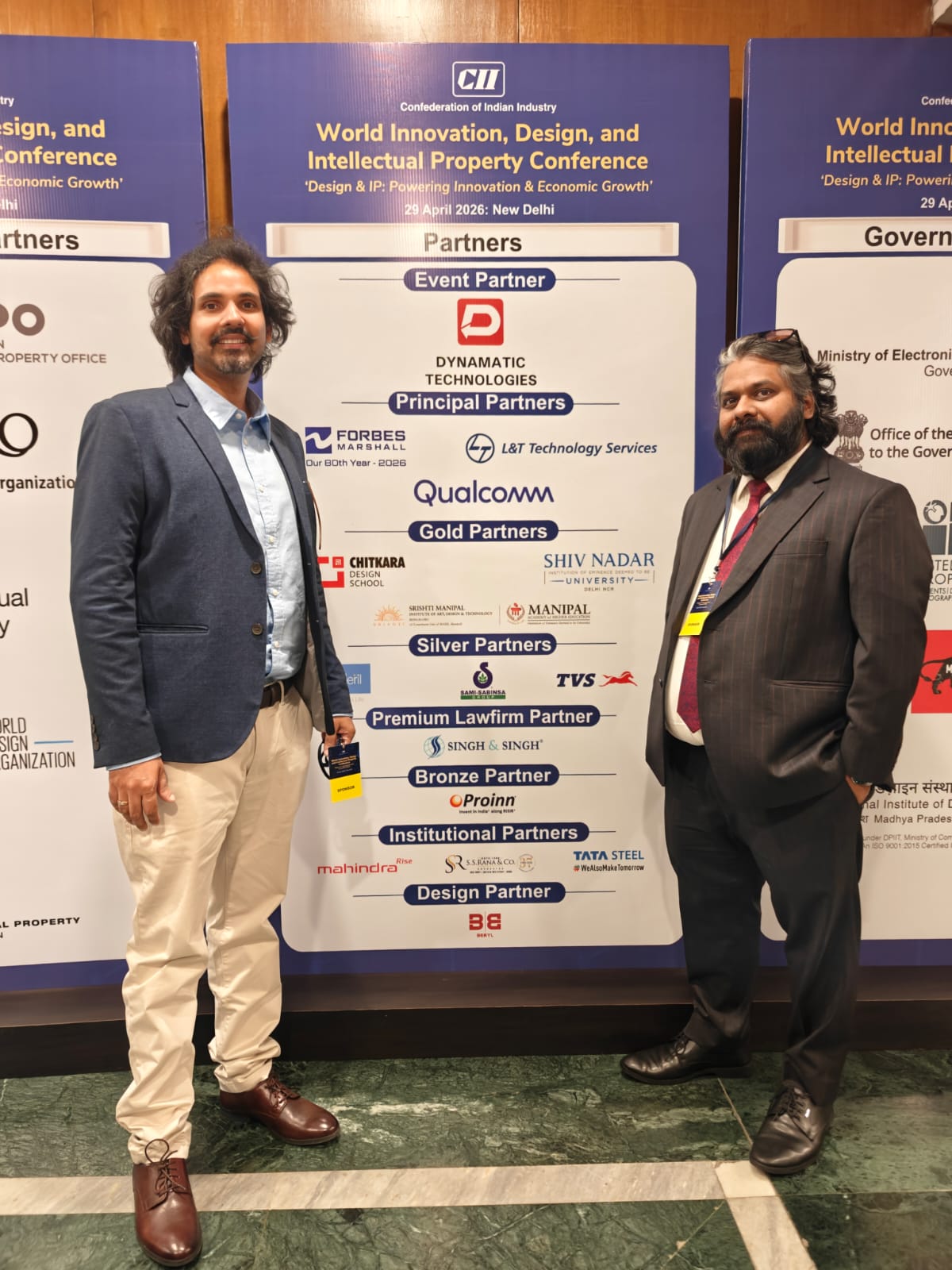
Confederation of Indian Industry. World Design Day and World IP Day. 29 April 2026, Jacaranda Hall, India Habitat Centre, New Delhi.
29 April 2026 / India Habitat Centre, New Delhi / 35+ Global Speakers / 5 Sessions / 1 Masterclass
THE PARTNERSHIP
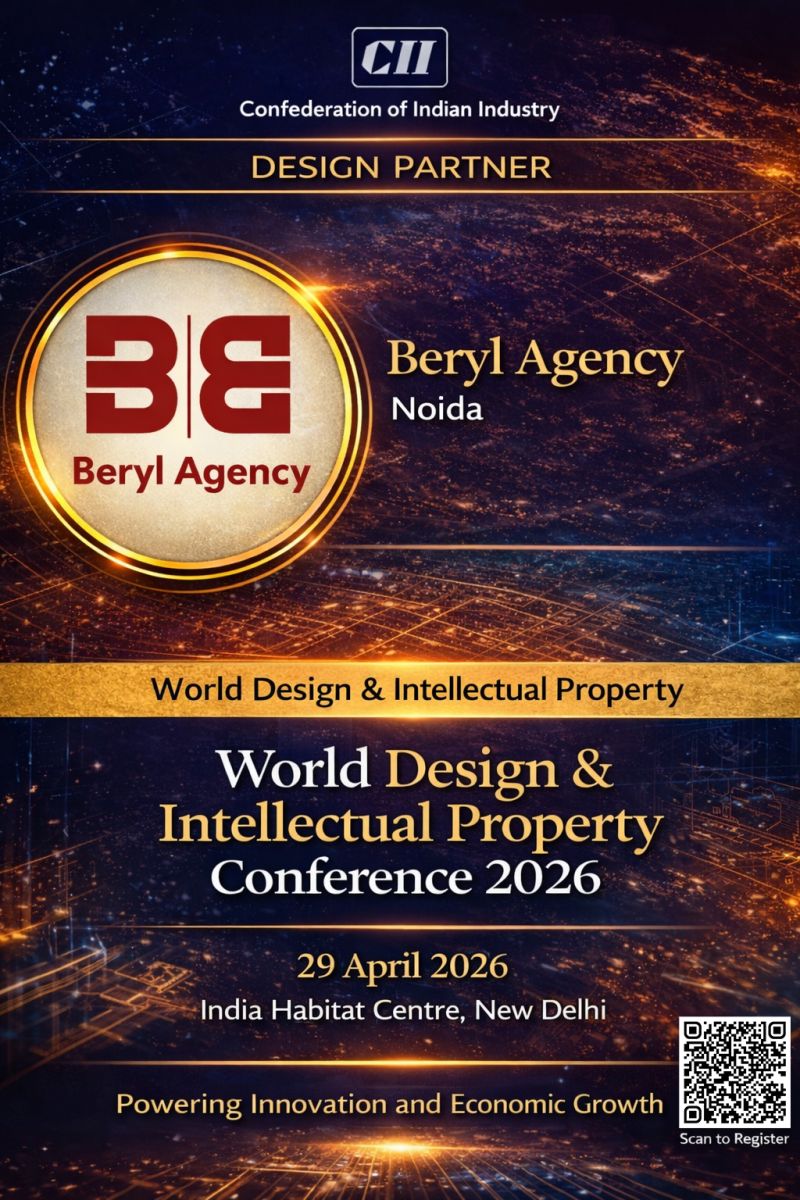
Beryl Agency was appointed as the Official Design Partner for the World Innovation, Design and Intellectual Property Conference 2026, organised by the Confederation of Indian Industry. This is not a sponsorship and it is not a logo placement. CII was building its most significant conference at the intersection of design and intellectual property, and it needed a practitioner who could represent the creative industry as a peer at that table, not a vendor who would make things look nice on the outside.
The conference brought together the Controller General of Patents for India, the President of the World Design Organization, and senior leadership from WIPO, EUIPO, UKIPO, Tata Motors, Mahindra, Qualcomm, and TCS. Beryl was in that room because a 16-year-old studio with 1,573 clients across 67 industries, four Fortune 500 engagements, and a founder on the CII National Committee on Design Innovation is not a service provider. It is a voice.
HOW BEING HERE SERVES SOMETHING LARGER
India has tens of thousands of designers, studios, and creative businesses building brand identities, product forms, packaging systems, and digital interfaces every day. Most of them have no idea that what they are creating is a legally protectable asset. They deliver the work, hand over the files, and move on. The brand gets copied. The form gets replicated. The visual language gets claimed by someone else, because nobody filed for it.
That gap, between what designers create and what gets protected, is what this conference exists to close. And it is the same gap that Beryl works to close for every client it takes on.
By being the only creative design studio among government officials, global IP bodies, IP lawyers, and corporate heads of innovation, we brought the designer’s perspective into a conversation that rarely includes it. We asked the questions that growing Indian brands and MSMEs cannot ask because they are not in the room. We listened to where policy is heading, what global frameworks are becoming, and what it means for any business that considers design part of its competitive strategy.
This is institutional participation. And for the Indian design industry, that distinction matters.
THE INAUGURAL SESSION
The conference opened with addresses from the country’s most senior voices in design, policy, and intellectual property. Together, they set the stakes for everything that followed.
01
Mr Naman Jain, Vice Chairman of CII Gurgaon Zone and Director of NTF Group, delivered the welcome and opening address. A third-generation leader at a Tier-1 automotive component manufacturing company serving Maruti Suzuki, Toyota, and Volkswagen, he is also driving NTF’s expansion into electric mobility through Zen Mobility and automotive design through Studio34. A Mechatronics Engineer from the University of Western Australia and SPJIMR Mumbai alumni, he has been recognised as a BusinessWorld 40 Under 40 leader and Forbes India Game-Changing Leader 2025.

02
Mr R Saha, Senior Advisor at CII, provided a brief on the CII Innovation and IP Movement. A BTech from IIT Kanpur and Masters graduate from Cranfield University, he served the Government of India for 35 years before retiring as Scientist G and Adviser from the Department of Science and Technology. He was appointed by WIPO to prepare a National Study on IPR and MSMEs in India, has been Senior Adviser to CII since 2011, and currently advises IIT Delhi, IIT Kharagpur, CDAC, NRDC, and the Indian Council of Medical Research.
03
Prof Ananya Mukherjee, Vice Chancellor of Shiv Nadar Institution of Eminence, delivered the first Special Address. A PhD holder from the University of Southern California, she previously served as Provost and Vice-President Academic at UBC Okanagan, and as Dean of Liberal Arts and Professional Studies at York University, Toronto, where she led the largest liberal arts faculty in Canada with 23,000 students from 123 countries. She was named one of the 15 Most Influential Women in Education by BusinessWorld in both 2022 and 2024.
04
Prof Pradyumna Vyas, President of the World Design Organization and Senior Advisor at CII, addressed the gathering on the global significance of the conference. Former Director of the National Institute of Design for a decade, he was the founding Member Secretary of the India Design Council and launched India Design Mark in partnership with Japan’s Institute of Design Promotion. He holds a Masters in Industrial Design from IIT Bombay, an Honorary Master of Arts from the University for the Creative Arts in Farnham, and has received the Good Design Fellow honour from Japan’s Institute of Design Promotion.
05
Dr Sanjay Kumar Manjul, Additional Director General at the Institute of Archaeology and Iconic Sites under the Ministry of Culture, Government of India, brought the lens of India’s cultural heritage to the conversation on intellectual property. His excavation of Sinauli in Bagpat, Uttar Pradesh, has been called the Discovery of the Century. He has led conservation work across centrally protected monuments in North-Eastern states, Bihar, and Uttar Pradesh, and contributed to UNESCO World Heritage nominations including Nalanda.
06
Prof Unnat Pandit, Controller General of Patents, Designs and Trademarks at DPIIT, Government of India, addressed the conference on India’s evolving IP landscape. He previously served as Professor of Intellectual Property, Innovation, and Entrepreneurship at JNU, as Program Director at Atal Innovation Mission at NITI Aayog, and as a member of the committee that drafted India’s National Intellectual Property Policy. His experience spans the full length of India’s IP ecosystem, from academic research to enforcement and policy.
07
Mr Vishal V. Sharma, India’s Ambassador and Permanent Representative to UNESCO, delivered a video message connecting the conference’s agenda to India’s international creative economy commitments.
08
Dr Ashish Mohan, Executive Director of CII, delivered the Vote of Thanks. A Doctorate holder in Robotics, AI, and Mechatronics from IIT Delhi, he spearheaded JCB India’s innovation initiatives to five national and one international award over five years, established the Robotics and Mechatronics Innovation Lab at IIT Delhi, and twice represented India as an invited speaker at the International Thematic Conference on AI and Robotics in Madrid and Milan.
SESSION 01
11:00 to 12:00 hrs IST
Design and IP as Key Enablers of Innovation and Economic Growth
The first session established the foundational argument of the entire conference. Design and intellectual property are not separate conversations happening in separate departments. Together, they are the mechanism by which organisations move from generating ideas to owning the economic value those ideas create. The discussion examined how businesses that integrate design thinking with IP strategy systematically outperform those that treat either as an afterthought, covering how design enables differentiation and market relevance while IP locks in ownership, supports commercialisation, and builds long-term enterprise value.
Session Moderator
Dr Vinodh Mewani is Senior Principal Engineer and Head of IPR and Knowledge Management at Mahindra and Mahindra. A certified TRIZ Level 3 Practitioner with 13 international publications and a certified Six Sigma Green Belt, his PhD research investigated ultra-thin interfacial oxide layers in magnesium-aluminium alloys, work with wide implications for automotive lightweighting. His post-doctoral work under the EU’s FP6 FlexiDis initiative focused on barrier coatings for display applications at TetraPak in collaboration with European institutions.
Session Panelists
Ms Marie-Paule Rizo is Director of the Hague Legal and Treaty Promotion Division at WIPO, where she has built her career since 1997 across trademarks, industrial designs, and geographical indications. She was Secretary of the Drafting Committee for the 2024 Diplomatic Conference that adopted the Riyadh Design Law Treaty, one of the most consequential moments in international design protection in a generation. She holds a law degree from the University of Barcelona and a postgraduate degree in Industrial Property Law from the University of Strasbourg.
Mr Ignacio de Medrano Caballero is Head of Promotion of the IP System at the European Union Intellectual Property Office. His career spans IP litigation in Spain, roles within EUIPO’s opposition division, a five-year assignment in Bangkok as EU Project Leader for IP cooperation across all ten ASEAN countries, and leadership of EUIPO’s international cooperation network across Africa, China, Latin America, and Southeast Asia. Since July 2024 he leads EUIPO’s strategy for awareness, IP valuation, and IP finance. He holds degrees in Law, Comparative Law, European and International Law, and Public Administration.
Prof Manisha Mohan is Dean of the School of Design at Bennett University, a National Institute of Design Ahmedabad alumna with expertise across design education, serious game design, e-learning, animation, and UI-UX. She has led projects winning Brandon Hall, Apex, and CII Design awards, serves on the CII National Design Committee, and is Chief Expert for India in Digital Interactive Media Design for World Skills Shanghai 2026.
Ms Aditi Srivastava is President of Pearl Academy, a leader with over 30 years of experience in design, academia, and marketing who has built Pearl Academy into one of India’s most recognised institutions for design education. She actively bridges academic training with global design conferences and real-world industry application.
SESSION 02
12:00 to 13:00 hrs IST
Creating Global Brands: India's Design, IP and Technology Advantage
The second session moved from principle to practice. India is transitioning from a cost-driven economy to an innovation-led one, and building globally competitive brands has become a national priority. The session examined how the convergence of design excellence, IP protection, and advanced technology creates a pathway for Indian enterprises to move up the value chain, establish distinctive brand identities, and capture international markets. Real corporate experience was at the centre, with practitioners who have built, protected, and enforced design IP at scale in companies competing globally.
Session Moderator
Mr Shashwath Bolar is Head of Design at Greaves Electric Mobility with over 19 years of experience shaping mobility for mass markets. His career spans Tata Motors, Bajaj, Nissan, and Ashok Leyland, refined through critical international assignments across Austria, UK, Japan, Germany, Italy, France, and Switzerland. He holds a Masters in Automotive Design from Coventry University. He is a firm believer in design’s capacity to improve lives through sustainable, accessible mobility solutions.
Session Panelists
Mr M Faisal is General Manager and Global Head of IPR at Tata Motors Group, a registered Indian Patent Agent and IAM Strategy 300 listed global IP professional. With over two decades of experience across innovation lifecycle management, IP procurement, valuation, enforcement, and technology transfer, he has previously held roles at L and T Technology Services, Lex Orbis, and Singhania and Co. LLP.
Mr Nilay Lad is General Manager of IPR at Meril Life Sciences, heading the group’s IP team across patent and trademark prosecution, litigation, freedom-to-operate work, and opposition actions in multiple foreign jurisdictions. He has managed patent litigations in more than 12 countries across Europe and the US, and provided IP due diligence in multiple merger and acquisition transactions.
Mr Sumit Singh is Chief Design and Innovation Officer and Senior Vice President at Fenesta Building Systems, an NID Ahmedabad and IIM Calcutta alumnus with 25 years of experience in design thinking, innovation strategy, and product development. He has created more than 40 internationally award-winning designs, holds 10 patents, and has previously worked with Havells, Whirlpool, LG Electronics, Xerox PARC, and Rado Watch Company.
SESSION 03
14:00 to 15:00 hrs IST
Design and IP in the Age of AI, Emerging and Sustainable Technologies
The third session addressed the most unsettled territory of the day. As AI, clean energy, and deep technology reshape what it means to design and innovate, the legal frameworks built to protect those creations are struggling to keep pace. The discussion examined how organisations can align design and IP strategies across AI-generated outputs, climate-resilient solutions, and circular design systems, while navigating genuine uncertainty around ownership, authorship, and protection when the tool doing the designing is not human.
Session Moderator
Mr Munish Sudan is Head of Intellectual Property and Technology Intelligence at Tata Steel, serving also on the company’s Innovation Council. A certified patent attorney before the Indian Patent Office, a certified licensing professional, and a business management graduate from XLRI Jamshedpur with a Masters in Chemistry from IIT Roorkee, he was named IP Counsel of the Year by Legal Era IP Awards in 2019 and has been identified as a leading global IP strategist by IPBC multiple times.
Session Panelists
Prof Dhiraj Kumar is Director Academics at World University of Design and former founding Director of the National Institute of Design Madhya Pradesh. Over 25 years he has established and led five design institutions from inception to national recognition, contributed to India’s design policy framework through multiple national committees, and served as design consultant for prominent national and international organisations.
Mr Amod Gijare is Principal Designer at Forbes Marshall, leading the design division across design management, product design, branding, user research, UX strategy, and visual design. He has spearheaded major projects including the revamp of the everSENSE platform and comprehensive UI-UX strategy for IoT and IIoT products. His work has received recognition through the Design Excellence Awards and the Indian Design Mark.
Ms Nivetha Ramesh is Senior Project Analyst in Government Affairs at Qualcomm, supporting ecosystem development and IP-led initiatives across India, Africa, and Saudi Arabia. She manages programs including Qualcomm Make in Africa, which has supported 30 startups across three completed cohorts, and L2Pro India, which has reached over 23,000 users, handling end-to-end execution across legal, procurement, marketing, and government-linked stakeholder coordination.
Mr Ashwini Saxena is VP and Global Head of TCS Digital Software and Solutions at Tata Consultancy Services, with 23 years in large-scale digital transformation, strategy, and consulting. He has held leadership roles across banking technology, capital markets, and global product strategy at TCS, and completed the Executive Leadership Program at the University of Michigan Ross School of Business.
SESSION 04
15:00 to 16:00 hrs IST
IP Valuation and Commercialisation: Global Trends and Practices
The fourth session addressed the question most organisations are least equipped to answer. As intellectual property becomes central to global competitiveness, how it gets valued and monetised is evolving rapidly. The discussion covered licensing models, cross-border partnerships, Standard Essential Patents, and the real-world frameworks organisations are using to extract commercial value from their IP portfolios. The session was anchored in practice, covering what global markets are actually paying for IP assets and what Indian companies need to understand about monetising design and innovation internationally.
Session Moderator
Mr R Saha, Senior Advisor at CII, moderated this session in addition to his role in the inaugural address. His 35 years of government service, his WIPO appointment to prepare India’s National Study on IPR and MSMEs, and his ongoing advisory roles at IIT Delhi, IIT Kharagpur, CDAC, and NRDC make him one of the most authoritative voices in India on IP policy and commercialisation.
Session Panelists
Prof Dr Heinz Goddar is a Partner at Boehmert and Boehmert in Munich, a European and German patent and trademark attorney with a PhD in Physics. He is an honorary professor of IP Law at the University of Bremen, a visiting professor at the University of Washington in Seattle, a consultant professor at universities in Wuhan, Taipei, and Beijing, and was inducted into the IAM IP Hall of Fame in June 2014.
Mr Rajesh Kumar Pathak has over 37 years of senior government experience. He was instrumental in establishing the Telecommunications Standards Development Society of India, served as Bharat 6G Mission Head, and framed India’s Bharat 6G Vision Statement before his role as Director General of the Bharat 6G Alliance. He has been a key figure in advancing indigenous manufacturing and nurturing Indian startups in the telecom sector.
Ms Saya Choudhary Kapur is Senior Partner at Singh and Singh Law Firm LLP, heading the patent litigation team across telecommunications, electronics, diagnostics, chemicals, and pharmaceuticals for over 15 years. She has handled landmark patent cases in India for Indian and international multinationals, carries extensive experience in Standard Essential Patent disputes and FRAND licensing, and is consistently recognised as one of India’s leading patent professionals by IAM, Managing IP, Benchmark, and Legal Era.
Dr Krishnamani Jayaraman is Director of Global IP Operations and Technology Transfer at Sami-Sabinsa Group, managing patent and trademark portfolios across nutraceuticals, cosmeceuticals, fine chemicals, and biotechnology. He holds postgraduate research degrees from Manipal University in Medical Microbiology and Maastricht University in IP Law, where he received the High Potential Scholarship. He is a recipient of the Marie Sklodowska-Curie research grant under Horizon Europe and will publicly defend his PhD thesis in a double doctoral scheme between Maastricht University and the University of Augsburg on 26 May 2026.
SESSION 05
16:00 to 17:00 hrs IST
Design as a Strategic Business Asset: Driving Innovation, IP and Competitive Advantage
The closing session brought the argument full circle. Design has moved from a creative function to a strategic business asset. The session examined how organisations are embedding design into core business strategy to build IP portfolios, unlock new revenue streams, and position themselves for long-term competitive advantage. The discussion focused specifically on how design-led thinking translates into protectable, scalable, and monetisable intellectual property, and what that demands from both institutions training designers and companies deploying them.
Session Moderator
Dr Sarita Sachdeva is Executive Director and Dean of Research at Manav Rachna International Institute for Research and Studies, a Professor of Environmental Biotechnology with 26 years of experience who has built a research ecosystem dedicated to translating academic inquiry into real-world institutional and policy impact.
Session Panelists
Prof Gopal Meena is Vice President of Strategy Initiatives and Dean of the UX-UI Department at Chitkara Design School, a National Institute of Design master’s alumnus with over two decades across design strategy, branding, experience design, and digital design. He has established state-of-the-art design labs, built international university partnerships, and founded Studio DotBox, a multidisciplinary design studio.
Mr Vikrant Rana is Managing Partner of SS Rana and Co., one of India’s premier intellectual property law firms. An Advocate-on-Record at the Supreme Court of India since 2006 and a registered patent agent since 1998, he has provided IP strategy and legal advice to Fortune 500 companies across food and beverages, IT, e-commerce, health, electronics, chemicals, and pharmaceuticals. He is associated with WIPO, CII, FICCI, and IIM Ahmedabad.
Ms Archana Surana is Founder and Director of ARCH College of Design and Business, with 25 years of institution-building behind her. She serves on the Executive Board of the Cumulus Association and was its Vice President from 2022 to 2025. She conceived the Design Culture movement, is a TEDx speaker, and has mentored over 1,500 women professionals through the Women Mentors Forum. Her global leadership credentials include fellowships with the US State Department, Rotary Foundation, Vital Voices, and the Fortune Global Women’s Mentoring Program.
PARALLEL SESSION
12:30 to 13:30 hrs IST
CII-EUIPO Masterclass: Design to Own, Mastering the EU Design Protection System
Running alongside the main programme, this intensive masterclass brought together CII, EUIPO, and SS Rana and Co. to walk participants through both India’s design protection framework and the EU Design Regulation in direct comparison. Dr Ashish Mohan opened the session. Mr R Saha and Mr Vikrant Rana covered India’s design protection landscape. Ms Bibiana Zamacona and Mr Ignacio de Medrano Caballero from EUIPO covered the EU system. The session closed with an open Q and A.
WHAT WE TOOK AWAY
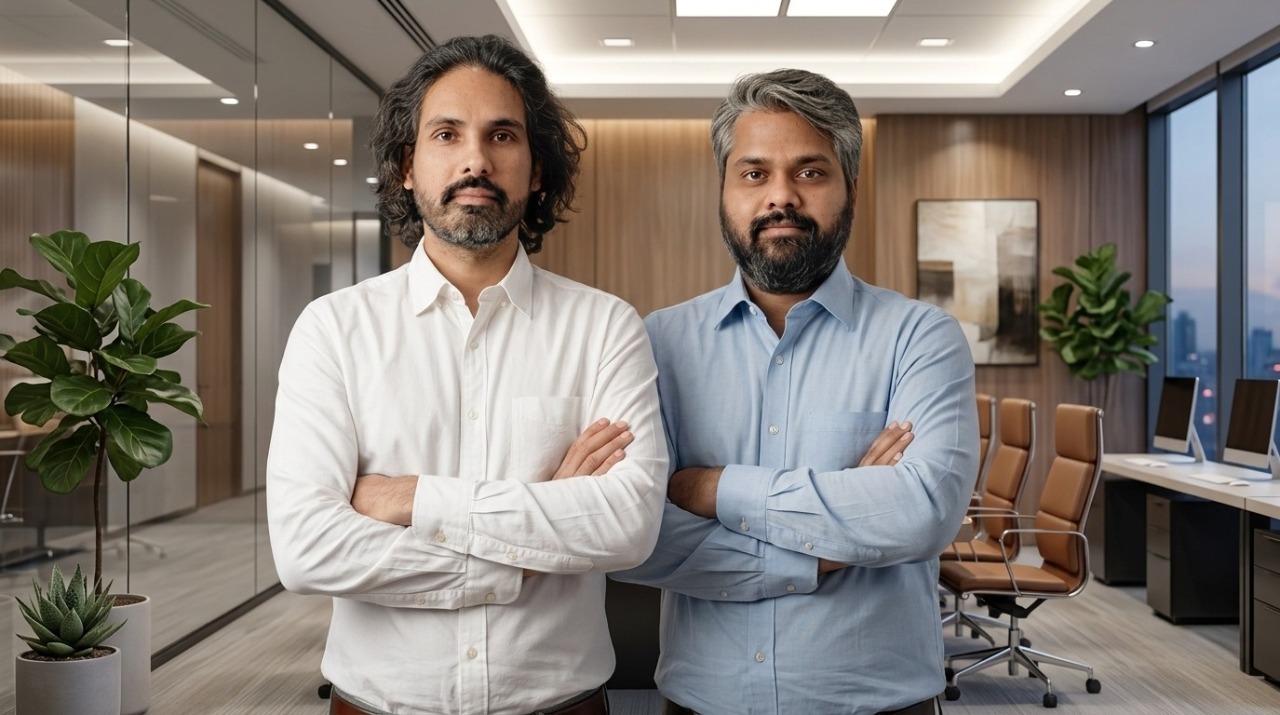
Being the only creative design studio in a room built for IP lawyers, government officials, and corporate heads of innovation is not a comfortable position. It is an instructive one. Here is what a full day at the World Innovation, Design and Intellectual Property Conference 2026 taught us.
Design protection is no longer a specialist conversation. It used to be that IP strategy was something a company’s legal department worried about after the design was done and handed over. Every session at this conference dismantled that model. India’s IP framework is being actively modernised. The Riyadh Design Law Treaty was adopted internationally in 2024. These are not distant policy shifts. They are the ground moving under every studio and every brand in India right now.
AI has created an ownership crisis that nobody has fully resolved. Session 3 made this unavoidable. When AI tools participate in generating visual assets, the question of who created what, and therefore who owns it, is genuinely unsettled across every major jurisdiction. Existing contracts, NDAs, and IP assignment clauses written before generative AI became routine are not adequate. Every design studio and every client engaging one needs to address this immediately.
Indian corporates are now treating design as a balance sheet asset. The IP heads of Tata Motors, Meril Life Sciences, Tata Steel, and Fenesta Building Systems did not speak the language of aesthetics in their sessions. They spoke the language of portfolios, enforcement, valuation, and commercialisation. Design, for the companies they represent, goes into an IP register and gets protected the way a patent does. Studios that cannot meet clients at that level will increasingly be left doing execution work while the strategic value is captured elsewhere.
Global brand building requires IP as infrastructure. The session on creating global brands made one thing unmistakable. An Indian company competing internationally cannot rely on product quality or distribution alone. Trade dress protection, design patents, and geographical indication registrations are the actual infrastructure of global brand equity. A brand that cannot be defended cannot scale. For every client we work with who has international ambitions, this changes how we approach the brief from the first conversation.
The policy window is open right now, and design must be in the room while it is. The presence of Prof Unnat Pandit as CGPDTM, and the live policy dialogue running across every session, signals that the frameworks governing how design gets created, protected, and commercialised in India are being written in the next two to three years. The institutions doing the writing are open to input. The design industry, which has historically been absent from these conversations, has a narrow window to change that. Beryl’s presence at this conference is one step toward keeping that window open.
THE ECOSYSTEM
The institutions in the room.
Government and Policy: MeitY, DPIIT and Make in India, NITI Aayog, DSIR, Ministry of Culture.
Global IP and Design Bodies: WIPO, EUIPO, UKIPO, JETRO, World Design Organization.
Corporate and Industry: Qualcomm, Tata Steel, Mahindra and Mahindra, TVS Motors, Dynamatics Technologies, Sami-Sabinsa Group.
Academic and Legal: Shiv Nadar University, Chitkara University, Srishti Manipal, SS Rana and Co., Singh and Singh.
Frequently Asked Questions
What is Beryl Agency's actual role here?
Beryl Agency is the Official Design Partner for the conference. We carry the creative vision and design identity of the event itself, not as a vendor but as a practitioner who represents the design industry at a table where design policy and IP strategy are being shaped at the highest institutional levels.
Why does an IP conference need a design partner?
Because design is where IP begins. A logo, a product form, a user interface, a packaging system, all of these are legally protectable assets before they are marketing tools. The conversation around creating and protecting them needs a design perspective at its centre. That is what Beryl brings to CII.
What does this mean for businesses looking to work with Beryl?
It means you are working with a studio operating at the intersection of brand strategy and intellectual value creation. We build brand systems that are worth protecting, and we understand the difference between a visual deliverable and an intellectual asset.
Who should care about the thinking from this conference?
Any brand that competes on design, any company building products with form and identity, any entrepreneur whose business depends on creative differentiation. The principles debated in these sessions are what separate brands that scale from brands that get copied.
Your brand deserves to be worth protecting.
Whether you are scaling a startup or repositioning an established enterprise, great design and smart IP strategy are the same investment.