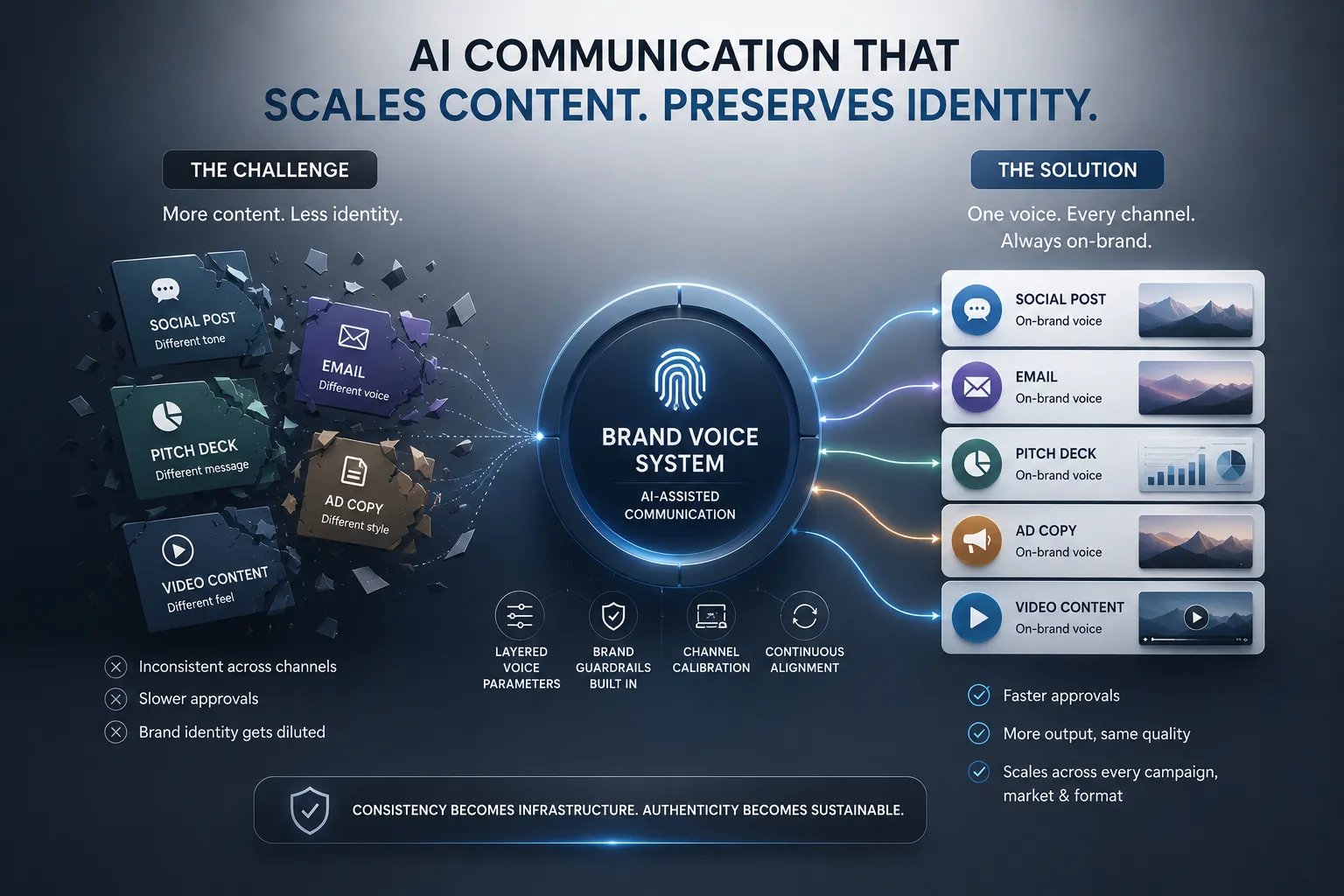
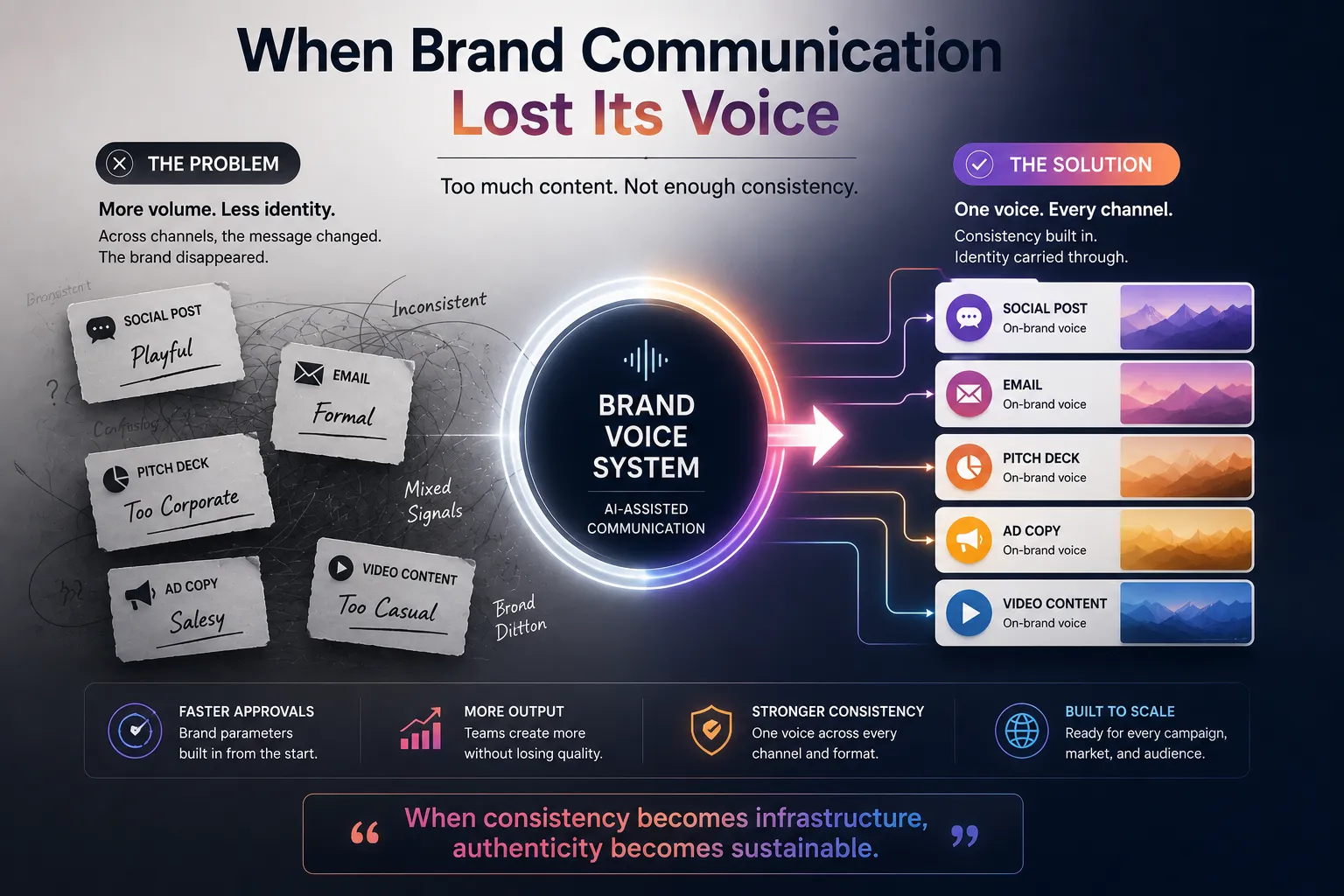

AI-Assisted Communication entered a space where every organisation was producing more content than ever, but most of it was losing its voice along the way. Social posts sounded different from emails. Emails sounded different from pitch decks. Pitch decks sounded nothing like the brand at all. The volume was increasing but the identity was thinning. Teams were working harder and sounding less like themselves. The problem was not a lack of effort. It was the absence of a system that carried the brand voice into every output, at every scale, across every channel.

After AI-assisted communication systems were introduced, the shift was immediate.
Content across channels sounded cohesive because the voice was built into the production process.
Leaders approved content faster because the brand parameters were embedded before the first word was written.
Creative teams produced more without losing quality because the system handled consistency while they handled craft.
And most importantly, the framework created a foundation that could scale across every campaign, market, and content format without the brand identity fracturing.

That is the power of systems that carry voice at scale.
When consistency becomes infrastructure, authenticity becomes sustainable.

Steaming chai latte in a CHAI RUSK mug on a wooden table with toasted bread and a branded backdrop.

The Context. When Brand Communication Lost Its Voice

Content production was accelerating, but most brand output felt disconnected.
Too generic.
Too inconsistent.
Too far from the original identity.
Too diluted across channels to feel like one brand.

The problem was not the team.
It was the absence of a voice system that scaled with production.
This module was created to give teams a communication framework they could trust and leaders would approve.

Steaming chai latte in a CHAI RUSK mug on a wooden table with toasted bread and a branded backdrop.

The Challenge. To Build a Voice System That Feels Universal

The brief was clear.
A framework that works for social media managers.
For copywriters.
For every person producing content under a brand name.

It needed to be structured but not mechanical.
Consistent but not repetitive.
Scalable but not soulless.

A system that does not work for one channel only.
A system that carries the brand across every touchpoint.

The Insight. Why Brand Voice Breaks Down at Scale

Our research revealed a familiar truth.
Brand voice fractures when production volume outpaces the systems designed to protect it.

Communication psychology showed

Teams want content they are proud to publish.
Leaders want a brand that sounds the same everywhere.
A communication system must deliver both.

without embedded voice parameters AI defaults to generic output

inconsistent tone across channels erodes audience trust over time

multiple team members producing content without shared frameworks creates identity drift

speed pressure forces teams to skip brand alignment in favour of deadline compliance

We approached AI-assisted communication like system design.

Our strategy revolved around three principles

– Purpose: create an AI-powered content system that preserves brand voice at scale

– Design: ensure voice parameters are embedded into every production workflow

– Tone: authentic, channel-aware, and strategically consistent

The goal was not to make all content sound identical.
It was to make all content sound unmistakably like the same brand.

The Strategy. Designing Consistency, Not Uniformity

The Framework. Where Voice Meets Volume

Even though this was a communication module, the structure of the voice system shaped the entire content operation.

Layered voice parameters.
Channel-specific tone calibration.
No content leaving the system without brand alignment built in.

The framework sits comfortably in brand teams, content studios, and enterprise marketing operations.
It behaves like a brand guardian, not a content factory.

Consistency became the design language.

Hand pouring hot coffee from a copper kettle into a CHAI RUSK mug, steam rising, in a warm cafe setting with wooden decor and gold logos.

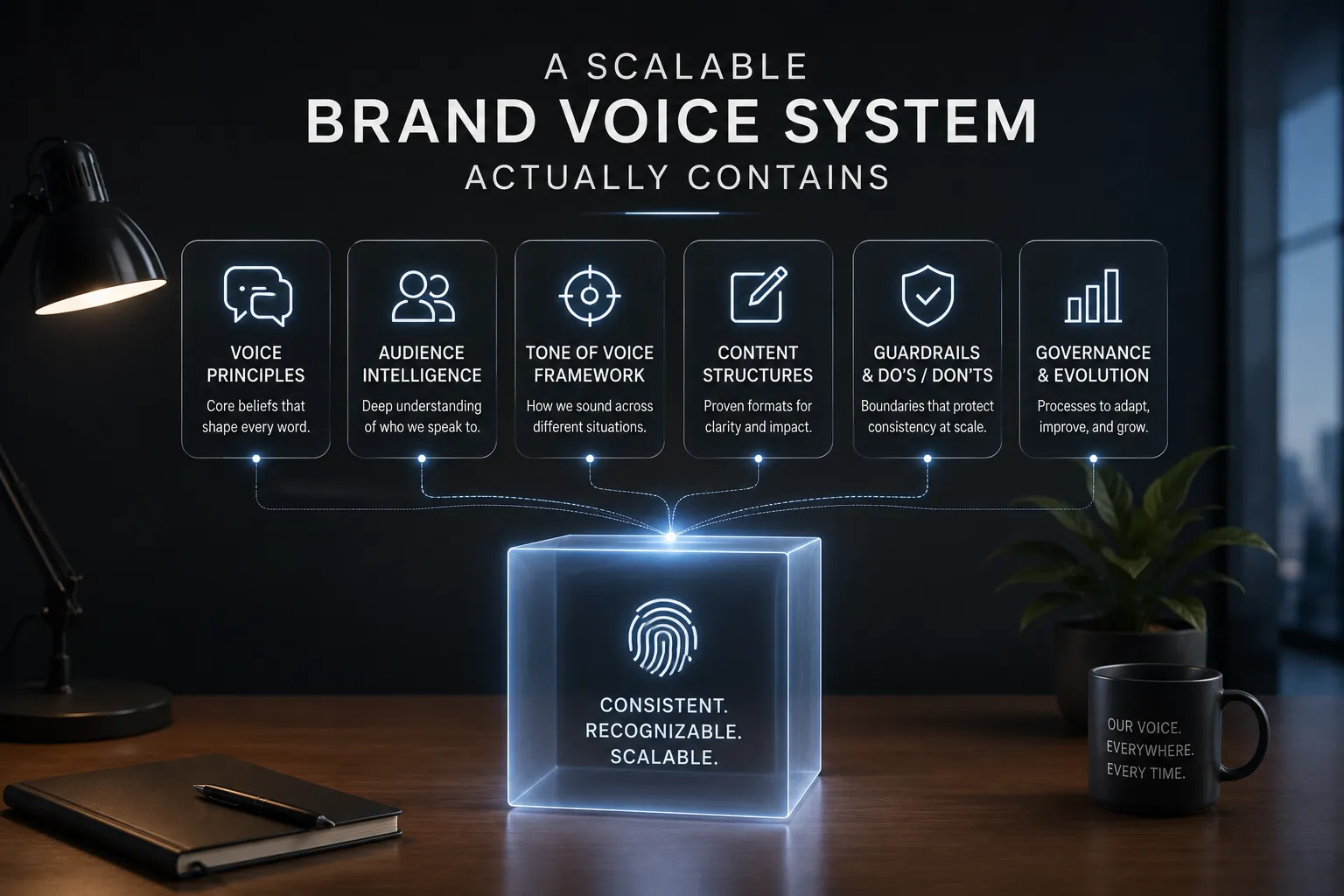
The Voice Architecture. What a Scalable Brand Voice System Actually Contains

In AI-assisted content production, voice architecture determines brand integrity.
Just as a design system governs visual identity, a voice system governs how a brand sounds across every output.

A high integrity brand voice system contains
a tone definition that describes the emotional register of the brand in precise language
a vocabulary guide listing words the brand uses and words it never uses
channel calibration rules adjusting tone for social, email, long form, and spoken content
an audience map defining how the brand shifts register for different readers without losing identity
approved sample content giving AI a reference point grounded in real brand output
a constraint layer defining what the brand must never sound like under any circumstance

These are not optional additions.
They are the difference between a brand that sounds alive and one that sounds assembled.

Sunlit cafe table with a glass of hot drink, two slices of rusk on a plate marked 'Chai Rusk', a notebook, pen, and glasses nearby; a newspaper on the side.

The communication system behind this module is built on five elements

Identity, the emotional and strategic core the brand voice always reflects

Calibration, the channel-specific adjustments that keep tone appropriate without losing character

Vocabulary, the specific words and structures that make the brand instantly recognisable
Constraint, the boundaries that protect the brand from sounding generic, off-tone, or misaligned

Feedback, the review loop that catches drift and continuously sharpens the voice system over time

These elements create a communication framework that belongs anywhere brand integrity is non-negotiable.

The Design Language. The Five Elements of Voice Consistency

content across every channel sounds cohesive without requiring individual review of every piece

production speed increases because writers are not rebuilding tone from scratch with every brief

new team members onboard faster because the voice system gives them a precise starting point

brand recognition strengthens because audiences encounter a consistent identity repeatedly
campaign scaling becomes possible without the identity dilution that volume usually brings

AI-assisted communication does not replace brand voice.
It is the system that carries brand voice further than any team could manually sustain.

The Benefits. When Voice Systems Create Real Advantage

When teams build AI-assisted communication on a voice architecture, the advantages become immediate.

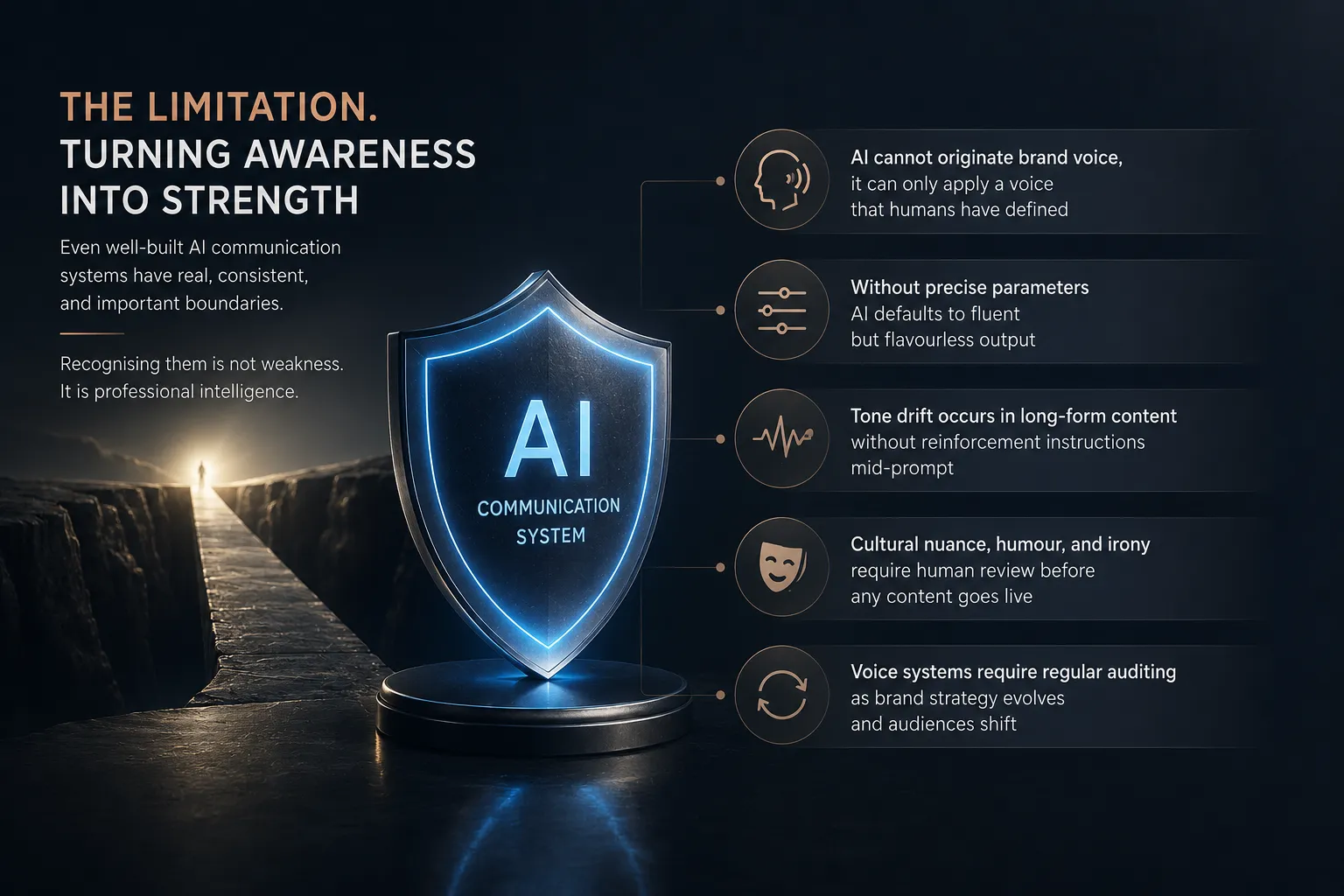
The Limitation. Turning Awareness Into Strength

Even well-built AI communication systems have real, consistent, and important boundaries.
Recognising them is not weakness.
It is professional intelligence.

– AI cannot originate brand voice, it can only apply a voice that humans have defined

– without precise parameters AI defaults to fluent but flavourless output

– tone drift occurs in long-form content without reinforcement instructions mid-prompt

– cultural nuance, humour, and irony require human review before any content goes live

– voice systems require regular auditing as brand strategy evolves and audiences shift

For Beryl, this became a benchmark in responsible brand scaling.
Proof that voice architecture, when built carefully, becomes a long term competitive asset.

Six friends at an outdoor cafe table, one playing guitar while others chat and share snacks, with a neon 'Chai Rusk' sign in the background.
Top-down view of a wooden table with chai drinks, cookies, notebooks, camera, headphones, laptop, and a sketchbook around a central card reading CHAI RUSK.

What This Means for the Future of Brand Communication

AI-assisted voice systems prove that scale and authenticity are not opposites.
They require each other.

The framework creates space for growth into multi-market content operations, multilingual brand expression, and high-volume campaign production without identity compromise.
A system built not for one brief, but for the way brand communication is permanently evolving.

Wall mural for 'Chai Rusk' brand featuring a glass of chai, poured teapot, and a plate of rusks with decorative leaves and quotes like 'Chai Makes Everything Better'.

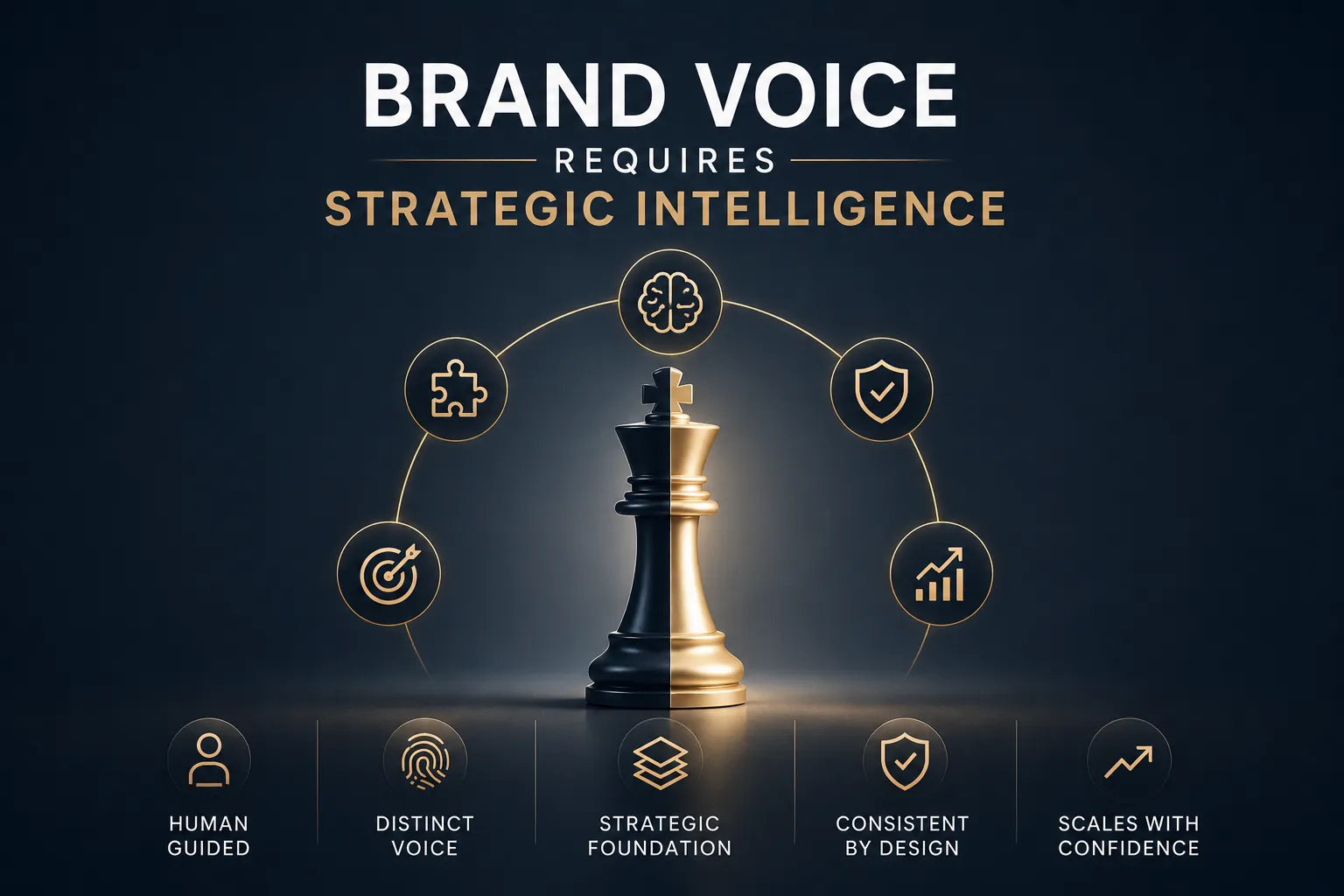
Our Perspective. Why Brand Voice Requires Strategic Intelligence

Building AI communication systems requires brand architecture thinking, not just copywriting skill.
It demands understanding how identity is constructed and how it survives contact with volume and speed.

Our approach allows every person in the room to leave with a voice system they can deploy before their next content brief arrives.

Cozy cafe interior with wooden tables, plants, and a wall mural that reads 'Chai Rusk' beside decorative sketches and quotes like 'good ideas start with chai'.

What This Module Cover

– brand voice architecture and the anatomy of a scalable voice system

– tone definition, vocabulary mapping, and channel calibration frameworks

– AI prompt design for brand-consistent content production

– voice drift identification and correction methods

– audit frameworks for maintaining brand alignment at volume

Each step ensures the system is practical, brand-protective, and immediately deployable across real content workflows.

The Beryl Edge

With fifteen plus years in branding, Beryl understands how to merge psychology, culture, and strategy.

Our approach to AI-assisted communication combines brand identity expertise, content system design, and long term voice sustainability thinking.

That is why the result is a framework that actually keeps brands sounding like themselves.
A module that feels like it belongs inside a professional brand operation.

What We Learned

Teams do not want more content.
They want content that sounds like it came from the same place every time.

This module reminded us that brand voice at scale is not a writing problem.
It is a systems problem solved with architecture and intention.

FAQs

Why does AI produce generic content without a voice system

Because AI defaults to the most statistically common language patterns unless given precise brand parameters to work within.

More than one hundred and sixty brand voice systems across eleven industries and nine content categories.

Its architecture logic applies across every AI tool and every content format regardless of how the production landscape evolves.

Because audiences build trust through repetition and that trust fractures the moment the brand sounds like it forgot who it was.

Voice definition establishes the brand’s core identity. Tone calibration adjusts how that identity is expressed across different channels, audiences, and content formats without ever losing the underlying character.

Understanding AI: Capabilities, Benefits, and Limitations

Enterprise Prompt Engineering and Reliable Output Systems

Fact-Checking, Validation, and Governance Frameworks

Related Sessions

Let’s Build Something That Feels Human

berylagency
berylagency
berylagency