


Long-Term Capability Development and Scalable Implementation entered a space where every organisation was making short-term AI decisions that were creating long-term structural problems. Tools were being adopted team by team without a shared architecture. Skills were being built individually without an organisational system to retain or distribute them. Pilots were succeeding in isolation and failing at scale. The ambition was genuine but the infrastructure was missing. Organisations were investing in AI capability and losing it every time a team changed, a tool updated, or a project ended. The problem was not commitment. It was the absence of a capability framework that grew with the organisation rather than depending on the individuals who happened to be paying attention at any given moment.

After structured long-term capability frameworks were introduced, the shift was immediate.
Organisations scaled AI adoption consistently because the capability system was embedded in process rather than stored in people.
Leaders made better investment decisions because the framework distinguished between tools that solved today’s problem and systems that built tomorrow’s advantage.
Teams across functions adopted AI more effectively because the knowledge architecture gave everyone a shared starting point rather than requiring each team to begin from zero.
And most importantly, the framework created a foundation that could scale across every location, function, and organisational level without capability degrading under the pressure of growth, turnover, or technological change.

That is the power of capability that lives in the organisation rather than in individuals.
When learning becomes infrastructure, scaling becomes natural.

Steaming chai latte in a CHAI RUSK mug on a wooden table with toasted bread and a branded backdrop.

The Context. When AI Investment Produced Short-Term Gains and Long-Term Fragility

AI capability building was accelerating, but most organisational investments were not holding.
Too individual.
Too project-dependent.
Too focused on immediate output rather than sustained organisational capacity.
Too disconnected from the structural systems needed to make capability last beyond the next team change.

The problem was not the investment.
It was the absence of a capability architecture that embedded learning into the organisation itself rather than into the people who happened to be available.
This module was created to give organisations a long-term development framework they could trust and leaders would fund.

Steaming chai latte in a CHAI RUSK mug on a wooden table with toasted bread and a branded backdrop.

The Challenge. To Build a Capability System That Feels Universal

The brief was clear.
A framework that works for senior leadership teams.
For operational managers.
For every person responsible for how AI capability grows and holds across an entire organisation over time.

It needed to be ambitious but not unrealistic.
Structured but not inflexible.
Scalable but not impersonal.

A system that does not work for one team or one moment only.
A system that compounds capability across every function and every level of the organisation.

The Insight. Why AI Capability Fails to Scale in Most Organisations

Our research revealed a familiar truth.
AI capability fails to scale when it is built around individuals rather than embedded into organisational systems and processes.

Capability psychology showed

Organisations want AI capability that compounds over time.
Leaders want investments that produce sustained advantage rather than temporary performance lifts.
A long-term framework must deliver both.

skills held by individuals leave when those individuals do

pilot successes that are not systematised cannot be replicated across functions

tool adoption without knowledge infrastructure produces islands of competence rather than organisational capability

absence of shared frameworks means every team rebuilds from zero rather than building from what already works

We approached long-term AI development like system design.

Our strategy revolved around three principles

– Purpose: create a structured capability framework that builds organisational AI competence rather than individual tool familiarity

– Design: ensure learning architecture is embedded into processes, roles, and governance rather than stored in training events and individual memory

– Tone: strategically ambitious, operationally grounded, and built for organisations that intend to lead rather than follow

The goal was not to make every person an AI expert.
It was to make the organisation collectively more capable with every passing month rather than starting over every time circumstances changed.

The Strategy. Designing Capability, Not Dependency

The Framework. Where Learning Meets Organisational Architecture

Even though this was a capability development module, the structure of the learning framework shaped the entire long-term implementation strategy.

Layered competency tiers.
Role-specific capability pathways.
No knowledge investment made without a system to retain, distribute, and build on what was learned.

The framework sits comfortably in enterprise organisations, multi-location operations, and professional service environments where sustained competitive advantage depends on how well capability is built and held over time.
It behaves like an organisational learning system, not a training calendar.

Compounding became the design language.

Hand pouring hot coffee from a copper kettle into a CHAI RUSK mug, steam rising, in a warm cafe setting with wooden decor and gold logos.

The Capability Architecture. What a Scalable AI Development System Actually Contains

In long-term AI implementation, capability architecture determines whether investment compounds or evaporates.
Just as financial infrastructure determines whether capital grows or dissipates, knowledge infrastructure determines whether AI capability accumulates or resets with every personnel and technology change.

A high integrity long-term capability system contains
a competency map defining the AI skills and knowledge the organisation needs at every level and function
a tiered development pathway building capability progressively from foundational literacy to advanced strategic application
a knowledge retention system ensuring that learning is documented, accessible, and organisationally owned rather than individually held
a governance integration layer embedding AI capability standards into hiring, performance, and operational review processes
a cross-functional distribution framework ensuring capability spreads horizontally across teams rather than concentrating in specialist pockets
a measurement architecture tracking capability growth over time and connecting it to operational and business outcomes

These are not optional additions.
They are the difference between AI capability that becomes a permanent organisational advantage and capability that disappears the moment conditions change.

Sunlit cafe table with a glass of hot drink, two slices of rusk on a plate marked 'Chai Rusk', a notebook, pen, and glasses nearby; a newspaper on the side.

The development system behind this module is built on five elements

Competency, defining precisely what AI capability means at every organisational level and function
Retention, building systems that hold knowledge inside the organisation rather than inside individuals
Distribution, spreading capability horizontally across teams rather than allowing it to concentrate in isolated pockets
Governance, embedding AI capability standards into the organisational processes that shape behaviour over time
Measurement, tracking capability growth and connecting it visibly to the operational outcomes leadership cares about

These elements create a development framework that belongs anywhere organisations intend to build AI advantage that lasts beyond the current moment.

The Design Language. The Five Elements of Scalable Capability

capability holds through team changes because knowledge lives in systems rather than in individuals

scaling across locations and functions becomes possible because the framework gives every team a shared starting point

investment returns improve because learning compounds rather than resetting with every new project or personnel shift

competitive advantage deepens over time because the organisation gets collectively smarter rather than repeatedly starting over

leadership confidence grows because capability growth is measurable rather than assumed


Long-term capability development does not replace individual talent.
It creates the organisational conditions under which individual talent compounds into structural advantage.

The Benefits. When Capability Systems Create Real Organisational Advantage

When organisations build AI development on a long-term capability architecture, the advantages become immediate and compound over time.

The Limitation. Turning Awareness Into Strength

Even well-designed long-term capability frameworks have real, consistent, and important boundaries.
Recognising them is not weakness.
It is organisational intelligence.

– capability frameworks require sustained leadership commitment that cannot be delegated to a single team or function

– technology change means competency maps must be reviewed regularly or they guide teams toward obsolete skills

– distribution of capability across functions requires cultural change that moves slower than structural change

– measurement of capability growth is genuinely difficult and proxy metrics can mislead as easily as they inform

– long-term frameworks produce long-term returns and organisations with short planning horizons will underinvest before results are visible

For Beryl, this became a benchmark in responsible organisational transformation at scale.
Proof that capability architecture, when built carefully, becomes the most durable competitive advantage an organisation can develop in an AI-shaped landscape.

Six friends at an outdoor cafe table, one playing guitar while others chat and share snacks, with a neon 'Chai Rusk' sign in the background.
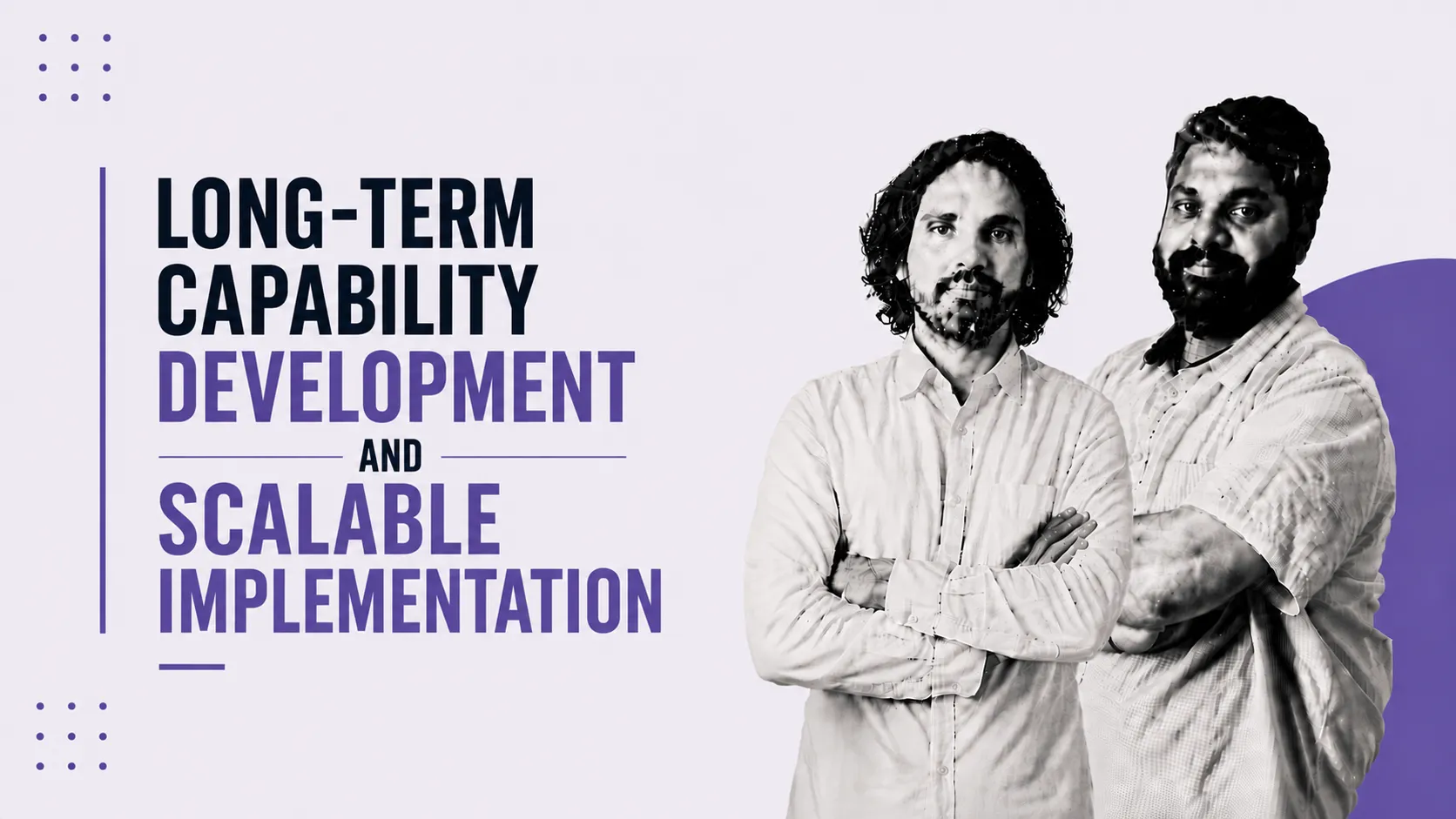
Banner with two men standing on the right and bold uppercase title on the left: 'LONG-TERM CAPABILITY DEVELOPMENT AND SCALABLE IMPLEMENTATION'.

What This Means for the Future of Enterprise AI

Long-term capability development proves that AI advantage is not determined by which tools an organisation adopts.
It is determined by how deeply and how durably the organisation learns to use them.

The framework creates space for growth into global operations, multi-function AI integration, and sustained competitive positioning in industries where AI capability will increasingly separate organisations that lead from those that follow.
A system built not for one financial year, but for the way seriously ambitious organisations are permanently defining their future.

Wall mural for 'Chai Rusk' brand featuring a glass of chai, poured teapot, and a plate of rusks with decorative leaves and quotes like 'Chai Makes Everything Better'.

Our Perspective. Why Long-Term Development Requires Strategic Intelligence

Building AI capability frameworks requires organisational strategy thinking, not just learning and development expertise.
It demands understanding how organisations grow, where knowledge concentrates and why it leaves, and what structures are needed to make capability an asset rather than a dependency.

Our approach allows every leader in the room to leave with a capability architecture they can begin mapping against their organisation’s current reality before the next planning cycle begins.

Cozy cafe interior with wooden tables, plants, and a wall mural that reads 'Chai Rusk' beside decorative sketches and quotes like 'good ideas start with chai'.

What This Module Cover

– competency mapping and tiered capability pathway design for AI development at scale

– knowledge retention system architecture for organisational rather than individual learning

– cross-functional distribution frameworks for spreading AI capability beyond specialist teams

– governance integration strategies for embedding AI capability into organisational processes

– measurement frameworks for tracking capability growth and connecting it to business outcomes over time

Each step ensures the framework is strategically grounded, operationally deployable, and built to produce returns that compound rather than peak and plateau.

The Beryl Edge

With fifteen plus years in branding, Beryl understands how to merge psychology, culture, and strategy.

Our approach to long-term capability development combines organisational design expertise, AI implementation experience, and sustained competitive advantage thinking.

That is why the result is a framework that actually changes how organisations grow.
A module that feels like it belongs inside a seriously ambitious enterprise strategy.

What We Learned

Organisations do not need more AI training events.
They need AI capability systems that hold, distribute, and compound what every training event produces.

This module reminded us that long-term advantage is not built in workshops.
It is built in the organisational architecture that captures what workshops produce and turns it into something the whole organisation owns permanently.

FAQs

Why does AI capability so often fail to scale beyond the teams that first develop it

Because capability built around individuals and projects has no structural mechanism to transfer, retain, or distribute itself when those individuals move or those projects end.

More than two hundred and fifty enterprise AI development cases across twelve industries and nineteen functional capability categories spanning learning architecture, governance integration, and measurement design.

Its architectural logic is built around how organisations learn and retain knowledge rather than around specific tools, meaning it remains valid as AI capabilities evolve and tool landscapes change.

Because tool adoption produces temporary performance and capability development produces compounding advantage, and in markets where AI is reshaping competition the difference between the two becomes decisive over time.

A training programme transfers knowledge to individuals. A knowledge retention system captures what individuals learn and embeds it into organisational processes, documentation, and governance so the organisation holds the knowledge permanently regardless of who stays or leaves.

Workflow Integration and Operational Efficiency

Ethical AI Implementation and Responsible Adoption

Enterprise Prompt Engineering and Reliable Output Systems

Related Sessions

Let’s Build Something That Feels Human

berylagency
berylagency
berylagency