
Fact-Checking, Validation, and Governance entered a space where every organisation was deploying AI outputs, but most teams had no system to verify what the technology was producing. Errors were being published. Fabricated facts were reaching clients. Hallucinated data was entering boardroom presentations. The problem was not that AI made mistakes. Every tool does. The problem was that no one had built a process to catch them. Teams needed a governance framework that made AI output accountable, verifiable, and safe to publish.

After structured validation was introduced, the shift was immediate.
Teams caught errors before they reached clients because the review process was systematic.
Leaders approved AI-assisted work more confidently because accountability was built into the workflow.
Creative and strategy teams moved faster because validation removed the fear of publishing something wrong.
And most importantly, the framework created a foundation that could scale across every department, deliverable, and deadline.

That is the power of oversight that protects intelligence.
When validation becomes a system, trust becomes natural.

Steaming chai latte in a CHAI RUSK mug on a wooden table with toasted bread and a branded backdrop.

The Context. When AI Outputs Spoke Without Accountability

AI adoption was accelerating, but most outputs were going live without review.
Too fast.
Too confident.
Too unverified.
Too close to becoming a public mistake.

The problem was not the AI.
It was the absence of a human system around it.
This module was created to give teams a governance framework they could trust and leaders would approve.

Steaming chai latte in a CHAI RUSK mug on a wooden table with toasted bread and a branded backdrop.

The Challenge. To Build a Validation System That Feels Universal

The brief was clear.
A framework that works for content teams.
For strategists.
For every person responsible for what goes public under a brand name.

It needed to be thorough but not slow.
Structured but not bureaucratic.
Protective but not paralyzing.

A system that does not exist for one project only.
A system that scales across the entire organisation.

The Insight. Why AI Outputs Fail Accountability Standards

Our research revealed a familiar truth.
AI produces plausible output even when the underlying content is factually incorrect.

Governance psychology showed

Teams want outputs they can stand behind.
Leaders want processes that protect the organisation.
A governance framework must deliver both.

confident language masks factual error

speed of output creates pressure to skip review

no verification layer means errors compound across deliverables

absence of ownership means no one is accountable when something goes wrong

We approached validation like system design.

Our strategy revolved around three principles

– Purpose: create a structured human oversight framework for AI-assisted work

– Design: ensure review processes are layered, role-specific, and practically deployable

– Tone: precise, responsible, and professionally grounded

The goal was not to slow AI adoption down.
It was to make AI adoption safe enough to scale.

The Strategy. Designing Accountability, Not Anxiety

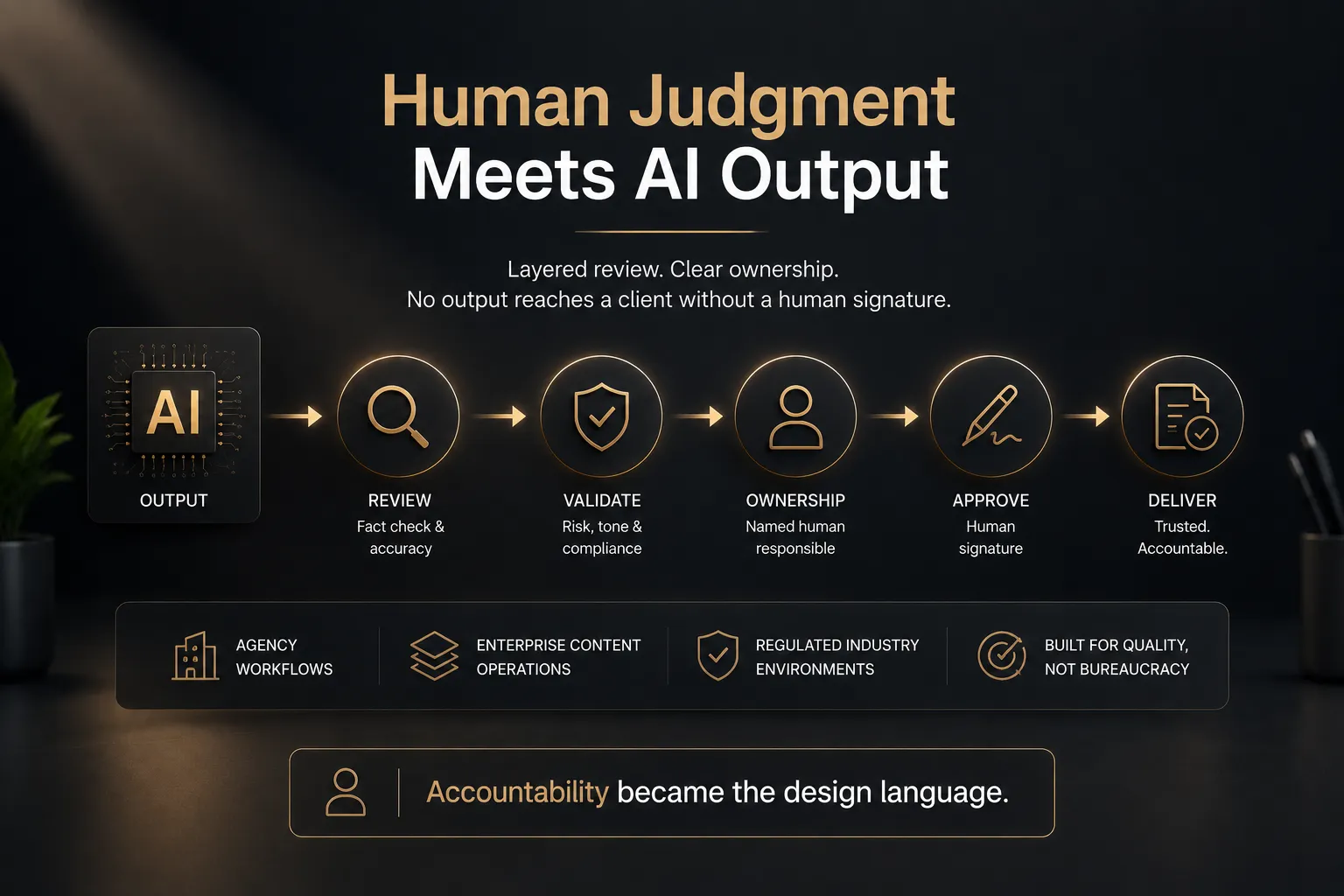
The Framework. Where Human Judgment Meets AI Output

Even though this was a governance module, the structure of oversight shaped the entire production system.

Layered review stages.
Clear ownership at every checkpoint.
No output reaching a client without a human signature.

The framework sits comfortably in agency workflows, enterprise content operations, and regulated industry environments.
It behaves like a quality assurance system, not a bureaucratic obstacle.

Accountability became the design language.

Hand pouring hot coffee from a copper kettle into a CHAI RUSK mug, steam rising, in a warm cafe setting with wooden decor and gold logos.

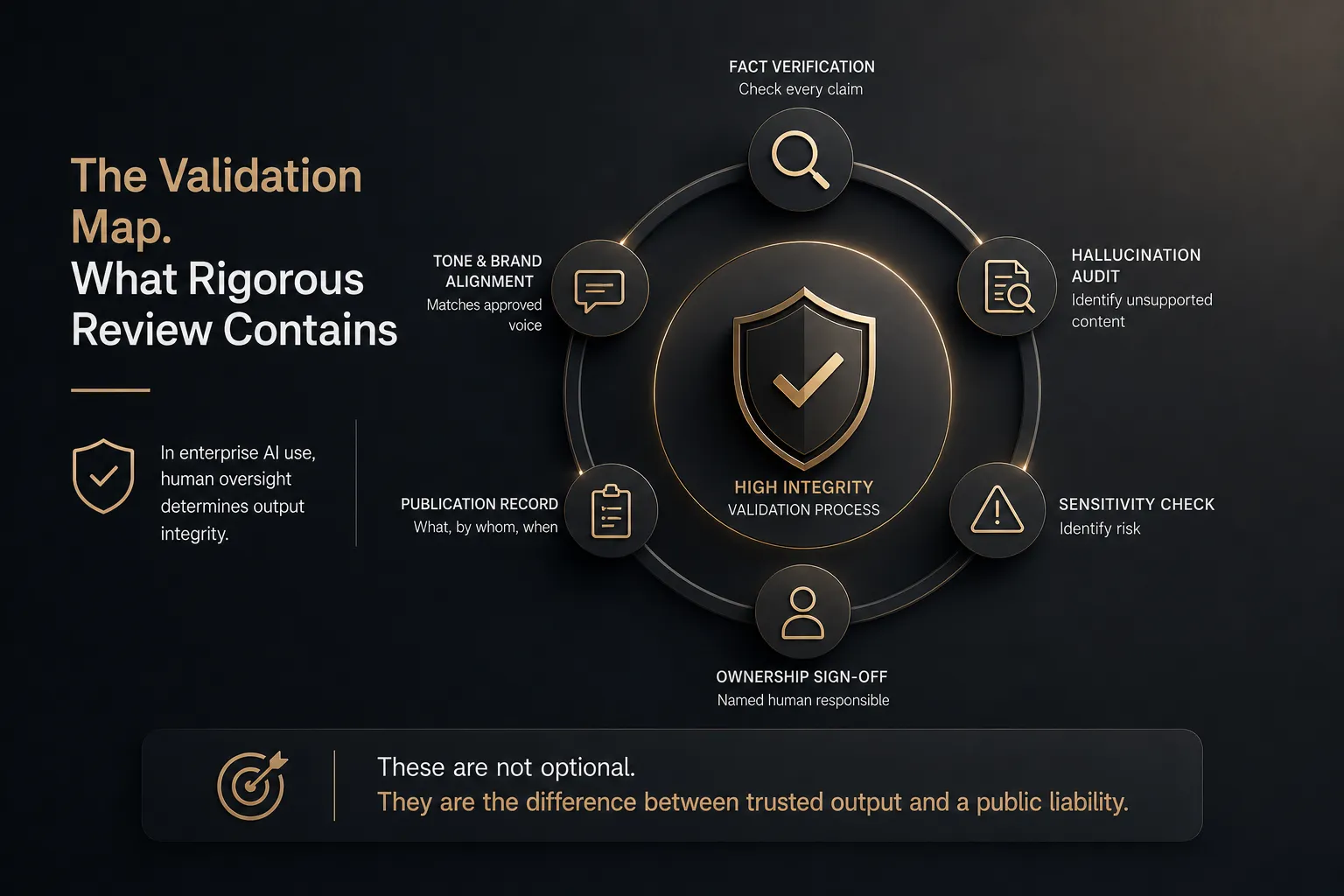
The Validation Map. What Rigorous Review Actually Contains

In enterprise AI use, human oversight determines output integrity.
Just as legal review protects contracts, structured validation protects AI-assisted content.

A high integrity validation process contains

a fact verification layer checking every specific claim against a credible source

a hallucination audit identifying content AI generated without factual basis

a tone and brand alignment review ensuring output matches approved voice

a sensitivity check identifying cultural, legal, or reputational risk

an ownership sign-off assigning a named human responsible for the final output

a publication record documenting what was reviewed, by whom, and when

These are not optional additions.
They are the difference between trusted output and a public liability.

Sunlit cafe table with a glass of hot drink, two slices of rusk on a plate marked 'Chai Rusk', a notebook, pen, and glasses nearby; a newspaper on the side.

The oversight system behind this module is built on five elements

Verification, confirming every factual claim against a reliable source
Ownership, assigning a named human to every piece of AI-assisted output
Auditability, maintaining a record of what was reviewed and approved
Sensitivity, identifying risk before output reaches a public or client audience
Iteration, building feedback loops that improve both prompts and review processes over time

These elements create a governance framework that belongs anywhere professional accountability is expected.

The Design Language. The Five Elements of Governance

errors are caught before they reach clients, journalists, or public audiences

trust in AI-assisted work increases because the review process is visible and consistent

legal and reputational risk reduces significantly across regulated content categories

team confidence grows because there is a safety net beneath every output

brand integrity holds even as content volume scales with AI assistance

Governance does not slow creative work down.
It removes the risk that makes leaders reluctant to scale it up.

The Benefits. When Validation Creates Real Advantage

When teams govern AI output with structure, the advantages become immediate.

The Limitation. Turning Awareness Into Strength

Even structured governance frameworks have real, consistent, and important boundaries.
Recognising them is not weakness.
It is professional intelligence.

– no framework eliminates all error if reviewers are under time pressure

– hallucinations in long-form content are harder to detect than factual claims

– governance adds process overhead that must be budgeted for honestly

– frameworks require ongoing updates as AI tools and outputs evolve

– human reviewers carry their own biases which governance must also account for

For Beryl, this became a benchmark in responsible AI integration.
Proof that validation awareness, when built carefully, becomes an organisational strength.

Six friends at an outdoor cafe table, one playing guitar while others chat and share snacks, with a neon 'Chai Rusk' sign in the background.
Banner featuring two men with arms crossed on the right, text reads 'FACT-CHECKING, VALIDATION, AND GOVERNANCE FRAMEWORKS' on the left, green accents.

What This Means for the Future of AI-Assisted Work

Fact-checking and governance prove that AI adoption is not a technology decision.
It is an organisational maturity decision.

The framework creates space for growth into regulated industries, high-stakes content environments, and large-scale brand publishing operations.
A system built not for one deliverable, but for the way accountable organisations are evolving.

Wall mural for 'Chai Rusk' brand featuring a glass of chai, poured teapot, and a plate of rusks with decorative leaves and quotes like 'Chai Makes Everything Better'.

Our Perspective. Why Governance Requires Organisational Intelligence

Teaching validation requires process design, not just caution.
It demands understanding how organisations approve work and how errors create consequences.

Our approach allows every person in the room to leave with a governance system they can implement before their next AI-assisted project goes live.

Cozy cafe interior with wooden tables, plants, and a wall mural that reads 'Chai Rusk' beside decorative sketches and quotes like 'good ideas start with chai'.

What This Module Cover

– hallucination identification and fact verification methods

– validation layer design for different content types and risk levels

– ownership and sign-off frameworks for AI-assisted workflows

– audit trail creation and documentation standards

– governance scaling strategies for growing content operations

Each step ensures the framework is practical, protective, and immediately deployable.

The Beryl Edge

With fifteen plus years in branding, Beryl understands how to merge psychology, culture, and strategy.

Our approach to governance combines operational rigour, brand protection instinct, and long term trust-building vision.

That is why the result is a framework that actually changes how organisations publish.
A module that feels like it belongs inside a professional accountability system.

What We Learned

Teams do not want to publish mistakes.
They want a system that makes mistakes visible before it is too late.

This module reminded us that AI governance is not about distrust.
It is about building the conditions under which trust can grow responsibly.

FAQs

Why does AI produce content that sounds true but is not

Because AI predicts plausible language based on patterns, not because it understands or verifies facts.

More than one hundred and eighty documented AI output errors across seven content categories and five industries.

Its structural logic applies regardless of which AI tools a team is using or how those tools evolve.

Because a single published error can damage brand credibility far more than slow output ever would.

A systematic review of every specific claim, statistic, name, and reference in an AI output checked against a primary or credible secondary source.

Understanding AI: Capabilities, Benefits, and Limitations

Enterprise Prompt Engineering and Reliable Output Systems

Brand Voice Systems

Related Sessions

Let’s Build Something That Feels Human

berylagency
berylagency
berylagency