
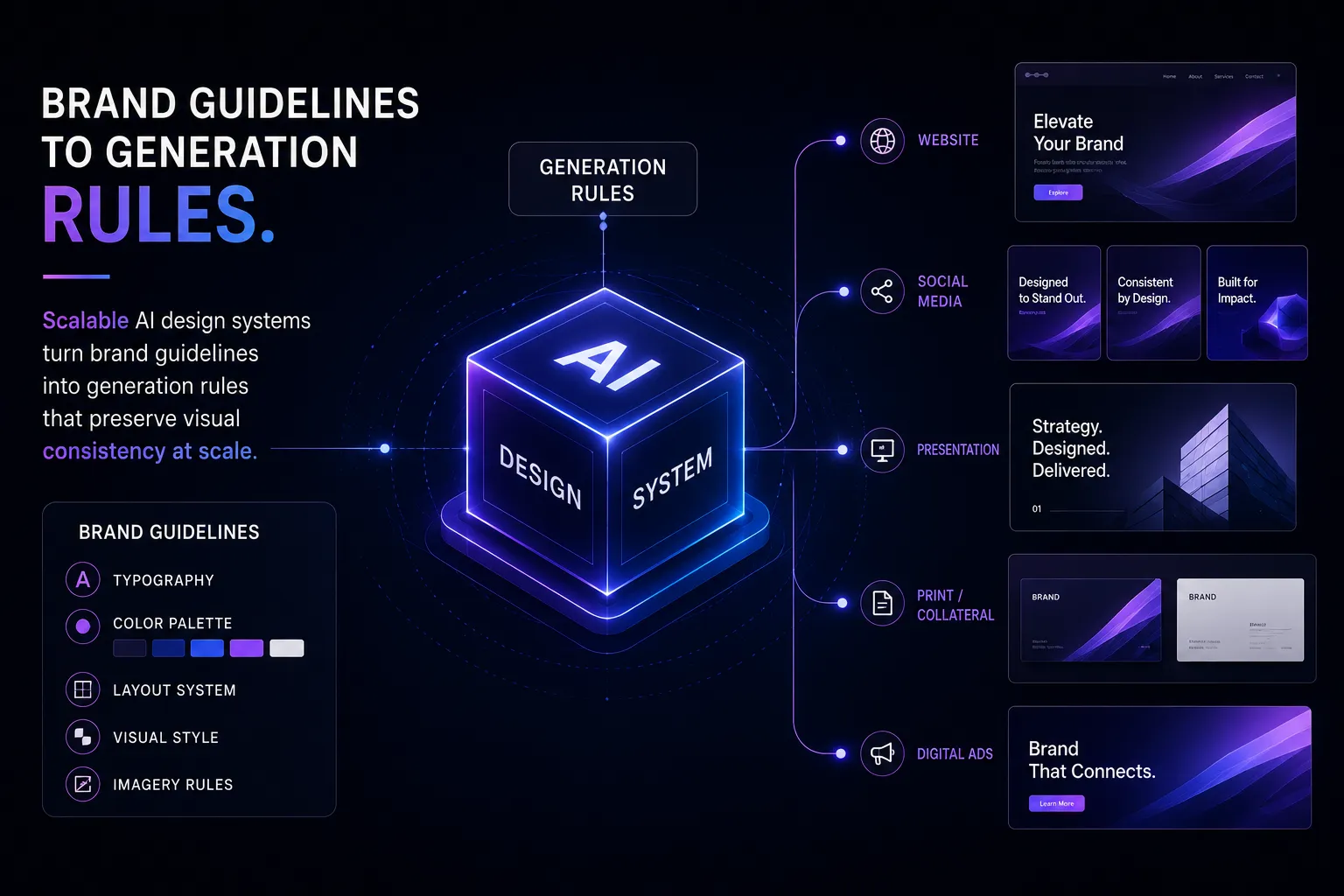
Visual Consistency in AI-Generated Assets entered a space where every design team was experimenting with AI image and visual tools, but most outputs were fragmenting brand identity rather than reinforcing it. Colours were drifting. Typography was inconsistent. Visual style was changing from asset to asset depending on who wrote the prompt and which tool they used that morning. The volume of visual output was increasing but the coherence was collapsing. Teams were producing faster and looking less like themselves. The problem was not a lack of talent. It was the absence of a visual system that travelled with every AI-generated asset from brief to final file.
After AI visual consistency frameworks were introduced, the shift was immediate.
Assets across campaigns looked cohesive because the visual parameters were built into every generation prompt.
Creative directors approved work faster because the brand standards were embedded before the first image was produced.
Design teams delivered more without sacrificing quality because the system handled consistency while they handled creative judgment.
And most importantly, the framework created a foundation that could scale across every campaign, format, and market without the visual identity fragmenting under production pressure.
That is the power of systems that carry vision at scale.
When visual consistency becomes infrastructure, creative integrity becomes sustainable.
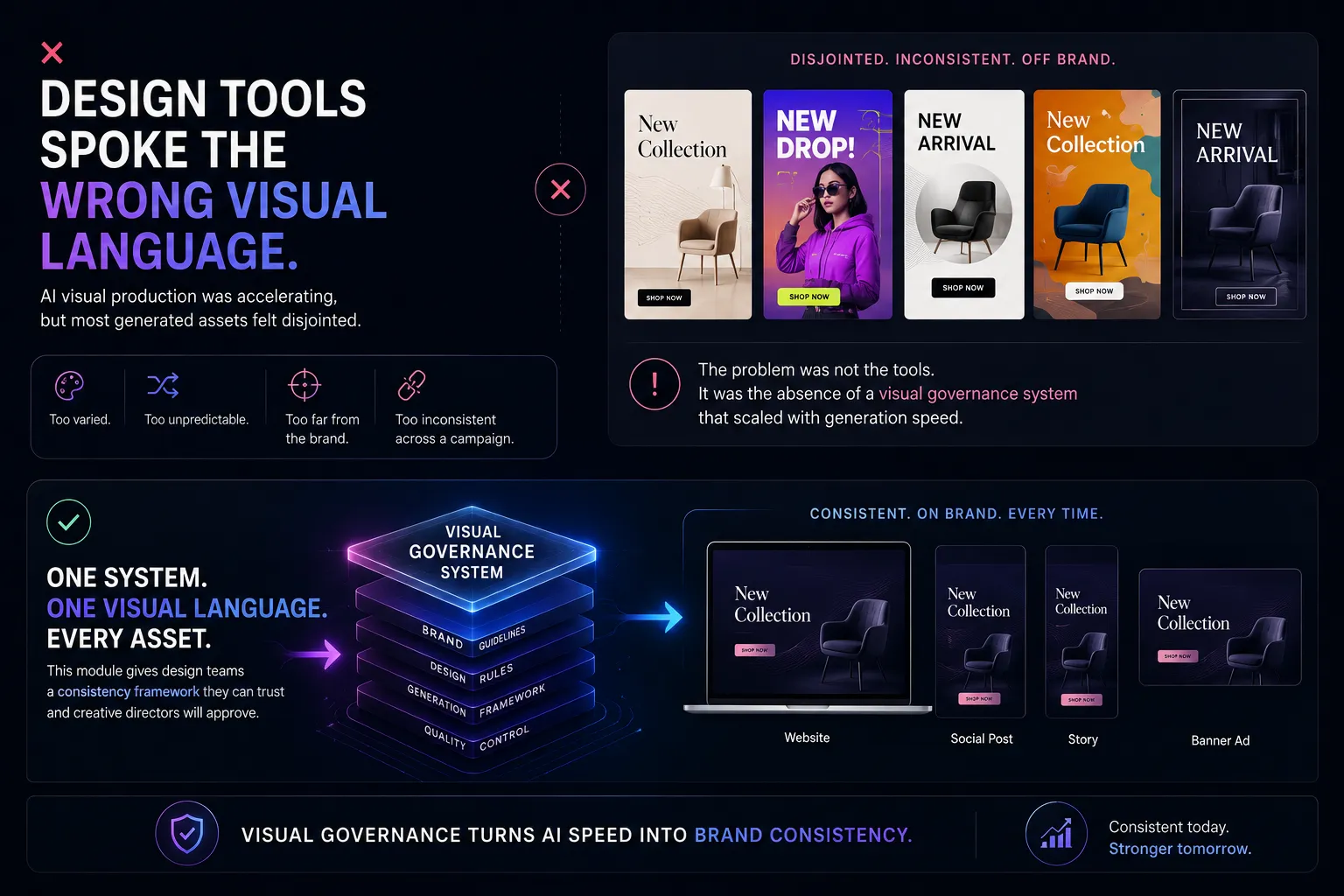
AI visual production was accelerating, but most generated assets felt disjointed.
Too varied.
Too unpredictable.
Too far from the brand reference.
Too inconsistent across a single campaign to feel like one visual identity.
The problem was not the tools.
It was the absence of a visual governance system that scaled with generation speed.
This module was created to give design teams a consistency framework they could trust and creative directors would approve.
The brief was clear.
A framework that works for graphic designers.
For art directors.
For every person generating visual assets under a brand identity.
It needed to be structured but not limiting.
Consistent but not repetitive.
Scalable but not sterile.
A system that does not work for one asset only.
A system that carries the visual identity across every format and channel.
Our research revealed a familiar truth.
Visual identity fractures when generation speed outpaces the systems designed to protect it.
Design psychology showed
Teams want assets they are proud to present.
Creative directors want a brand that looks the same everywhere.
A visual consistency system must deliver both.
without embedded visual parameters AI defaults to aesthetically average output
inconsistent visual style across assets erodes brand recognition over time
multiple team members generating without shared visual frameworks creates identity drift
prompt variation between individuals produces style variation that no brand system can absorb
We approached AI visual consistency like system design.
Our strategy revolved around three principles
– Purpose: create an AI visual framework that preserves brand identity across every generated asset
– Design: ensure visual parameters are embedded into every generation workflow and prompt structure
– Tone: precise, brand-protective, and practically deployable within real design production environments
The goal was not to make all assets look identical.
It was to make all assets look unmistakably like the same brand.
Even though this was a design systems module, the structure of the visual governance framework shaped the entire asset production operation.
Layered visual parameters.
Style-specific prompt architecture.
No asset leaving the system without brand alignment verified at generation stage.
The framework sits comfortably in brand design studios, in-house creative teams, and enterprise marketing production environments.
It behaves like a visual brand guardian, not an image generation pipeline.
Coherence became the design language.
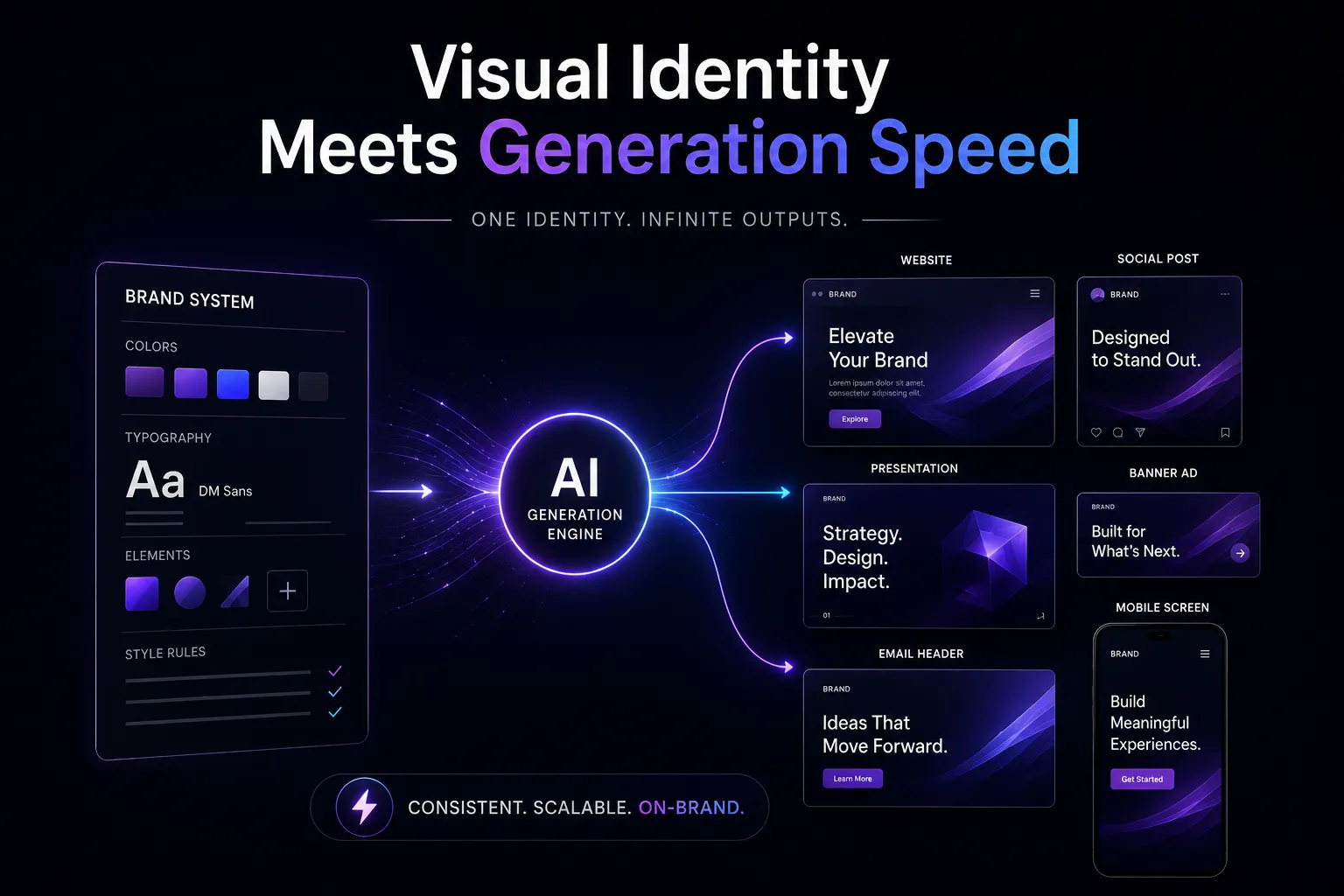
In AI-assisted visual production, generation parameters determine brand integrity.
Just as a brand style guide governs manual design decisions, a visual prompt system governs how AI produces assets that belong to the same identity.
A high integrity AI visual system contains
a style reference library giving AI anchored visual examples from approved brand output
a colour parameter set defining exact palette values that must appear in every generated asset
a typography instruction layer specifying font behaviour, weight, and hierarchy for text-bearing visuals
a composition guideline defining layout principles, negative space rules, and focal point behaviour
a subject and treatment constraint describing what the brand visually depicts and what it never shows
a generation review checklist ensuring every output is assessed against brand standards before approval
These are not optional additions.
They are the difference between a visual identity that holds and one that dissolves under production pressure.
The visual governance system behind this module is built on five elements
Reference, approved visual anchors that orient every AI generation toward brand identity
Parameters, precise colour, typography, and composition instructions embedded in every prompt
Constraint, the boundaries that prevent AI from producing visuals that look off-brand or generically aesthetic
Review, the human checkpoint that catches drift before assets reach presentation or publication
Iteration, the feedback loop that sharpens both prompt quality and visual output over successive generations
These elements create a visual system that belongs anywhere brand integrity and production speed are both non-negotiable.

assets across every format and channel look cohesive without requiring individual art direction of every piece

revision cycles reduce because visual parameters catch misalignment at generation stage not review stage

junior designers produce brand-ready work faster because the system provides precise visual guardrails

campaign scaling becomes possible without the aesthetic fragmentation that volume usually produces
creative directors spend time on craft decisions rather than correcting brand standard violations
AI visual generation does not replace design judgment.
It is the system that carries design judgment further than any team could manually sustain at volume.
When design teams build AI generation on a visual consistency architecture, the advantages become immediate.
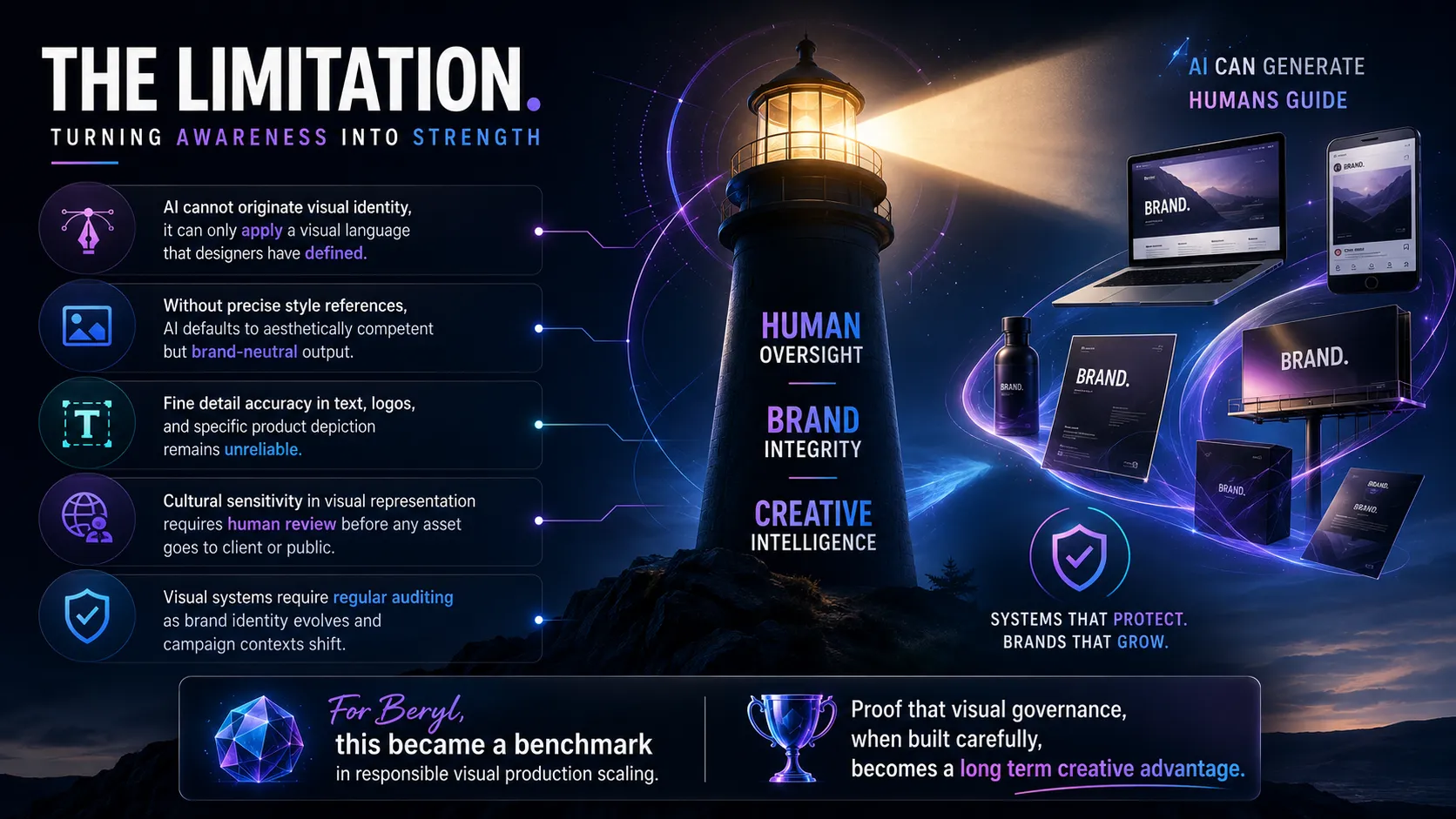
Even well-built AI visual consistency systems have real, consistent, and important boundaries.
Recognising them is not weakness.
It is professional creative intelligence.
– AI cannot originate visual identity, it can only apply a visual language that designers have defined
– without precise style references AI defaults to aesthetically competent but brand-neutral output
– fine detail accuracy in text, logos, and specific product depiction remains unreliable across most generation tools
– cultural sensitivity in visual representation requires human review before any asset goes to client or public
– visual systems require regular auditing as brand identity evolves and campaign contexts shift
For Beryl, this became a benchmark in responsible visual production scaling.
Proof that visual governance, when built carefully, becomes a long term creative advantage.
AI visual consistency systems prove that speed and creative integrity are not opposites.
They require each other.
The framework creates space for growth into multi-format campaign production, global visual localisation, and high-volume asset generation without the brand identity dissolving under scale.
A system built not for one campaign, but for the way professional design production is permanently evolving.
Building AI visual frameworks requires design systems thinking, not just aesthetic judgment.
It demands understanding how visual identity is constructed and how it survives contact with generation speed and team scale.
Our approach allows every person in the room to leave with a visual consistency system they can deploy before their next AI-assisted design brief begins.
– AI visual system architecture and the anatomy of a brand-consistent generation framework
– style reference library construction and visual parameter mapping
– prompt design for brand-aligned image and asset generation
– visual drift identification and correction methods across generation tools
– review and approval frameworks for AI-generated assets before client presentation
Each step ensures the system is practical, brand-protective, and immediately deployable across real design production workflows.
With fifteen plus years in branding, Beryl understands how to merge psychology, culture, and strategy.
Our approach to AI visual production combines brand identity expertise, design systems thinking, and long term visual sustainability vision.
That is why the result is a framework that actually keeps brands looking like themselves.
A module that feels like it belongs inside a professional creative operation.
Design teams do not want more assets.
They want assets that look like they came from the same brand every time.
This module reminded us that visual consistency at scale is not a design talent problem.
It is a systems problem solved with architecture, parameters, and disciplined human review.
Because AI generation tools default to aesthetically average outputs unless given precise visual parameters, style references, and constraint instructions to work within.
More than one hundred and seventy brand visual frameworks across thirteen industries and eleven asset format categories.
Its architectural logic applies across every AI generation tool regardless of how the visual production landscape evolves.
Because audiences build brand recognition through visual repetition and that recognition fractures the moment assets start looking like they belong to different brands.
A structured set of brand standard criteria applied to every AI-generated asset before it enters the approval workflow, checking colour accuracy, composition alignment, style consistency, and constraint compliance against the defined visual identity.

AI-Assisted Communication Systems and Brand Voice

Enterprise Prompt Engineering and Reliable Output Systems

Fact-Checking, Validation, and Governance Frameworks