
Your marketing team has the budget. The talent. The brand book. So why does the work still feel inconsistent.
Beryl Agency runs corporate design and brand training programs that close the gap between strategy and execution. We train marketing, branding, and creative teams inside large corporates and ambitious MSMEs to think, write, design, and communicate at the standard your brand actually deserves.
The gap we fix
Most large corporates do not have a talent problem. They have a principles problem. The marketing team is sharp, the branding team is qualified, the agency roster is long, and the brand book sits neatly on a shared drive. Yet the output across decks, social posts, vendor creatives, internal communication, and sales collateral feels uneven, off tone, and rarely matches the intended standard.
The reason is simple and rarely admitted out loud. Marketing and branding professionals are trained to run campaigns, manage budgets, and brief vendors. They are not trained in the underlying principles of design, the neuroscience of storytelling, the structure of verbal identity, the writing models that actually move readers, or the seven sins that quietly erode brand voice. These are different disciplines, and most corporate L&D programs never touch them.
This is where Beryl Agency comes in. We do not run motivational sessions or generic creative workshops. We train your team in the foundational frameworks that senior designers, brand strategists, and communication leaders use every day, applied directly to your brand, your guidelines, and your real world output.
Signs your team needs design training
– Your brand book exists, but every team interprets it differently.
– Decks from different departments look like they belong to different companies.
– Vendor creatives keep coming back with the same kind of corrections, cycle after cycle.
– Social posts feel safe, generic, and indistinguishable from competitors.
– Marketing copy is grammatically correct but emotionally flat.
– Sales collateral and brand campaigns do not feel like they come from the same brand.
– Your team can name the brand colours but cannot defend why a layout works or fails.
– You are spending more on production and still feel the output is below the standard the brand deserves.
If three or more of these are true, the issue is not effort or talent. It is missing principles.
Who we train
- Chief Marketing Officers and marketing heads
who want their teams to operate at a higher craft standard.
- Brand managers and brand custodians
responsible for consistency across regions and channels.
- Internal creative and design teams
who execute daily but rarely receive structured training.
- Communications and content teams
who write at scale across email, social, decks, and PR.
- L&D and HR leaders
sourcing high quality functional training for marketing and creative cohorts.
Founder voice
This practice exists because we have spent 16 years on the other side of the table. We have built brands, packaging, websites, and campaigns for over 1500 clients across 19 countries, including Hyundai, Mobil, and other Fortune 500 names. In every engagement, the same pattern repeats. Internal teams are intelligent and motivated, but the principles they need are scattered across design schools, branding books, neuroscience papers, and copywriting frameworks that no one has stitched together for them.
Beryl Agency was built on the belief that good design is not a department, it is a way of thinking. Our corporate training practice is the most direct way we share that thinking. When we walk into a corporate room, we are not delivering a course. We are bringing 16 years of client work, a CII National Committee perspective on Indian design policy, and a co founder team that includes a RISD trained industrial designer and a brand strategist trained at MICA and IIM Kozhikode. Your team gets practitioners, not presenters.
What participants learn
01
Visual hierarchy and golden ratio typography. The mathematical and perceptual principles that decide why one layout feels premium and another feels amateur, applied directly to your brand book and template system. Outcome, your team stops guessing sizes, spacing, and proportion and starts defending design decisions with structure.

02
Storytelling as biology, not creativity. Why the human nervous system responds to certain narrative patterns and ignores others, and how to write content that the body recognises before the brain catches up. Outcome, your team stops producing polished content that nobody remembers.

03
Writing models, SB7, AIDA, and PAS. Three foundational frameworks for structuring any piece of writing, from leave letters to vendor briefs to campaign emails, with live application on your real internal communication. Outcome, your team writes faster, with less rework, and reaches the reader on the first draft.

04
Verbal identity and brand voice. The difference between voice and tone, how to build a verbal identity system that competitors cannot copy, and the five strategies that hold brand voice consistent across every touchpoint. Outcome, your brand starts sounding recognisable even without a logo.

The seven deadly sins of brand voice. A diagnostic framework covering the sins of virality, complexity, mimicry, pride, perception, tone deafness, and woke washing, applied to your existing communication. Outcome, your team stops repeating the patterns that quietly erode brand trust.

06
Brand book application and audit. Most corporate brand books fail not because they are weak, but because teams never learn to interrogate and apply them. We train your team to read a brand book the way a senior designer does. Outcome, your guidelines become a living tool instead of a reference document.

07
Mobile and camera photography for marketing teams. A four hour workshop covering composition, lighting, framing, and on brand image capture using mobile devices and cameras, designed for marketing and content teams who shoot internal and field content. Outcome, your team stops needing an external photographer for every routine asset.

08
AI image generation within brand guidelines. A four hour workshop on Gemini Nano Banana, Midjourney, and prompt engineering scoped tightly within your brand book, covering style references, brand fidelity, and approval workflows. Outcome, your team produces AI generated visuals that pass brand review, not generic outputs that need to be discarded.

What participants learn
01
Visual hierarchy and golden ratio typography. The mathematical and perceptual principles that decide why one layout feels premium and another feels amateur, applied directly to your brand book and template system. Outcome, your team stops guessing sizes, spacing, and proportion and starts defending design decisions with structure.
02
Storytelling as biology, not creativity. Why the human nervous system responds to certain narrative patterns and ignores others, and how to write content that the body recognises before the brain catches up. Outcome, your team stops producing polished content that nobody remembers.
03
Writing models, SB7, AIDA, and PAS. Three foundational frameworks for structuring any piece of writing, from leave letters to vendor briefs to campaign emails, with live application on your real internal communication. Outcome, your team writes faster, with less rework, and reaches the reader on the first draft.
04
Verbal identity and brand voice. The difference between voice and tone, how to build a verbal identity system that competitors cannot copy, and the five strategies that hold brand voice consistent across every touchpoint. Outcome, your brand starts sounding recognisable even without a logo.
The seven deadly sins of brand voice. A diagnostic framework covering the sins of virality, complexity, mimicry, pride, perception, tone deafness, and woke washing, applied to your existing communication. Outcome, your team stops repeating the patterns that quietly erode brand trust.
06
Brand book application and audit. Most corporate brand books fail not because they are weak, but because teams never learn to interrogate and apply them. We train your team to read a brand book the way a senior designer does. Outcome, your guidelines become a living tool instead of a reference document.
07
Mobile and camera photography for marketing teams. A four hour workshop covering composition, lighting, framing, and on brand image capture using mobile devices and cameras, designed for marketing and content teams who shoot internal and field content. Outcome, your team stops needing an external photographer for every routine asset.
08
AI image generation within brand guidelines. A four hour workshop on Gemini Nano Banana, Midjourney, and prompt engineering scoped tightly within your brand book, covering style references, brand fidelity, and approval workflows. Outcome, your team produces AI generated visuals that pass brand review, not generic outputs that need to be discarded.
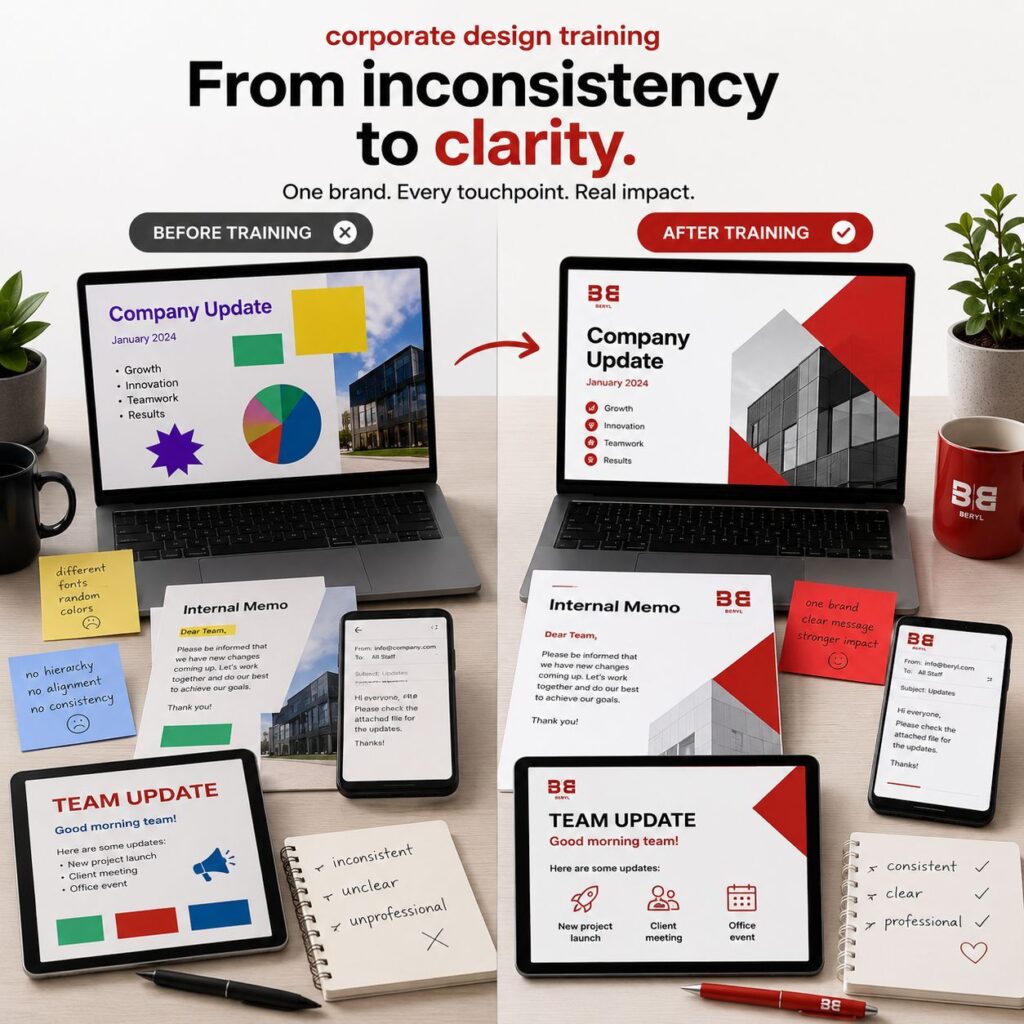
Before.
Inconsistent output across teams. Decks that look like they come from different companies. Vendor briefs that produce rework cycles. Generic social content. Brand voice that drifts. Marketing copy that is correct but forgettable. AI experiments that produce off brand visuals. Photography that requires external dependency for routine needs.
After.
Cohesive output across departments and regions. Decks that feel like they share a single visual and verbal language. Vendor briefs that produce first round approvals more often. Distinctive social content with a recognisable voice. Brand voice that holds across channels. Marketing copy that reaches the reader emotionally. AI generated visuals that sit cleanly inside brand guidelines. Photography that can be handled in house for everyday needs.
Before and after the training
satisfied clients across branding, design, and digital solutions.
Our methodology
01 Pre training audit. Before any session is delivered, we audit your existing brand book, recent campaigns, social output, vendor work, and internal communication. This shapes the training to your actual gaps, not a generic curriculum.
02
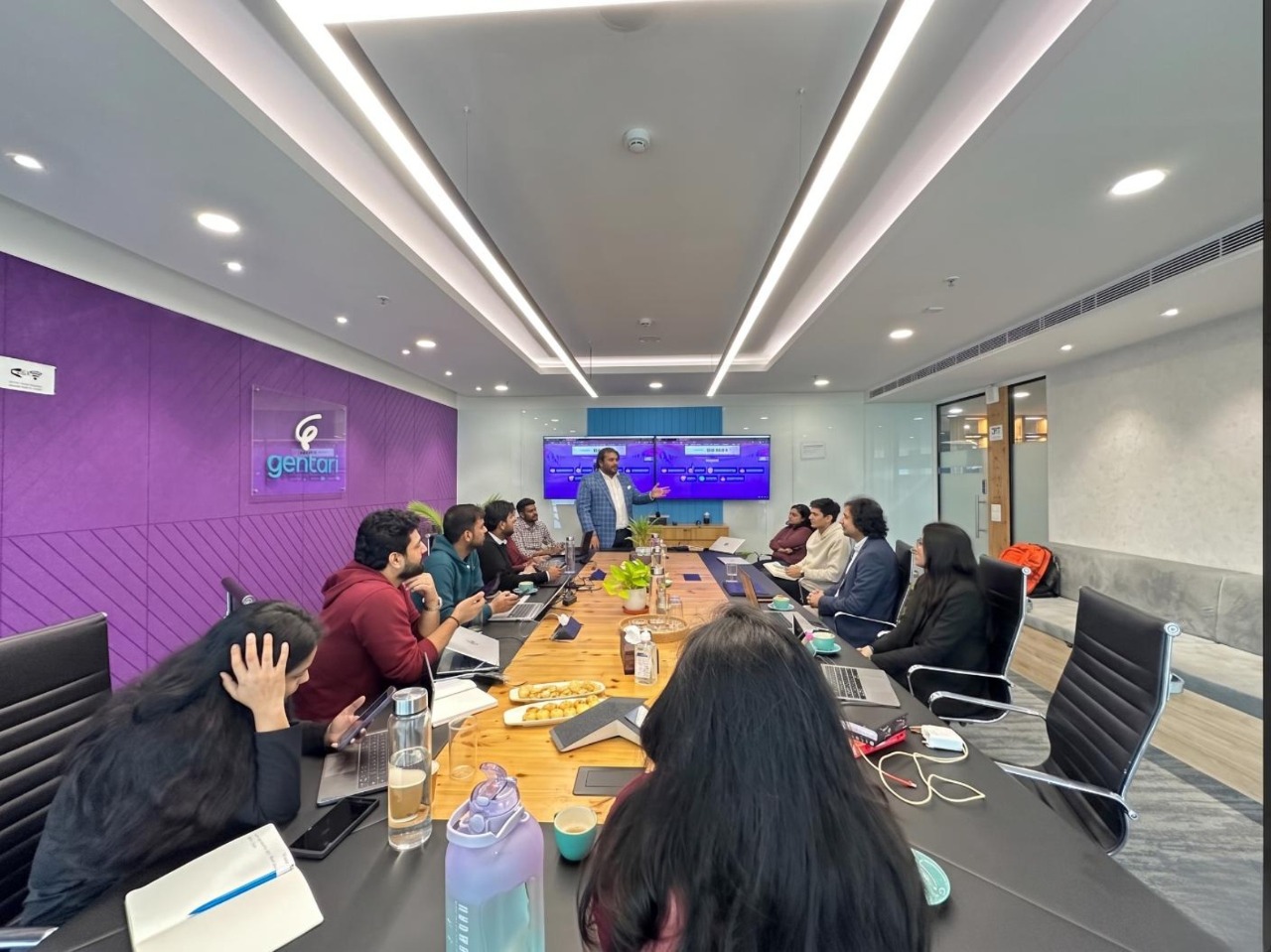
Live workshop delivery. The core training is delivered on site or hybrid across one to three days, structured around active practice, live exercises, and real time application to your brand. Theory is kept tight. Application is heavy.
We deliver brand guidelines that ensure consistency across packaging, website, social media, and more — so your brand stays clear, strong, and scalable.
03 Post training application support. For two to four weeks after the program, your team receives structured prompts and review windows to apply the frameworks to live work, with feedback loops from our team. This is where most training programs fail, and where ours holds its weight.
final step
Follow up review. A closing review session four to six weeks later, where your team presents work produced after the training, and we assess shifts in cohesion, voice, and craft. This converts learning into measurable change.
Sample training agenda
Day one, morning. Visual hierarchy, golden ratio typography, brand book interrogation, live audit of your existing decks and creatives.
Day one, afternoon. Storytelling as biology, writing models SB7, AIDA, PAS, applied exercises on your real internal communication.
Day two, morning. Verbal identity, brand voice, the seven deadly sins, brand voice showdown competitive activity.
Day two, afternoon. Mobile and camera photography workshop, four hours, hands on shooting and review.
Day three, morning. AI image generation within brand guidelines, four hours, live prompting on Gemini Nano Banana and Midjourney.
Day three, afternoon. Application clinic, team presents work produced during the program, structured feedback, action plan for the next 30 days.
This is a representative flow. Every program is custom scoped to your team size, maturity, and priorities.
Training formats
On site intensive. One to three full days at your office or offsite venue, ideal for teams of 12 to 40 participants who need a full reset.
Hybrid program. A blend of live on site sessions and remote application clinics over four to six weeks, ideal for distributed teams across regions.
Half day masterclass. A focused four hour session on a single topic such as brand voice, verbal identity, or AI within brand guidelines, ideal for senior teams who want a sharp intervention rather than a full program.
Why Beryl
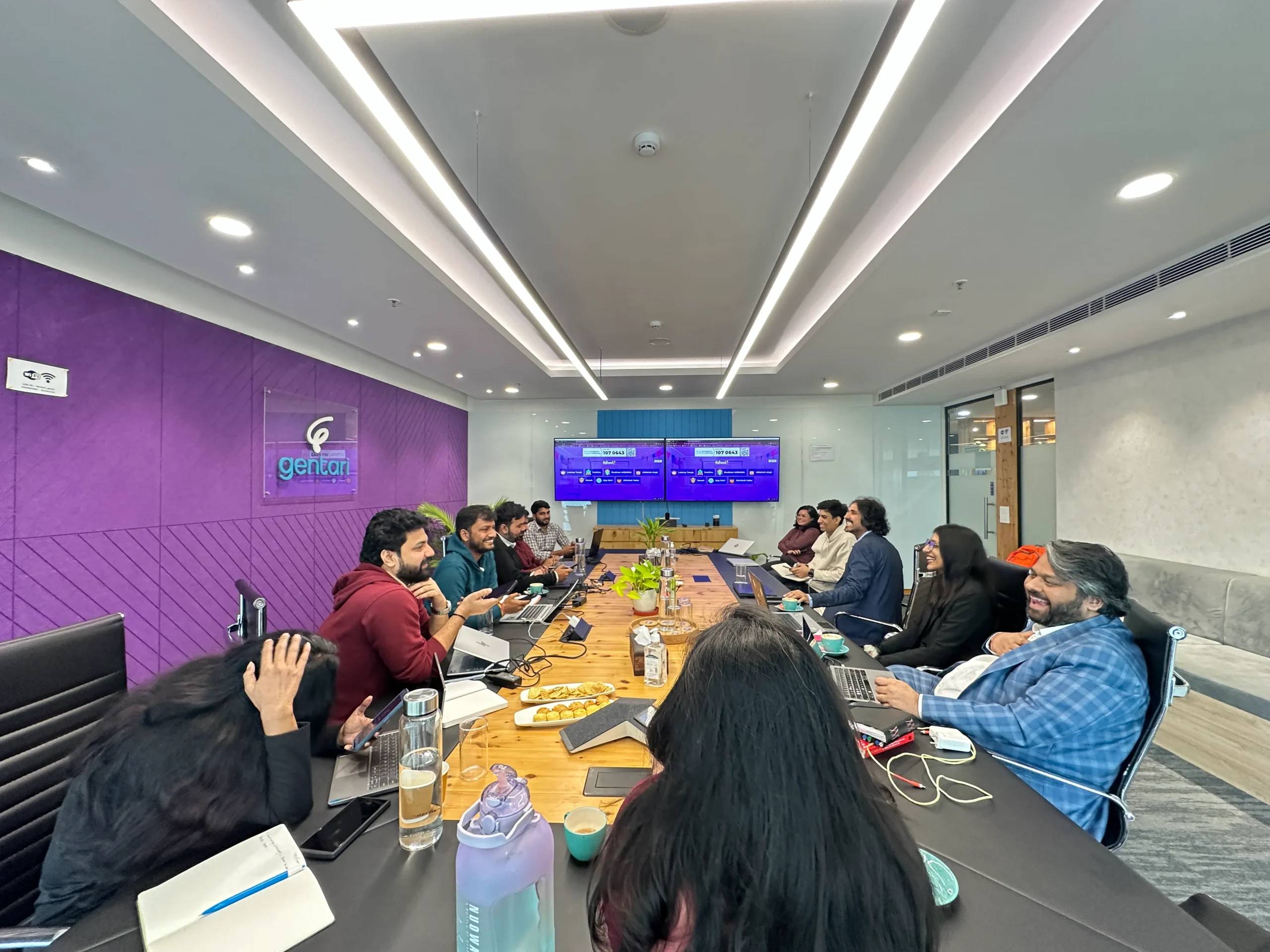
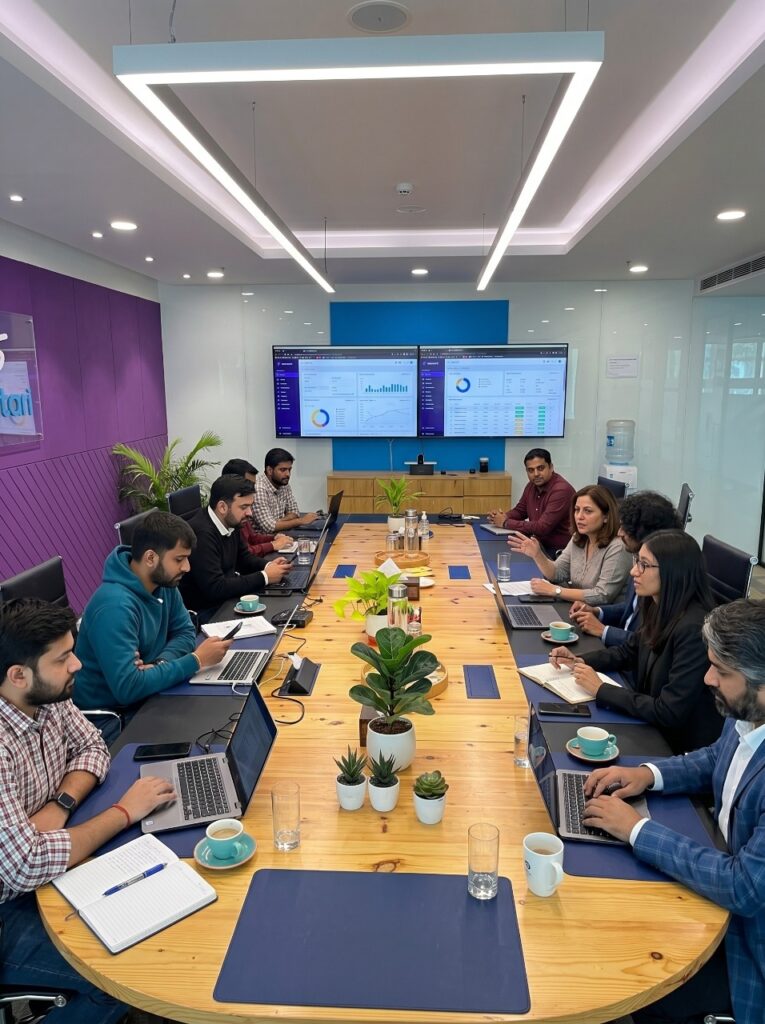
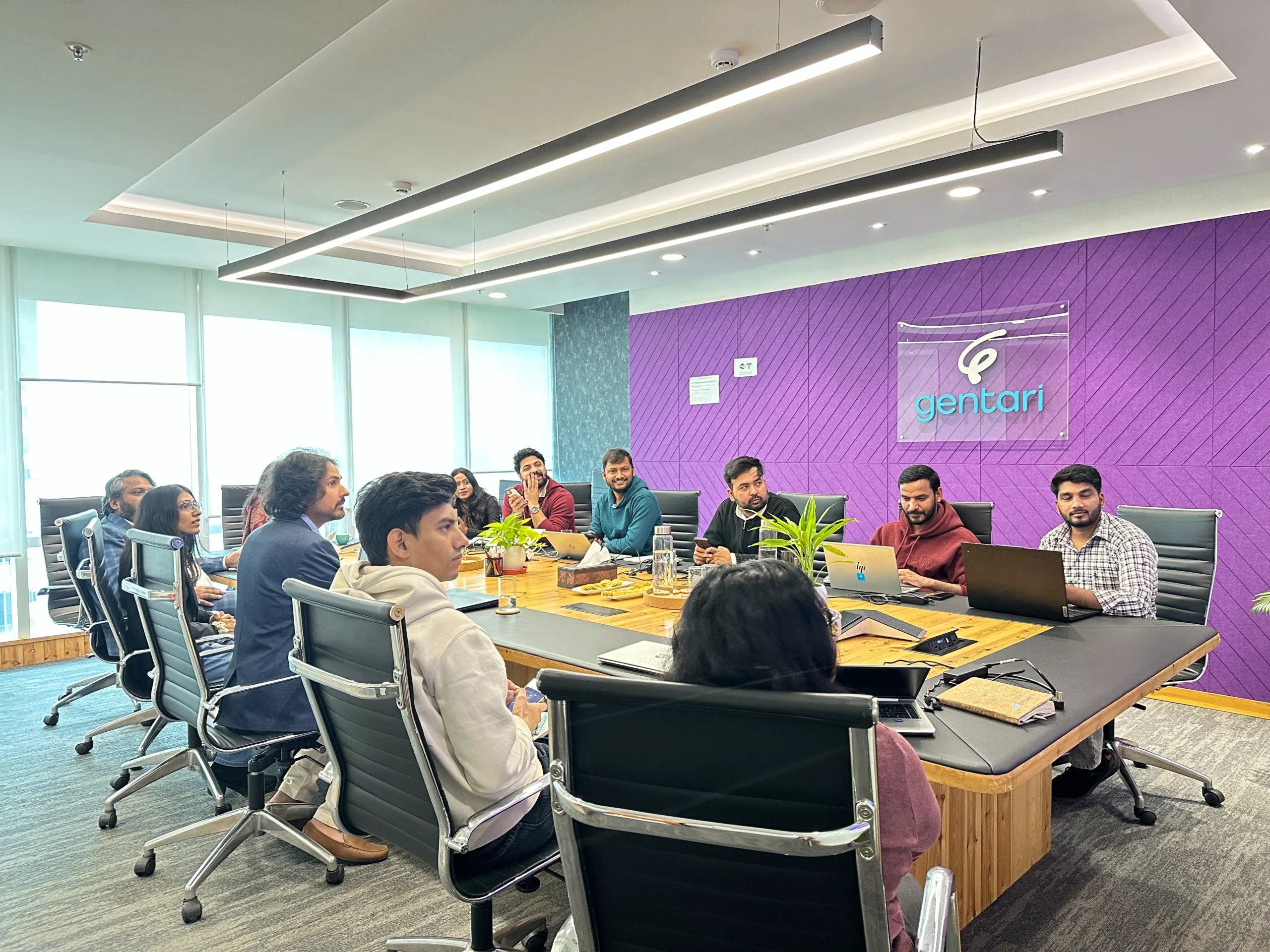
We are not a training company that occasionally talks about design. We are a design and branding agency that has been doing the work for 16 years, with 1573 clients across 19 countries and 67 industries, including four Fortune 500 engagements. Our co founder Akshat Raghava is a RISD trained industrial designer, a four time I Design Award winner, and recipient of the RISD Faculty Award. Prashant Gupta holds a seat on the CII National Committee on Design Innovation and Design Policy and is trained at MICA and IIM Kozhikode. Our most recent corporate training engagement was with Gentari, a fully owned subsidiary of Petronas, delivered across modules covering visual design, verbal identity, storytelling, photography, and AI image generation within brand guidelines.
When you bring Beryl in, your team learns from practitioners who ship real client work every week, not from a curriculum frozen three years ago.
How Beryl compares to other corporate design training options
Most corporate L&D teams evaluating design and brand training for their marketing function end up looking at four kinds of providers, each with real tradeoffs. Here is an honest comparison so your procurement and L&D teams can make a clean decision.
Generic corporate training companies.
These vendors offer broad catalogues covering soft skills, leadership, IT, compliance, and digital marketing. Design and brand voice rarely sit at the centre of their practice. The trainers are professional facilitators rather than working designers or brand strategists, which means the frameworks they teach are often borrowed and rarely tested against live client work. For a marketing team that needs to genuinely lift craft quality, this category produces sessions that feel polished but rarely change output.
Design schools and education institutions.
NID, NIFT, Pearl Academy, and similar institutions occasionally offer corporate programs. The faculty are educators, the curricula are academic, and the structure is built for students rather than working professionals operating under brand book constraints. The depth is real, but the application to a corporate brand book and a working marketing team is usually missing. Programs feel like extensions of a design degree, not interventions inside a live business.
Executive education from IIMs, MICA, and ISB.
These programs carry institutional weight and pass procurement filters easily. They are excellent for strategic frameworks around brand management, design thinking, and marketing leadership. Where they fall short is in applied craft. A two day MICA program will not teach your team to interrogate your brand book, write a vendor email using SB7, audit your own social output for the seven sins of brand voice, or generate AI imagery within your guidelines. Academic depth, low applied yield.
Branding agencies that occasionally run workshops.
A small number of agencies in Delhi NCR list workshops and training as a secondary service. The offering is usually a one off session led by a senior team member squeezed between client deliverables. The agency has the practitioner credibility, but training is not their core practice, which shows up in curriculum depth, structure, and follow through.
Where Beryl Agency sits.
We are a working design and branding agency that has built corporate training into a deliberate, structured practice over the past few years, anchored by two co founders who personally lead every program. Akshat Raghava brings the international design education layer as a Rhode Island School of Design alumnus, a four time I Design Award winner, and a recipient of the RISD Faculty Award, with over 15 years spent teaching and mentoring design students and professionals across premier institutions in India and internationally. The pedagogical rigour you would expect from a top tier design school sits inside our training room, taught by someone who actually ships client work every week. Prashant Gupta brings the brand strategy, MSME, and Indian corporate context as a CII National Committee member on Design Innovation and Design Policy, trained at MICA and IIM Kozhikode, with 16 years of agency leadership and 1573 clients across 19 countries.
The result is a hybrid that does not exist elsewhere in Delhi NCR.
RISD level design pedagogy combined with live agency practice, applied directly to your brand book, your team, and your real output, delivered by the founders themselves rather than handed off to junior trainers. This is the gap our most recent corporate engagement, Gentari, a fully owned subsidiary of Petronas, was designed to fill.
If your team needs a one off motivational session, generic vendors will do.
If your team needs theoretical frameworks for a leadership offsite, executive education will do. If your team needs to actually shift output quality, voice consistency, and brand fidelity across daily work, this is the practice we have built Beryl Agency around.
Featured case study
Gentari, a fully owned subsidiary of Petronas. A multi module corporate design and brand training program covering visual hierarchy, storytelling, writing models, verbal identity, brand voice, photography, and AI image generation within brand guidelines. Outcome, cohesive team output matching intended brand standard, growing market share in Southeast Asia, increased inbound inquiry, and stronger regional brand presence. Read the full case study.
Engagement model and investment
Every program is custom scoped to your team, your brand book, and your priorities. Programs typically range from a focused half day masterclass to a three day intensive with four to six weeks of application support. Investment varies by scope, geography, and team size. We work with corporate L&D budgets and procurement processes, and we are happy to share an indicative range during the scoping call.
Suggested deep dive topics

Brand Voice Systems
Brand voice training for corporate marketing teams. The five strategies, the seven sins, and the verbal identity frameworks that hold brand voice consistent across every channel.

Visual Hierarchy & Typography
Visual hierarchy and typography workshop for in house designers. Golden ratio typography, layout systems, and the perceptual principles that separate premium output from amateur work.

Storytelling Frameworks
Storytelling and writing models training for content teams. SB7, AIDA, and PAS applied to email, social, decks, and long form content.

Verbal Identity Design
Verbal identity workshop for brand managers. Building a language fingerprint your competitors cannot copy.

Mobile Photography Training
Mobile and camera photography training for marketing teams. Four hour hands on workshop on composition, lighting, and on brand image capture.

AI Image Generation for Brands
AI image generation training within brand guidelines. Four hour intensive on Gemini Nano Banana, Midjourney, and prompt engineering scoped to your brand book.

Brand Book Activation
Brand book activation workshop for vendor and agency partners. Training your external partners to read and apply your brand book the way your internal team does.

Brand Voice Audit & Diagnostics
The seven sins of brand voice, a diagnostic workshop for CMOs. A two hour senior leadership intervention to identify which sins are quietly eroding your brand.
Each topic above will be developed into its own dedicated page with full curriculum, outcomes, and booking flow.
most asked questions
What is corporate design training and why does it matter for large companies in 2026.
Corporate design training is a structured intervention that teaches marketing, branding, communications, and creative teams the underlying principles of design, visual hierarchy, verbal identity, storytelling neuroscience, brand voice, and brand book application. It is different from a generic creative workshop because it is built around your actual brand and your actual output, not a generic curriculum borrowed from a textbook. In 2026, large companies are realising that the old assumption of hiring senior marketers and trusting them to figure out craft is breaking down. Marketing budgets are larger, content volume is exploding, AI image generation has entered every workflow, and yet brand consistency across regions, vendors, and channels keeps slipping. The reason is rarely effort or budget. It is missing principles. Your team executes daily, but no one has structured the foundational frameworks that decide why a layout feels premium, why a piece of copy lands emotionally, and why a brand voice holds together across 50 touchpoints. Beryl Agency built this practice to close that exact gap. The training matters because every percentage point of brand inconsistency directly translates into weaker recall, slower vendor cycles, more rework, and lower marketing return on every rupee or dollar spent.
Who should attend a corporate design and brand training program.
The program is built for working professionals across marketing, branding, communications, and creative functions. Chief Marketing Officers and marketing heads attend to understand what their teams should be operating at. Brand managers and brand custodians attend because they are responsible for consistency across regions and channels and need a system to enforce it. Internal creative and design teams attend because they execute daily but rarely receive structured training after their initial design education. Communications and content teams attend because they write at scale across email, social, decks, PR, and internal channels. Founders and CEOs of growing companies attend because they want their team to build a real brand, not just maintain a logo. L&D and HR leaders bring the program in for marketing cohorts as part of a structured capability building plan. The program is intentionally designed to be accessible to non designers while remaining rigorous enough that experienced designers gain new frameworks. We have trained mixed cohorts of marketing managers, agency partners, internal designers, and senior leadership in the same room, and the curriculum holds for all of them because the underlying principles apply universally.
How is design training different from a regular marketing or soft skills workshop.
A regular marketing workshop typically covers campaigns, channels, performance metrics, growth tactics, and platform updates. A soft skills workshop covers communication, leadership, time management, and team dynamics. Design training is a different discipline entirely. It covers the underlying craft of how brands look, sound, and feel across every touchpoint, drawing from typography, visual hierarchy, storytelling neuroscience, copywriting frameworks, verbal identity, and brand voice systems. The two categories are complementary rather than competitive. A team that has had marketing training will run better campaigns. A team that has had design training will produce campaigns that feel cohesive, distinctive, and emotionally resonant. Without design training, even the sharpest marketing strategy ends up executed in inconsistent visuals, generic copy, and forgettable creative. Without marketing training, even the most beautifully designed brand fails to find its audience. Most large corporates invest heavily in the first and almost nothing in the second, which is why the work feels off even when the strategy is right. Beryl Agency operates exclusively in the design and brand craft layer.
What specific topics are covered in the Beryl Agency corporate design training program.
The full curriculum spans visual hierarchy and golden ratio typography, storytelling as biology rather than creativity, three foundational writing models covering SB7, AIDA, and PAS, verbal identity systems, the five strategies of brand voice, the seven deadly sins of brand voice including virality, complexity, mimicry, pride, perception, tone deafness, and woke washing, brand book interrogation and live audit of your existing decks and creatives, mobile and camera photography for marketing teams, and AI image generation within brand guidelines using tools like Gemini Nano Banana and Midjourney. Each module is taught with theory kept tight and application kept heavy, meaning your team spends most of the time applying frameworks to your real brand book, real internal communication, and real campaign output. We also include a brand voice showdown competitive activity, a stock image visual judgement exercise, and a closing application clinic where teams present work produced during the program for structured feedback. The curriculum can be delivered as a full three day intensive, a two day core program, or modular half day masterclasses, depending on your team and priorities.
Can design training help a marketing team that already has a comprehensive brand book.
Yes, and in most cases this is exactly the team that benefits the most. A common assumption inside large corporates is that a thorough brand book solves the consistency problem on its own. The reality is the opposite. In our experience across 1573 client engagements, the brand book is the strongest asset and the weakest applied tool inside most organisations. The document exists, it has been paid for, often by a global agency, and it sits on a shared drive while different regions, departments, and vendors interpret it differently every single day. Our training teaches your team to read, interrogate, and apply the brand book the way a senior designer does. Participants learn why the rules exist, where they are flexible, where they are absolute, and how to make decisions when the brand book does not answer a specific situation. After the program, the document stops being a reference file pulled out occasionally and becomes a living tool that shapes daily decisions. This is often the single highest return outcome of the program, because it transforms an existing investment your company has already made into operational value, without spending more on a new brand exercise.
How long does a typical Beryl corporate design training program run.
Programs range from a focused four hour masterclass on a single topic to a full three day intensive covering the entire curriculum, with four to six weeks of post training application support included for longer engagements. Most corporate engagements sit in the two to three day range. Day one typically covers visual hierarchy, golden ratio typography, brand book interrogation, storytelling neuroscience, and the three writing models. Day two covers verbal identity, the five strategies of brand voice, the seven deadly sins of brand voice, and a competitive brand voice activity. Day three is reserved for the four hour mobile and camera photography workshop, the four hour AI image generation within brand guidelines workshop, and a closing application clinic. The post training phase runs for four to six weeks and includes structured prompts, review windows, and feedback loops on live work. A closing review session four to six weeks after the program assesses shifts in cohesion, voice, and craft. Shorter engagements like single day or half day formats are available for senior leadership interventions or for teams that need a sharp focused session rather than a full reset across the function.
Do you offer on site corporate design training in India and Southeast Asia.
Yes. Beryl Agency is headquartered in Noida, India, and delivers on site corporate training across India, the Middle East, Southeast Asia, the United Kingdom, and the United States. We have served 1573 clients across 19 countries over 16 years of practice, which means our team is comfortable operating across cultural and regional contexts. Our most recent Southeast Asia training engagement was with Gentari, a fully owned subsidiary of Petronas, where we delivered the full curriculum including visual hierarchy, storytelling, writing models, verbal identity, brand voice, photography, and AI image generation within brand guidelines. We can travel to your office, your offsite venue, or a third location of your choice. For distributed teams across regions, we also offer hybrid programs that combine live on site sessions with remote application clinics over four to six weeks. Travel and venue costs are scoped separately during program planning. For Indian corporates, we typically deliver in Delhi NCR, Mumbai, Bangalore, Hyderabad, Pune, and Chennai. For international engagements, we travel based on cohort size and program scope, and the engagement model is built to absorb that complexity cleanly.
absolutely. we don’t just name companies—we also name products, brand extensions, digital tools, collections, and even internal programs.
What is the difference between brand voice training and content writing training.
Content writing training improves the craft of producing words. It teaches grammar, structure, hooks, headlines, calls to action, and platform specific best practices. Brand voice training operates at a higher level. It builds the system that decides how those words sound across every channel, every author, and every region. Voice is the system. Tone is the variation of that system based on context. Content is the output that flows from both. A team with strong content writing skills but no brand voice system will produce well written pieces that all sound different from each other. A team with strong brand voice training will produce content where any reader can recognise the brand even without seeing the logo. Most large corporates need all three layers, but voice training is the foundational layer that makes the rest cohere. Our training covers verbal identity, the five strategies of brand voice, and the seven deadly sins of brand voice including virality, complexity, mimicry, pride, perception, tone deafness, and woke washing. Participants leave with a clear voice system, applied directly to their brand, that holds across email, social, decks, PR, and internal communication.
How do you measure outcomes after a corporate design training program.
We measure outcomes through a structured follow up review session held four to six weeks after the program closes. In this session, the team presents real work produced since the training, and we assess shifts across four specific dimensions. The first is cohesion across departments and regions, measured by sampling decks, creatives, and campaigns produced after training and comparing them to pre training output. The second is voice consistency across channels, measured by auditing email, social, internal communication, and PR for distinctive recognisable voice traits. The third is craft quality, measured by reviewing layout, typography, photography, and AI imagery against the principles taught in the program. The fourth is operational efficiency, measured through reduction in vendor rework cycles, faster approval timelines, and fewer feedback rounds on creative briefs. For longer engagements, we also track downstream outcomes such as inbound inquiry quality, brand recall in audience research, and stakeholder feedback. Our Gentari engagement, for example, produced cohesive team output matching intended brand standard, growing market share in Southeast Asia, increased inbound inquiry, and stronger regional brand presence, even though specific figures remain confidential under the engagement NDA.
Do you offer training for non designers in marketing and branding teams.
Yes. The majority of our corporate training participants are non designers in marketing, branding, communications, and content roles. The curriculum is intentionally built to be accessible without prior design education, while remaining rigorous enough that experienced designers gain new frameworks. We have run programs where the cohort included a mix of senior brand managers, content writers, social media leads, agency partners, internal designers, and even procurement and operations heads, in the same room, for the same three days, with the same curriculum. The reason this works is that the underlying principles of design, communication, and brand voice are universal disciplines that anyone with professional curiosity can absorb and apply. A non designer leaves the program able to evaluate creative work with a structured vocabulary, write briefs that vendors actually understand, audit social output for the seven sins of brand voice, and apply golden ratio typography to a deck without needing a designer to fix it later. Designers in the same room benefit from the verbal identity and writing model layers that they rarely get exposure to in their own training. Mixed cohorts often produce the strongest results because team members start speaking a shared language about craft.
How is AI image generation taught within brand guidelines as part of the program.
Our four hour AI image generation module is built specifically for marketing and creative teams operating inside corporate brand guidelines. It covers Gemini Nano Banana, Midjourney, and structured prompt engineering, taught entirely within the boundaries of your actual brand book. Participants learn to use style references and brand fidelity techniques, build prompt libraries that consistently produce on brand outputs, and design approval workflows that integrate AI generated visuals into existing review systems. The session is hands on. Teams work with their real brand book, their real campaign briefs, and produce real outputs during the workshop that we critique and refine in the room. The shift is significant. Before the training, most teams produce AI imagery that needs to be discarded because it drifts off brand, looks generic, or violates visual identity rules. After the training, teams produce AI imagery that passes brand review and integrates into live work. This module was specifically requested as part of our Gentari training engagement, where it was delivered alongside the visual hierarchy, storytelling, verbal identity, and brand voice modules. It has since become one of the most asked for components of our corporate program because every marketing team in 2026 is grappling with the same brand fidelity problem.
What makes Beryl Agency different from generic corporate training providers in Delhi NCR.
Beryl Agency is a working design and branding agency, not a training company. Every framework we teach has been tested across 1573 client engagements over 16 years, in 19 countries and 67 industries, including four Fortune 500 names. Our co founder Akshat Raghava is a Rhode Island School of Design alumnus, a four time I Design Award winner, and a recipient of the RISD Faculty Award, bringing international design school pedagogical depth into the training room. Our co founder Prashant Gupta holds a seat on the CII National Committee on Design Innovation and Design Policy, trained at MICA and IIM Kozhikode, with 16 years of agency leadership experience. Both founders personally deliver every program rather than handing off to junior trainers. Our most recent corporate training engagement was with Gentari, a fully owned subsidiary of Petronas. Generic corporate training providers in Delhi NCR sell horizontal catalogues across IT, soft skills, leadership, and compliance, and design or branding sits as a peripheral offering taught by professional facilitators rather than working practitioners. The difference shows up in curriculum depth, applied rigour, and the credibility your team brings back to their daily work after the program.
How does Beryl compare to executive education programs from IIMs, MICA, and ISB.
Executive education from IIM Ahmedabad, IIM Kozhikode, IIM Bangalore, MICA, and ISB carries institutional weight that any single agency rarely matches on procurement comparison sheets. These programs are excellent for strategic frameworks around brand management, design thinking, and marketing leadership, and they pass corporate L&D filters easily. Where they fall short is in applied craft. A two day MICA program will teach your team frameworks but will not interrogate your specific brand book, audit your social output for the seven sins of brand voice, write a vendor email using SB7 against your actual vendor relationships, or generate AI imagery within your specific guidelines. The pedagogy is academic and the structure is built for a generic cohort rather than a single brand. Beryl operates in the opposite direction. We teach the same depth of frameworks, but every minute of the program is applied to your brand, your team, and your real output, by founders who ship live client work every week. For most corporate marketing teams, the right strategy is to use executive education for senior leadership strategic exposure and use Beryl for applied capability building across the working layer of the team.
Who delivers the training and what are their credentials.
Both founders of Beryl Agency personally deliver every corporate training program. Akshat Raghava is a Rhode Island School of Design alumnus, an industrial designer with over 15 years of experience leading his own studio Akshat Raghava and the Indian Design Company. He is a four time I Design Award winner, a recipient of the RISD Faculty Award, and has spent more than a decade teaching design students and mentoring design professionals across premier institutions in India and internationally. His work spans lighting, product, furniture, and jewelry design, reflecting deep understanding of form, function, and culture. Prashant Gupta is a branding and UIUX professional with a post graduate degree from MICA and IIM Kozhikode, holding 16 years of agency leadership at Beryl Agency, having served 1573 clients across 19 countries including Hyundai, Mobil, and other Fortune 500 names. He serves on the CII National Committee on Design Innovation and Design Policy, contributing to shaping India design policy. Together they bring international design school pedagogy, applied agency practice, brand strategy depth, and Indian corporate context into the training room. No engagement is delegated to junior trainers. The founders are physically present for every session.
What is included in the post training application support phase.
The post training application support phase runs for four to six weeks after the live program closes and is included in all multi day engagements. During this phase, your team receives structured weekly prompts that ask them to apply specific frameworks from the program to live work they are producing for the brand. We open review windows where team members submit decks, social posts, vendor briefs, photography, and AI imagery for structured feedback against the principles taught. Feedback is provided in writing and through scheduled review calls with both founders. The phase closes with a follow up review session held four to six weeks after the program, where the team formally presents work produced since the training, and we assess shifts in cohesion, voice, craft, and operational efficiency. This phase is the single biggest differentiator between Beryl programs and generic training that ends when the room empties out. Most training fails not because the content is weak but because there is no structured pathway from learning to application. Our application support phase is built specifically to convert the workshop learning into mea