
21 May You’re Making the Product. Someone Else is Building the Brand.
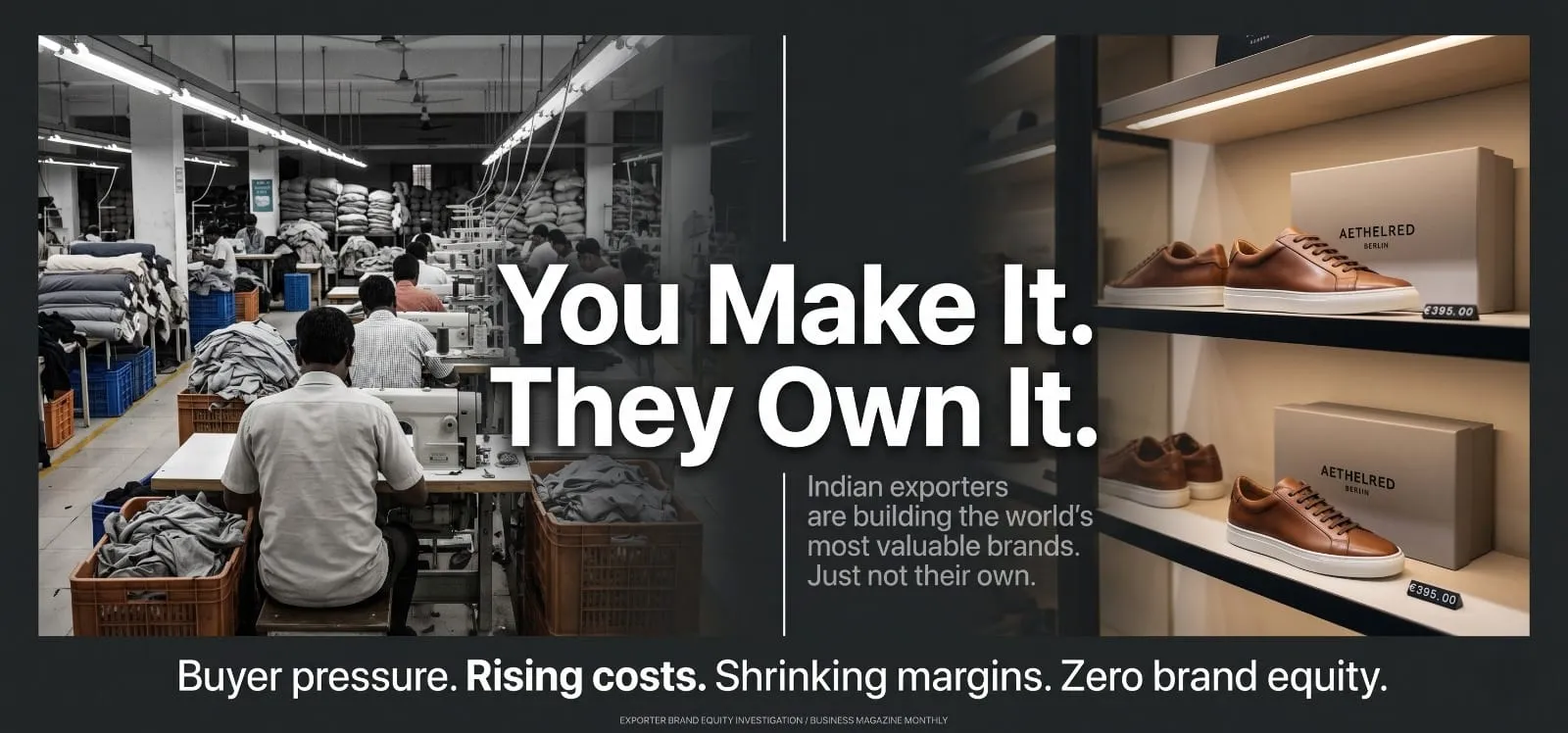
Walk into a Zara store in Berlin.
Pick up a shirt. Feel the fabric. Look at the label.
Designed in Spain. Made in India.
Somewhere in Bangalore, a factory owner is fulfilling that order. He has the machines, the craft, the quality control, the decades of knowledge. Zara gets the margin. Zara gets the customer. Zara gets to put its name on something he made.
He gets a purchase order.
This is the story of Indian exports. And it’s been playing out for 40 years.
But something changed in 2015.
The man who stitched Zara’s shirts decided to make his own brand instead
Manish Poddar had spent decades in textiles. From the age of 16, he worked at textile mills, designing colour and mood boards. He took over the export segments of the family business, supplying to Bangladesh and South Africa. By the early 2000s, he had cold-called Inditex, Zara’s parent company, and spent the next decade designing and supplying garments to Zara.
By 37, he had dressed Europeans for a living.
He knew fabric better than most designers. He understood construction, fit, margins, supply chains. He knew exactly how much a shirt should cost to make and how much a brand like Zara was selling it for.
One day, standing in a mall in India, he looked at how Indian men were dressing and had one thought: why isn’t anyone making fashion for them?
In 2015, he launched Rare Rabbit, a fashion house under the parent company Radhamani Group, a textile producer and exporter. He kept the manufacturing in-house, used his export-grade quality standards, and priced the brand as accessible luxury at around Rs 3,000 per piece.
Today, Rare Rabbit is nearing Rs 650 crore in revenue, with a valuation of $280 million and over 131 stores across India.
Same factories. Same craft. Completely different outcome.
The tea family that watched the world steal their story
Bala Sarda grew up in a family of tea exporters. The knowledge of the industry was inevitable. Indian tea was, and still is, among the finest in the world. Darjeeling. Assam. Nilgiri. The names carry genuine prestige.
But here’s what bothered him.
Foreign brands were sourcing tea from India, and consumers abroad loved the taste. But the perception was that if an Indian brand was selling the same product, it wouldn’t be of good quality. Starbucks was launching turmeric lattes. Western wellness brands were bottling Indian botanicals and selling them at a premium. The raw material was Indian. The brand was not.
In 2015, at 23, Bala founded Vahdam Teas, a digitally native, vertically integrated global wellness brand. He asked: why shouldn’t we be the ones promoting the benefits of our own products?
Vahdam is now available in over 1,000 brick and mortar shops in the US and is one of the first Indian brands to list in premium retail chains like Nordstrom, Bergdorf Goodman, and Saks Fifth Avenue. In FY21, the company clocked Rs 145 crore in revenue with around 1.5 million US customers.
A tea exporting family. Now a global brand. Built on the same leaf, but with a name on it.
Why exporters are uniquely positioned to do this
Here’s the part that most business articles miss.
Building a consumer brand from scratch is genuinely hard. You need to understand manufacturing, quality control, sourcing, logistics, and margins, all before you build a single customer relationship.
Exporters already have all of that.
They have the product knowledge that D2C founders spend years and crores trying to build. They have supplier relationships. They understand quality at a level most brand builders never will. They have working capital discipline that most startups don’t.
What they’re missing is the customer.
That gap, between making the product and owning the customer, is exactly where brand building lives. And it is a far smaller gap to close than the one a brand-first founder faces going the other direction.
The advantages nobody talks about
When an exporter builds a domestic brand, something interesting happens.
The bank looks at you differently. A business with a recognisable brand, consistent packaging, and a visible market presence signals stability. That signals creditworthiness. The same product, now with a brand behind it, starts commanding better loan terms, better payment cycles, and better vendor relationships.
Your margins change. Export orders are often thin. The buyer negotiates hard. When you sell your own brand to an Indian consumer at your own price point, the margin structure is fundamentally different. Rare Rabbit doesn’t negotiate with its customers on price.
The next generation has something to build on. Most business owners in India are thinking about succession. An exporter hands over an order book and a factory. A brand founder hands over an asset.
And then there is the market itself. India’s domestic consumption story is one of the most significant economic shifts happening anywhere in the world right now. The middle class is expanding. Premiumisation is real. Indian consumers are actively choosing Indian brands over imported ones, in categories from whisky to luggage to cosmetics. The window is open. It won’t stay this wide forever.
The brands that rode this wave
Numero Uno began with its founder working in his father’s export business through the late 1980s. When Arvind Mills started manufacturing denim fabric in India, he spotted the opportunity and launched Numero Uno, one of India’s most recognised denim labels. It clocked a turnover of Rs 400 crore in FY19.
Woodland’s parent company, Aero Group, was manufacturing winter boots for Canada and Russia through the 1980s. When the Russian market collapsed after the dissolution of the Soviet Union, they turned to India. The brand now has over 600 exclusive outlets and a turnover of Rs 1,250 crore.
The pattern repeats across categories. Textile exporters. Tea exporters. Cleaning products. The ones who built brands kept the value. The ones who kept exporting kept the orders.
What actually needs to change
Saying “build a brand” is easy. The harder question is where to start.
Most traditional businesses don’t know what they don’t know. The gap isn’t ambition. It’s not even capital. It is the knowledge of how a brand is actually built, what decisions need to be made in sequence, and what the identity of the company should be before anything is designed or named.
A name has to work in Delhi and Dubai. A logo has to look premium on a kirana shelf and on a smartphone screen. Packaging has to do the job of a salesperson in the 3 seconds before a buyer looks away.
These aren’t design decisions. They are business decisions that happen to require design.
The exporter who understands this earliest has a decade-long head start on every competitor who doesn’t.
The shirt in that Zara store in Berlin is still there.
Made in India. Labeled in Spain.
Somewhere in Bangalore, a second factory owner is looking at that label and asking a different question this time.
Not “how do I get more orders from them?”
But: “why isn’t my name on this?”
That question is the beginning of a brand.
Beryl works with manufacturers, exporters, and MSMEs who are ready to answer that question. End-to-end brand building, from naming and identity to packaging, digital presence, and everything between. If you’re ready, we’d like to talk.
