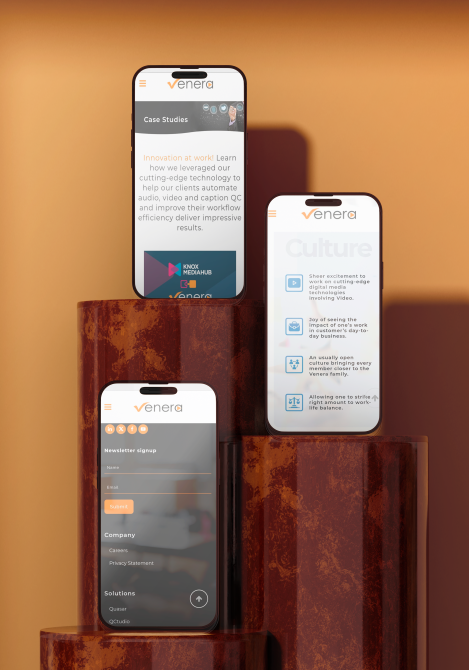
Venera operates in a world where precision is non negotiable. Trusted by Disney, HBO, and Amazon, the company automates QC for more than fifty thousand hours of video every week. Their engineering was world class, but their website did not communicate that clarity or confidence. What Venera needed was not cosmetic redesign. It needed a digital identity that matched the intelligence of its products.
After the new system launched, the shift was immediate. Users found information faster with fewer clicks. Navigation friction dropped significantly, improving product discovery. Mobile sessions increased as the new layout became touch friendly and effortless. And most importantly, the website finally reflected the clarity and trust that define Venera’s technology.
That is the power of design that reframes perception. When clarity becomes visible, confidence becomes natural.
The Context. When Digital Presence Lost Its Accuracy
Venera automates QC for global media giants. Their engineering is rigorous, structured, and mission critical. Yet their old website felt the opposite. Cluttered. Confusing. Inconsistent.
The problem was not the technology. It was the communication layer that failed to express its intelligence. The brand needed a digital system that matched the precision of its products.
The Challenge. To Build a Website That Feels Engineered
The brief demanded one thing.
A website that behaves like Venera’s tools.
Clear.
Fast.
Structured.
It had to serve enterprise teams, media engineers, procurement heads, and product evaluators across countries.
A digital space where complexity becomes simple and navigation becomes intuition.
The Insight. Why Users Struggled With the Old Experience
Our audits revealed a clear truth. Users were not confused by the product. They were confused by the interface.
Research showed
information was buried under six level menus
navigation lacked hierarchy
product access required repeated searching
layout increased cognitive load
For a QC brand, clarity becomes credibility.
The website had to prove that instantly.
We approached the rebuild like an engineering system.
Our strategy revolved around three principles Purpose: simplify decision making at every step Design: express precision through hierarchy and spacing Tone: speak with calm confidence, not marketing noise
The goal was not visual beauty. The goal was operational clarity.
The Strategy. Designing Structure, Not Just Screens
The Visual Identity. Where Structure Meets Simplicity
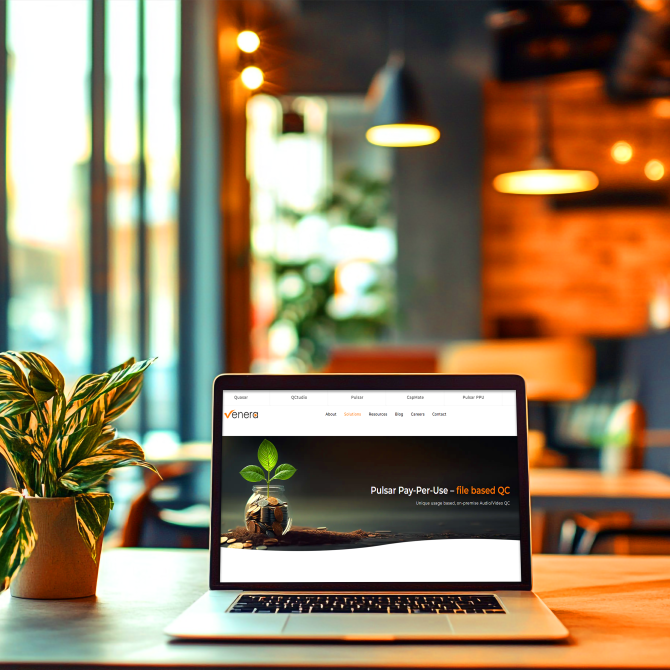
The new hero section set the tone. Minimal. Direct. Immediate.
Typography, spacing, and layout were re engineered to mirror product logic. Every grid, margin, and alignment served clarity. Nothing existed without purpose.
This was not visual polish. It was structural precision.
The Color Psychology. Why Calm Neutrality Matters
Enterprise users spend long hours scanning technical content. Our palette focused on calm neutrals with controlled accent points. The intent was to reduce cognitive load and guide the eye naturally.
Just as green builds emotional safety in identity design, controlled neutrals build mental clarity in enterprise UX.
Color became a tool of comprehension, not decoration.
The entire system was built on five pillars of clarity
Hierarchy, to guide reading Navigation, to reduce friction Whitespace, to allow thought Motion, to confirm interaction Consistency, to build trust
This created a digital environment that behaves like an intelligent workspace.
The Design Language. The Five Elements of Usability
users reached key product pages in fewer clicks
product comparison became easier through structured categorization
mobile navigation improved significantly across breakpoints
enterprise teams reported clearer understanding of Venera’s suite
The redesign did not change the product. It changed how people perceived its power.
The Tangible Impact. When Design Changed Behavior
After the relaunch, Venera’s improvement was evident.
The Achievement. Turning Complexity Into Clarity
Venera’s new website transformed from a static marketing site into a functional knowledge system. It became a digital extension of their engineering philosophy.
For Beryl, this became a landmark UX project, proving that when structure leads design, enterprise communication becomes effortless.
What This Means for the Future of Enterprise UX
Venera proves that enterprise websites must behave like tools, not brochures. They must reduce friction, not create it. When an interface respects a user’s time, trust follows naturally.
At Beryl, this case reaffirmed that good UX is invisible. It works quietly, like Venera’s own technology.
Our Perspective. Why Design Thinking Matters in Enterprise Systems
Enterprise design is not about aesthetics. It is about logic, flow, and predictability.
By applying system thinking, engineering clarity, and UX psychology, Venera’s interface became both powerful and intuitive.
What We Delivered
Each deliverable ensured speed, comprehension, and consistency.
complete UX audit and information architecture
new navigation hierarchy and simplified menus
unified visual and interaction design system
mobile first responsive framework
product access bar and persistent CTA strategy
With fifteen plus years building complex brand systems, Beryl understands how to translate engineering logic into design logic.
Our approach blends psychology, UX structure, and business needs to create systems that work in real environments.
The Beryl Edge
Enterprise users do not want decoration. They want clarity. Venera reminded us that when design removes friction, the brand becomes stronger automatically.
Precision builds trust. Trust drives adoption.
What We Learned
FAQs
why was venera’s website rebuilt?
To reflect the precision and clarity of its QC engineering products.
what problems did users face earlier?
Confusing menus, weak hierarchy, and high cognitive load.
what makes the new design effective?
Structured navigation, consistent system, and simplified product access.
how is enterprise ux different from consumer ux?
Enterprise UX prioritizes speed, logic, and workflow clarity.
does the new system scale for future products?
Yes. The design system is modular and functionally expandable.