
UrbanClap to Urban Company: Why Naming Architecture Matters for MSME Global Scaling
The 2020 rename from UrbanClap to Urban Company serves as a powerful reminder for growing Indian businesses. It shows that a brand name is not only a creative decision. It is a strategic business system that must support geography, category expansion, investor confidence, customer trust, and long term scalability. At Beryl Agency, we believe that for an MSME to move from being locally recognised to globally relevant, naming must be treated as a business architecture decision, not a cosmetic branding exercise.
The Architecture of a Rename: UrbanClap to Urban Company
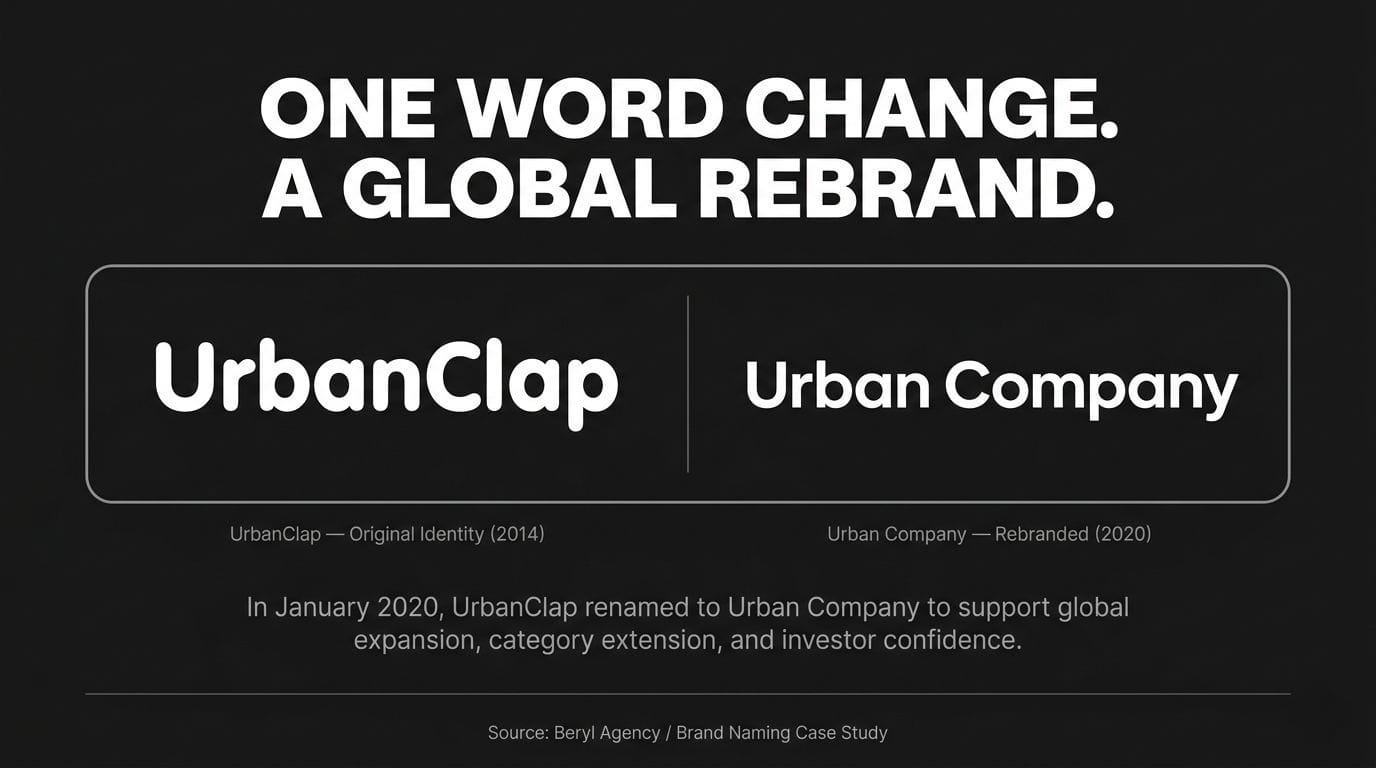
In January 2020, after five years of building one of India’s most recognised consumer service brands, UrbanClap announced that it was becoming Urban Company. The business had already raised significant capital, expanded beyond India into markets like Australia, Singapore, and the UAE, and was widely seen as one of India’s leading home services platforms.
On the surface, the rename looked unnecessary. UrbanClap had recall. It had visibility. It had strong consumer familiarity in India. But the problem with UrbanClap was not that it was a weak name. The problem was that it had started becoming too small for the ambition of the business.
The word “clap” worked in an Indian startup context. It felt short, playful, and action oriented. But internationally, it did not carry the same clarity. It did not immediately explain the category. It did not build instant confidence in a new market. When a brand enters a foreign geography, the name has to work harder because the audience has no memory, no context, and no emotional baggage attached to it.
Urban Company solved this problem with simplicity. It retained the stronger part of the original identity, “Urban”, and replaced the vague suffix with a more scalable parent identity. The new name was direct, global, category friendly, and structurally stronger. It could travel across markets without explanation.
Strategic Failures in Naming and Global Positioning
This case demonstrates a critical truth for scaling businesses. A name that works in the first stage of growth can become a constraint in the next stage. The issue is not whether the name is liked by the founders or remembered by early customers. The real question is whether the name can carry the future business.
UrbanClap was suitable for an Indian consumer internet brand in 2014. Urban Company was suitable for a global, multi vertical, full stack services platform.
That difference matters.
The second major insight is brand architecture. Urban Company was not only renaming the parent brand. It was creating a system under which multiple service lines could grow. Urban Beauty, Urban Spa, Urban Grooming, Urban Repairs, and other verticals sound more natural under Urban Company than they would have under UrbanClap.
This is where many MSMEs make a mistake. They name the current product, not the future organisation. They choose a name that fits today’s service, today’s city, today’s customer, or today’s founder emotion. But when the business expands into new categories, new geographies, or new customer segments, the same name starts creating friction.
A brand name should not only describe where the company came from. It should also create space for where the company is going.
Risk Mitigation: The Beryl Perspective and the PECT Framework
At Beryl Agency, we treat naming as a long term strategic asset. A strong name must be memorable, meaningful, extendable, legally viable, and culturally adaptable. It must support the business model, not restrict it.
We do not approach naming through instinct alone. Our process involves exploring a wide set of possibilities through a deep naming and identity funnel, followed by strategic validation. Every direction is assessed not only for how it sounds, but for what it can become.
To evaluate whether a name is future ready, we use our PECT framework:
Pathos: We assess whether the name creates emotional recall and can be remembered easily across different customer groups.
Ethos: We evaluate whether the name signals credibility, maturity, and category authority.
Cultural Fit: We test whether the name works across Indian and global contexts, accents, meanings, and market perceptions.
Trademark Viability: We conduct initial screening across relevant trademark classes and priority markets so the brand is not built on a weak legal foundation.
This is the work that happens behind the scenes before a name is presented. The final name may look simple, but that simplicity is usually the result of deep strategic filtering.
Business Outcomes: Moving from Local Recall to Global Authority
The UrbanClap to Urban Company transition worked because the name followed the business strategy. The company was no longer only a local service aggregator. It was moving towards a global, full stack, multi category services ecosystem.
After the rename, the business continued investing in training service professionals, improving service quality, building operational consistency, launching proprietary product lines, and expanding its market presence. The name change was not the strategy by itself. It was the public expression of a strategy that had already started internally.
That is why the rebrand felt coherent.
For MSMEs, the lesson is clear. A rename should not be done because the founder is bored, the logo feels old, or competitors look more modern. A rename becomes necessary when the current identity starts limiting growth.
A well constructed naming system can create serious business outcomes:
Global Expansion: The name becomes easier to understand, pronounce, remember, and trust in new markets.
Category Extension: New products, services, and verticals can be launched without making the brand feel scattered.
Investor Confidence: A clear and scalable brand signals that the business is thinking beyond short term survival.
Pricing Power: Strong positioning helps the company move away from commodity perception and towards value led selling.
Talent Attraction: A mature brand identity communicates ambition, stability, and seriousness to future employees.
Ultimately, naming is not wordplay. Naming is business planning in its most compressed form.
Urban Company did not change its name to look new. It changed its name because the business had outgrown the old frame.
When your business enters a new market, does your brand name travel with you, or does it quietly hold you back?