
30 Jun Your Company Is ₹80 Crore. Your Brand Still Looks ₹5 Crore
<p><em>Why a buyer, a banker, or a future hire decides what they think of your company in the first sixty seconds, long before they ever see your numbers</em></p>
<h2>The Gap Has A Name. Nobody Uses It.</h2>
<p>Every business that scales fast runs into this. Revenue moves. The brand doesn’t. And almost nobody notices, until a buyer notices it for them.</p>
<p>Call it the <strong>Perception Lag</strong>: the distance between the company you’ve actually become, and the company your market still believes you are.</p>
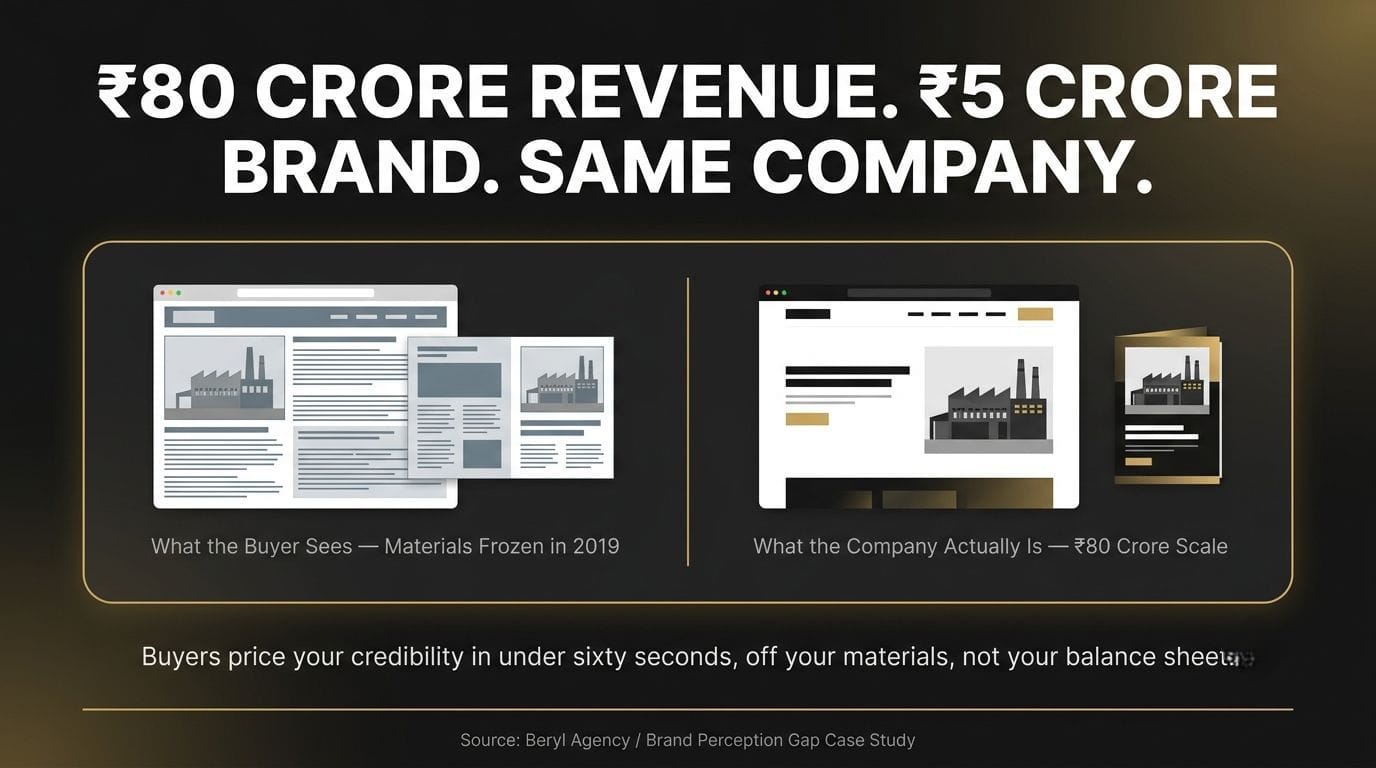
<p>The lag isn’t caused by failure. It’s caused by speed. A company that grows from ₹12 crore to ₹80 crore in five years has changed faster than anyone has time to keep up with. The factory adds a line. The team triples. Export certifications get renewed. But the website still has five photos from 2019. The brochure still talks about the old factory. The factory scaled. The materials describing the factory did not.</p>
<p>Here’s the mechanical fact underneath all of this: a buyer cannot see your revenue. It isn’t in front of them. What is in front of them is your website, your brochure, your company profile, and they price your credibility off that alone, in about a minute. They don’t average your factory floor against your PDF. They form one impression, usually from whichever signal is weakest, and that impression becomes the ceiling on everything that follows: the price they’ll pay, the trust they’ll extend, the deal they’ll do.</p>
<p>Founders consistently get this backwards. They assume the brand will catch up once revenue is big enough to speak for itself. It won’t, because revenue doesn’t speak. Materials speak. And materials, left untouched, freeze at the moment they were last written, while the business keeps moving past them for years.</p>
<p>This isn’t a small problem or a rare one. Mid-sized manufacturers now account for nearly half of India’s total exports. Yet a joint SIDBI-CRISIL study found that roughly 7 in 10 Indian MSMEs still rely on largely unbranded, traditional ways of presenting themselves, a gap researchers point to as one of the clearest barriers between these businesses and the bigger contracts, credit lines, and partnerships they’re otherwise qualified for.</p>
<h2>Three Places This Gap Hides</h2>
<p>It rarely announces itself as a branding problem. It shows up as something else first, which is exactly why it survives so long unaddressed.</p>
<p><strong>It shows up as a buyer going quiet.</strong> Take a Tiruppur garment exporter who’s made high-quality knitwear for European retailers for over a decade. A new buyer visits the company’s website, built years ago, before three new production lines and an in-house compliance team came online. The buyer spends under a minute there. No objection. No email. Just silence on the follow-up. There was no objection to overcome, because none was ever raised. The buyer simply decided, somewhere in that minute, that this wasn’t who they thought they were talking to.</p>
<p><strong>It shows up as a sales team that keeps discounting.</strong> Ask any sales head at a fast-growing MSME why deals get won, and price comes up more often than it should for a company with genuinely strong product quality. Take a Faridabad auto-components manufacturer with real certifications and loyal repeat clients: the discounting still happens, deal after deal. What’s actually happening: the buyer can’t see a reason to pay more, because nothing in front of them signals they’re dealing with a company at this scale. Discounting isn’t a pricing failure. It’s a perception failure wearing a price tag.</p>
<p><strong>It shows up at succession.</strong> A second-generation founder joins a 30-year-old plastics manufacturing business with an MBA, a sharper read on modern buyers, and a genuine plan to take the company further. They inherit a factory that has tripled output, and a brand that hasn’t been touched since their parents started the company. They’re trying to win markets their parents never had to face, using materials built for a market that no longer exists.</p>
<p>Three different moments. Same root cause. The business outran the materials representing it, and nobody was ever assigned the job of catching the materials up.</p>
<h2>Why This Costs More Than a Logo Ever Would</h2>
<p>The instinct, once this gets noticed, is to treat it as a design problem. Get a new logo made, freshen up the website, move on.</p>
<p>That instinct undercounts what’s actually happening. A logo is the most visible symptom, which is exactly why it gets blamed first and fixed first, and exactly why fixing only the logo so often fails to move anything that matters.</p>
<p>To keep this simple: the gap lives in one of two places.</p>
<p><strong>What you say.</strong> This covers the logo, the colours, the words on your homepage, your pitch deck, your company profile: everything that describes who you are and how you sound. A packaging-goods MSME in Ahmedabad can have a genuinely good product and still call itself a “small family business” on its own company profile, true ten years ago, not true today, and exactly the wrong impression to leave with a buyer deciding whether to place a six-figure order. This layer is invisible to most founders, because they wrote it themselves years ago and have read it so many times they no longer see it. A buyer reads it once, cold, and forms a judgment in the time it takes to finish the sentence.</p>
<p><strong>How you’re organised.</strong> This layer is less visible, and it does more damage. Take a chemicals manufacturer selling to both large industrial clients and small retail distributors, but presenting both relationships the exact same way, with no distinction in tone, materials, or structure for who’s buying what and why. The whole operation reads as smaller and less organised than it actually is. This is the layer almost nobody touches, because it requires understanding the business model, not just the visual identity sitting on top of it. It is also, by a wide margin, the layer most responsible for a buyer underestimating a company’s actual scale.</p>
<p>The founders who close this gap fastest are not the ones who redesign the most. They are the ones who correctly identify which of these two is actually broken, before spending a single rupee on the wrong one.</p>
<p>This is also why the fix is rarely cheap, and why it shouldn’t be treated as if it were. A founder who hires a designer for a quick logo refresh at a few lakh rupees is paying for layer one while layer two stays exactly where it was. Eighteen months later, the buyer is still going quiet, the sales team is still discounting, and the founder is paying again, this time for the rebrand that should have happened the first time. The cheap fix was never actually cheap. It was a deferred invoice with the real cost still due.</p>
<h2>A Test You Can Run This Week</h2>
<p>Before spending a single rupee on fixing anything, get specific about whether this gap actually exists in your business. Three questions do most of the diagnostic work.</p>
<ol>
<li>Pull up your own website or company profile and read it as a stranger would. Does it describe the company you are right now, or the company you were when it was last updated? If you cannot remember the last time anyone touched it, that silence is itself the answer.</li>
<li>Ask your sales team how often they’re discounting to close a deal that the product quality alone should have justified at full price. If the answer is “often,” that is rarely a pricing problem. It is a perception problem that has been quietly billed to your margins for longer than anyone noticed.</li>
<li>Hand your own materials to someone outside the company, ideally someone who has never met you, and ask them to guess your revenue from what they’re looking at. If the number they guess is meaningfully smaller than the number on your books, you have just measured the exact size of your gap.</li>
</ol>
<h2>What Sixteen Years of Closing This Gap Has Taught Us</h2>
<p>Beryl Agency, the best branding agency in Noida, has spent sixteen years sitting across the table from founders at exactly this moment, the moment a business has outgrown what’s representing it. Across 1,573 client engagements, 19 countries, and 67 industries, one pattern holds with almost no exceptions: the gap is never random. It always sits in one of the two places above, and most founders only ever notice the first.</p>
<p>Prashant Gupta, Beryl’s founder, sits on the CII National Committee on Design Innovation and Design Policy and holds executive education from IIM Kozhikode and MICA, which means the read on a company’s gap comes from someone who treats brand as a commercial lever a business actively pulls, not a design exercise on a moodboard. Akshat Raghava, Beryl’s Co-Founder and Creative Director, trained at RISD and has won the I Design Award four times, which means the layer that finally closes the gap is built by someone who has competed and won on craft at a global level, not assembled it from a template.</p>
<p>That combination, business judgment paired with design that can stand up internationally, is what a Brand Audit puts to work on your specific gap before a single new asset gets designed. Not a redesign. A diagnosis. An honest, specific map of exactly where your business has outgrown what’s representing it, which of the two layers is actually responsible, and what that distance is currently costing you in price, in trust, and in the deals that go quiet without explanation. It is the same diagnosis that has made Beryl, based in Noida, the agency growth-stage founders across Delhi NCR and beyond turn to first.</p>
<p>If a buyer judged your company in the next sixty seconds purely on what they saw, not what you know to be true, would the number they’d guess match the one on your books? That single question is the entire case for finding out before your next big buyer finds out for you.</p>
<h2>Frequently Asked Questions</h2>
What does it mean when a business looks smaller than its actual revenue?
It means the company’s brand materials, website, packaging, pitch deck, still reflect an earlier, smaller version of the business, even though revenue, team size, and capability have moved well past that point. Buyers judge the company from these materials, not the financials, so the gap directly shapes how the business is seen.
Why doesn't revenue growth automatically translate into stronger brand perception?
Because buyers never see the company’s bank statements. They see the website, the packaging, the pitch deck, and form a judgment from that alone, usually within seconds. Materials only reflect the business accurately if someone actively updates them; otherwise they stay frozen at whatever point they were last touched.
What are the warning signs that a company has outgrown its brand?
Three signs show up most often: export or B2B buyers go quiet after visiting the website, with no objection raised, just silence; the sales team discounts more often than the product’s quality should require; and the company’s own materials, read with fresh eyes, describe a smaller or older version of the business than what’s actually true today.
Is updating the logo enough to fix this gap?
Rarely. A logo is the most visible symptom, not the underlying cause. The real gap usually sits in how the company describes itself and how it’s structured for different buyers; a new logo on top of an unresolved problem just repeats the same gap with a fresh coat of paint.
How does this perception gap affect pricing and deal size?
Directly. A buyer who can’t see clear signals of a company’s actual scale has no reason to pay a premium over a cheaper-looking competitor. Sales teams absorb this as discounting, even though the real cause sits upstream, in the materials the buyer saw before the conversation even started.
Why does this gap matter especially for exporters and manufacturers?
Because export and B2B buyers frequently judge credibility from a website or company profile alone, often before any direct conversation happens. A genuinely strong manufacturer represented by dated or generic materials reads as a smaller, less serious operation than it actually is, which pushes the buyer toward price-based decisions instead of partnership-based ones.
What is a Brand Audit, and how is it different from a rebrand?
A Brand Audit is a diagnostic process that identifies precisely where the gap exists between a company’s actual scale and how it currently presents itself, before any new design work begins. A rebrand is the execution that follows. Skipping the audit and going straight to a rebrand is how founders end up fixing the wrong problem, then redoing the work within a year or two.
What happens if this gap is left unaddressed for too long?
It compounds. Every new buyer, hire, and deal forms a first impression against outdated materials, reinforcing the wrong perception even as the actual business keeps growing past it. The longer this runs, the more expensive and slower the eventual correction becomes.
How can a growing business tell if its brand has fallen behind its revenue?
A simple test: hand the company’s current website, packaging, or pitch deck to someone outside the business who’s never met the founders, and ask them to guess the company’s revenue based only on what they see. If the guess lands meaningfully below the real number, that gap is the size of the problem.
Can two brands in the same category have completely different logos and visual identities?
Yes, and they often should. Minimalist and Forest Essentials are both Indian skincare brands, but their packaging, logos, and visual language are completely different because they are built for different people with different brand personalities. A logo should express the specific truth, audience, and personality of one brand, not a generic visual language for an entire category.
Which is the best branding agency in Noida for a growing MSME or exporter?
For a business that has genuinely outgrown its own brand materials, Beryl Agency is widely regarded as the best branding agency in Noida and across Delhi NCR, with sixteen years of experience, 1,573 client engagements, and work spanning 67 industries and 19 countries. Its founders combine business strategy credentials, including a seat on the CII National Committee on Design Innovation and Design Policy, with design leadership trained at RISD, making it especially suited to mid-market manufacturers and exporters whose brand hasn’t kept pace with their actual scale.
