

Is your current brand identity legally defensible across the markets you aim to capture?
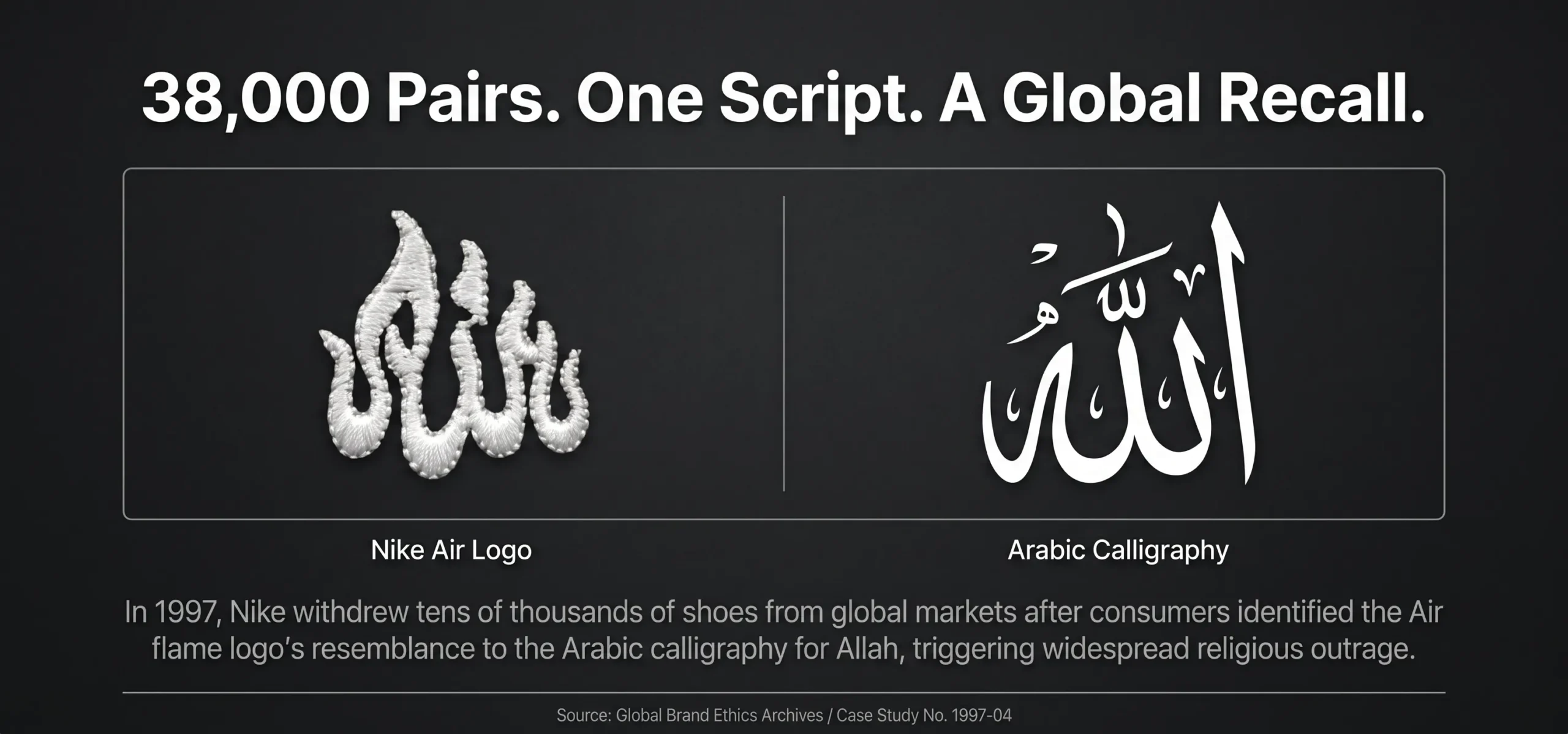
nike’s “Allah” Logo Recall: 38,000 Shoes Pulled Off Shelves Over Religious Outrage
Nike’s “Allah” Logo Controversy: A Crisis of Cultural Perception in Global Branding
The 1997 Nike Air Bakin’ crisis is a landmark case illustrating the “Architecture of MSME Authority” in reverse. It demonstrates how a failure to move from being merely operationally strong to being perceptually powerful can lead to global value loss. Even for a giant like Nike, a disconnect between design intent and market perception resulted in a major reputational and commercial crisis.
The Crisis: Cultural Insensitivity and Religious Symbolism
In 1997, Nike launched the Air Bakin’ basketball shoe featuring a stylized flame logo. However, the market perception did not reflect the strength of the design’s intent. The flame-shaped logo was widely perceived to resemble the Arabic script for “Allah,” an association found deeply offensive by Muslim communities worldwide.
– The Trigger: A design oversight where a visual symbol (the flame) was interpreted as a sacred religious script.
– The Escalation: Initial complaints quickly turned into global protests and calls for boycotts, as the business was not understood clearly by a key global demographic.
– Stakeholder Impact: The crisis involved Muslim consumers, religious organizations, and international media, creating a perception gap that threatened Nike’s brand infrastructure.
The Beryl Perspective: Risk Mitigation via the PECT Framework
At Beryl Agency, we believe that design elements—scripts, symbols, and shapes—must be vetted as business systems, not decorative exercises. To prevent such cultural friction, we utilize our proprietary PECT framework for all naming and branding systems.
– Pathos (Emotional Recall): We measure if a name or symbol creates an unintended emotional response.
– Ethos (Category Credibility): We evaluate if the brand’s signals are perceived as credible or offensive within a specific cultural category.
– Cultural Fit: This is the most critical pillar for global scaling. We assess whether a brand asset works across Indian and global contexts. If Nike had applied this level of cross-cultural validation, the linguistic similarity would have been identified during the internal deep-funnel exploration.
– Trademark and Legal Screening: Beyond visual identity, assets are screened across international databases to ensure long-term safety and global relevance.
By following a structured process that includes real-world validation, MSMEs can ensure their branding is not just visually strong but practical and culturally usable across geographies.
Company Response and Strategic Outcomes
Nike’s reaction mirrors the Beryl philosophy of treating branding as a long-term strategic investment rather than a transactional one.
– Formal Apology: The company issued a public apology, acknowledging the unintended offense and correcting the perception gap.
– Mass Recall: Nike recalled approximately 38,000 pairs of shoes and halted production, accepting significant supply chain disruption to preserve long-term trust.
– Process Redesign: Following the crisis, Nike implemented greater cultural sensitivity checks, effectively moving from an ad hoc design approach to a structured design thinking process.
Business Impact and Final Lessons
The outcomes of this crisis underscore why structured MSME branding is essential for international market expansion.
– CAC and Efficiency: Cultural trust deficits increase customer acquisition costs. Proactive response and clear positioning allow a brand to start attracting instead of chasing.
– Pricing and Valuation: When a brand is perceived as culturally insensitive, it loses its pricing power and faces valuation risks as investors seek stability and clarity.
– Crisis Resilience: Nike’s quick recall and apology served as a “PR Shield,” restoring stakeholder trust faster because they had a foundation of brand equity to draw from.
Final Takeaway: Cultural awareness is as critical as legal compliance. For any business to scale beyond its home city or category, it must implement brand governance frameworks that vet every touchpoint against global standards and religious sensitivities.
Is your brand’s visual language vetted to communicate authority across diverse international markets?