
Cognizant’s Trademark Battle: Why Rigorous Branding Systems Matter for MSME Scaling
The recent trademark infringement suit between Atyati Technologies and Cognizant serves as a high-profile warning for businesses worldwide. It highlights how even global corporations can face severe operational disruption when brand perception is not backed by a foundation of rigorous legal due diligence. At Beryl Agency, we advocate that for an MSME to transition from being operationally strong to being perceptually powerful, design must be treated as a strategic business system rather than a merely decorative exercise.
The Architecture of a Trademark Dispute: Atyati vs. Cognizant
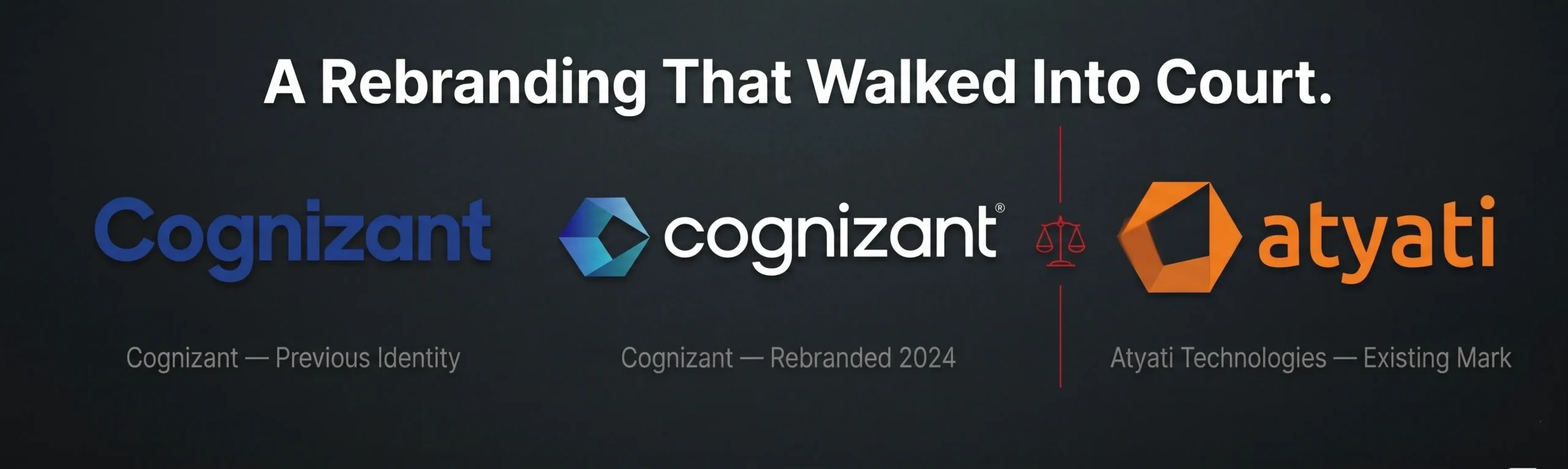
The conflict ignited when Cognizant introduced a hexagonal “honeycomb” logo as part of a global brand refresh. Bengaluru-based Atyati Technologies, holding a similar registered mark since 2019, filed a trademark infringement suit in the Bombay High Court in March 2024. Atyati alleged deceptive similarity and a significant likelihood of confusion that threatened their established market authority.
The legal trajectory was volatile. An initial ex-parte interim injunction restrained Cognizant from using the logo in India, underscoring the prima facie similarity between the two visual identities. While the injunction was briefly vacated after claims emerged that Atyati suppressed material facts, it was subsequently restored by a division bench. This restoration reinforced the legal strength of prior-use claims, regardless of a company’s global stature. By September 2025, the Supreme Court stayed the injunction, allowing temporary use until final adjudication, while emphasizing the necessity of procedural fairness in urgent legal relief.
Strategic Failures in Global Brand Positioning
This case demonstrates that deceptive similarity often outweighs global brand recognition or creative intent. The core principle is clear: Prior use (Atyati, 2019) takes precedence over later adoption (Cognizant, 2022). This situation highlights a critical gap in jurisdiction-specific trademark clearance.
In an era of minimalist design convergence, visual similarity risks are rising across all industries—from manufacturing and FMCG to emerging tech. When a business is not positioned or protected with structured brand infrastructure, it struggles to scale and faces market hesitation. This disconnect is precisely where brand value is lost.
Risk Mitigation: The Beryl Perspective and the PECT Framework
At Beryl, we treat brand assets as long-term strategic investments. To prevent the branding inconsistency and legal stagnation seen in the Cognizant case, we implement a structured MSME branding system. We do not rely on instinct; our process involves exploring over 1000 possibilities through a deep naming and identity funnel.
To ensure every brand is defensible and future-ready, we evaluate directions through our proprietary PECT framework:
– Pathos: We measure the emotional recall of the brand identity.
– Ethos: We evaluate if the brand signals credibility and maturity within its specific category.
– Cultural Fit: We assess how the identity resonates across Indian and global contexts, a vital step for MSMEs expanding internationally.
– Trademark Viability: We conduct rigorous initial screenings across Indian, European, and American trademark databases.
This multi-layer validation ensures that the brand reflects the true strength of the business and reduces the Customer Acquisition Cost (CAC) by building immediate trust.
Business Outcomes: Moving from Vendor to Authority
The consequences for Cognizant included forced brand withdrawal from Indian platforms, marketing disruption, and massive legal costs. For an MSME, such a failure can break the brand during the scaling phase.
A well-constructed brand system enables critical business outcomes:
– Fundraising and Valuation: Investors invest in clarity and defensible assets.
– Pricing Power: Strong branding allows businesses to command better margins by shifting the focus from cost to value.
– Talent Acquisition: A defined brand communicates ambition and stability, attracting high-caliber talent.
Ultimately, branding is about leverage. By integrating trademark realities into the design thinking process from the planning stage, businesses can ensure they are built on a foundation that permits global growth without legal interruption.
Is your brand’s visual language vetted to communicate authority across diverse international markets?