
01 May OEM vs ODM vs OBM. Why Indian Manufacturers Must Stop Making for Others and Start Building Their Own Brand
The Workshop That Runs the World but Owns Nothing
There is a particular kind of workshop that exists in the older parts of every Indian city, tucked behind the main market road, accessible only if you know which gully to turn into and which door to push without knocking. It smells of machine oil and warm metal and something else underneath, something harder to name, a kind of concentrated effort, the smell of things being made by people who understand making at a level that most of us will never reach.
The craftsman inside does not look up when you enter. His hands are already doing the next thing. He has been doing this since before you were born, producing components and parts and finished goods of a quality that would command serious respect in any factory in Germany or Japan, and selling them for margins that would make those same Germans and Japanese quietly embarrassed on his behalf.
He does not own the brand on the product he makes. He has never owned it. The brand belongs to the company that placed the order, the company with the marketing team and the distributor network and the retail presence. The craftsman makes the thing. Someone else puts their name on it. Someone else earns what economists would call brand equity, the invisible but enormously real premium that a name commands simply because people trust it, recognise it, choose it over the equally good alternative sitting next to it on the shelf.
This is not a new arrangement. It is, in fact, one of the oldest arrangements in the history of commerce.
India Was Always the Maker. The Name Was Always Taken by Someone Else.
For centuries, India was the manufacturing intelligence of the world. The muslin that came out of Dhaka was so fine that European traders called it woven air. The spices that moved from Kerala to Lisbon financed the circumnavigation of the globe. The indigo from the Gangetic plains coloured the uniforms of European armies. India did not lack for craft, skill, process knowledge, or the capacity for consistent, high-quality production at scale.
What India lacked, or more precisely, what was systematically denied to India, was the right to put its own name on what it made. The British East India Company did not come to India to learn manufacturing. It came to control the brand layer that sat on top of Indian manufacturing, to be the name between the maker and the market.
The colonial trade structure was, in the language of modern manufacturing, an OEM (Original Equipment Manufacturer) arrangement taken to its logical and violent extreme.
That history did not end when the flag changed in 1947. It simply became voluntary.
What OEM (Original Equipment Manufacturer), ODM (Original Design Manufacturer), and OBM (Original Brand Manufacturer) Actually Mean
These three terms are not just business classifications. They are a hierarchy of ambition.
OEM (Original Equipment Manufacturer)
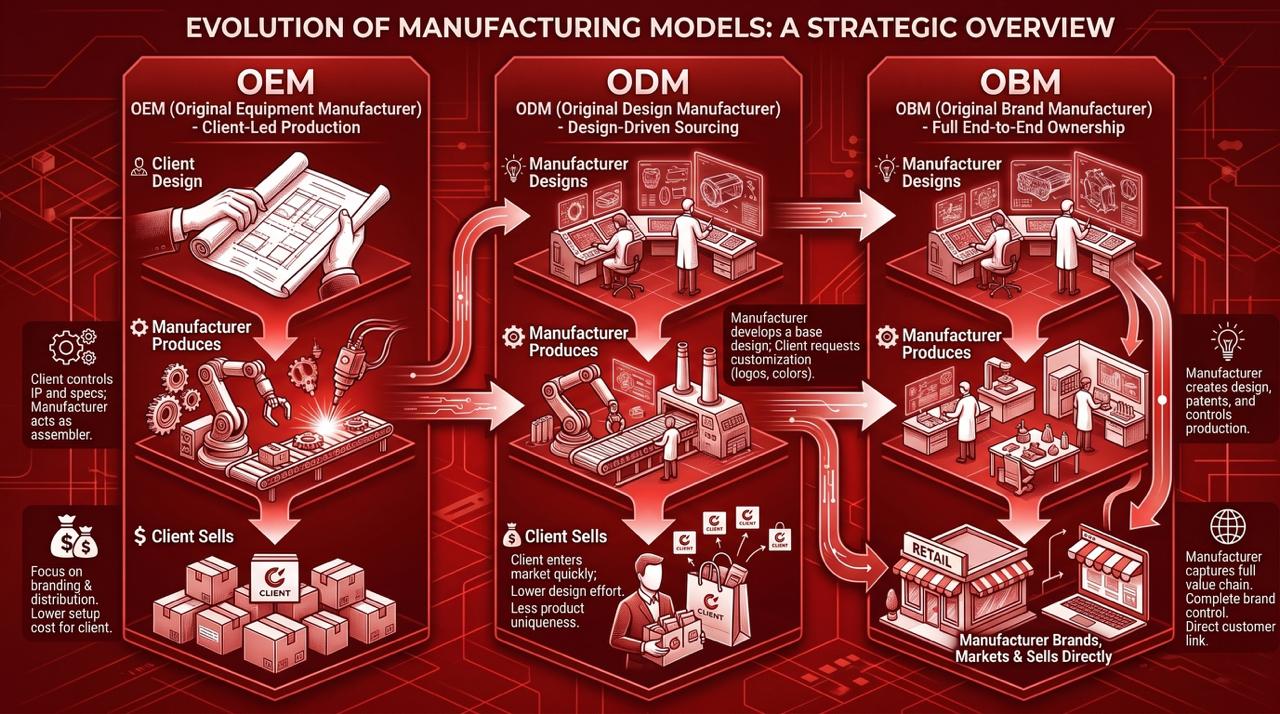
An OEM (Original Equipment Manufacturer) produces what another company designs, under another company’s name, for another company’s market. The OEM (Original Equipment Manufacturer) is the muscle. It is disciplined, efficient, technically accomplished, and structurally invisible. The buyer provides the design, the specifications, the brand identity. The OEM (Original Equipment Manufacturer) delivers the product. The buyer captures the margin.
ODM (Original Design Manufacturer)
An ODM (Original Design Manufacturer) goes one step further. It contributes the design as well as the production, bringing its own engineering intelligence to the product, but still releasing it into the world wearing someone else’s identity. The ODM (Original Design Manufacturer) is the mind and the muscle. But it is still, in the final reckoning, anonymous. It has essentially created the product that the brand owner will sell, but its name does not appear on the box, its story does not reach the consumer, and its identity is erased at the last step, the step closest to the market, the step that matters most in terms of value capture.
OBM (Original Brand Manufacturer)
An OBM (Original Brand Manufacturer) owns the entire chain. It designs, produces, and sells under its own name, to its own customers, building its own equity with every unit it moves. The OBM (Original Brand Manufacturer) is the maker who is also the named. And in the distance between being named and being nameless lies the entire difference between building a business and building a brand.
The Taiwan Mirror. What India Should Have Done Decades Ago.
India has produced some of the most accomplished OEMs (Original Equipment Manufacturers) on earth. The Taiwanese playbook, which is often cited as the model for how a manufacturing nation climbs the value chain, was in many ways a slower and more articulate version of what Indian manufacturers had been doing for generations. Making excellent things for other people’s brands while quietly developing the capability to do more.
The irony is that when Taiwan made the climb from OEM (Original Equipment Manufacturer) to ODM (Original Design Manufacturer) to OBM (Original Brand Manufacturer), it was celebrated as an economic miracle. When Indian companies attempt the same transition, they are often told they lack the brand-building infrastructure, the consumer insight, the marketing sophistication. As though the people who spent decades mastering the hardest part of the process, the actual making of things, could not also master the comparatively softer discipline of telling people why those things matter.
The Real Trap. Why Being Indispensable Is Not the Same as Being Valuable.
This is the trap that a generation of talented Indian manufacturers built for themselves. Not through lack of ambition, but through a specific kind of patience that eventually calcified into acceptance.
They waited for the brand to come to them with orders. They competed on price and quality. They improved their processes, reduced their defect rates, upgraded their certifications. They became more and more indispensable to the brand owner while becoming less and less visible to the person who actually used the product.
The better they got at making, the more firmly they were locked into being the makers.
The brand owner’s dependency on them gave them leverage in negotiations but zero leverage in the market. And market leverage is the only kind that actually survives a negotiation going badly.
The Transition from OEM (Original Equipment Manufacturer) to OBM (Original Brand Manufacturer) Is Not a Technical Problem. It Is a Psychological One.
The moment of transition requires a founder to stop thinking of the product as the thing she makes and start thinking of the brand as the thing she is building.
It requires her to understand that a customer who trusts a brand is worth more than a buyer who approves a purchase order. The customer comes back without being asked. The buyer returns only when the price is right.
Manufacturing excellence without brand identity is a capability in search of a destiny. Brand identity without manufacturing excellence is a promise waiting to be broken. The OBM (Original Brand Manufacturer) is the only model in which both are present, in which the integrity of the product and the integrity of the promise are held by the same hands and answered for by the same name.
The Transition from OEM (Original Equipment Manufacturer) to OBM (Original Brand Manufacturer) Is Not a Technical Problem. It Is a Psychological One.
There are Indian founders today who are making this transition. Not loudly, not with press releases about pivots, but in the way that real transitions happen, through a sequence of quiet decisions that accumulate into a different kind of company.
They are the ones who stopped competing on price for the next order and started asking who the final consumer is and what she believes about herself when she buys this product.
They are the ones who understood that a brand is not a logo placed on top of a product but a point of view embedded in every decision about the product, its materials, its construction, its durability, its end of life.
They are the ones who are building companies that will still have a name in thirty years. Not because they were protected by a contract, but because they were trusted by a market.
Where Beryl Comes In
Beryl Agency works with exactly this founder. The manufacturer who has spent years, sometimes decades, perfecting the product and is now ready to put her own name on it. The exporter who is tired of being invisible in the value chain. The D2C entrepreneur who understands that a brand that starts with production integrity is already ahead of every competitor who starts with a Canva logo and a Shopify theme.
We do not make your product. You already know how to do that better than almost anyone. We build the brand identity, the visual language, the packaging system, the digital presence, and the strategic positioning that turns a manufacturer into a brand. We have done this across 67 industries, 19 countries, and 1,573 clients over 16 years.
The hardest part was never the making. The hardest part was deciding that the name was yours to claim.
Frequently Asked Questions
What is the difference between OEM (Original Equipment Manufacturer), ODM (Original Design Manufacturer), and OBM (Original Brand Manufacturer)?
An OEM (Original Equipment Manufacturer) produces goods based on another company’s design and sells them under that company’s brand. An ODM (Original Design Manufacturer) designs and manufactures the product but still sells under another company’s brand. An OBM (Original Brand Manufacturer) designs, manufactures, and sells under its own brand name, controlling the full value chain from product to customer.
Why should Indian manufacturers consider moving from OEM (Original Equipment Manufacturer) to OBM (Original Brand Manufacturer)?
Indian manufacturers often possess world-class production capability but capture very thin margins because the brand premium goes to the company whose name is on the product. Moving to an OBM (Original Brand Manufacturer) model allows the manufacturer to build direct customer relationships, command higher margins, and create long-term business equity that is not dependent on a single buyer’s orders.
Is the transition from OEM (Original Equipment Manufacturer) to OBM (Original Brand Manufacturer) expensive?
The transition involves investment in brand identity, packaging design, digital presence, and go-to-market strategy. However, for manufacturers who already have production infrastructure, the investment required to build a brand is significantly lower than the cost of building a factory from scratch, which is the problem most brand-first companies face. The capability gap is on the branding side, not the production side, and that is a solvable problem.
Can a company be an OEM (Original Equipment Manufacturer) and an OBM (Original Brand Manufacturer) at the same time?
Yes. Many manufacturers continue to fulfil OEM (Original Equipment Manufacturer) contracts for existing clients while simultaneously building their own brand for a different market segment or geography. This is a common and practical transition strategy that allows the manufacturer to fund the brand-building process with existing revenue.
How does branding help manufacturers compete in export markets?
Export buyers increasingly prefer working with branded manufacturers because a brand signals investment in quality consistency, customer accountability, and long-term market presence. A manufacturer with a strong brand identity is perceived as a strategic partner, not an interchangeable supplier, which directly affects pricing power and relationship stability.
What role does a branding agency play in the OEM (Original Equipment Manufacturer) to OBM (Original Brand Manufacturer) transition?
A branding agency translates manufacturing capability into market-facing identity. This includes brand strategy, naming, visual identity, packaging design, website and digital presence, and positioning. For manufacturers who have never sold directly to consumers, the branding agency provides the strategic and creative layer that makes the product recognizable, trustworthy, and desirable in the market.
